90s Press
A selection of interviews and features from the 90s music press. For scans of press reviews check out the album pages in the Discography section.
Boston Phoenix 1991
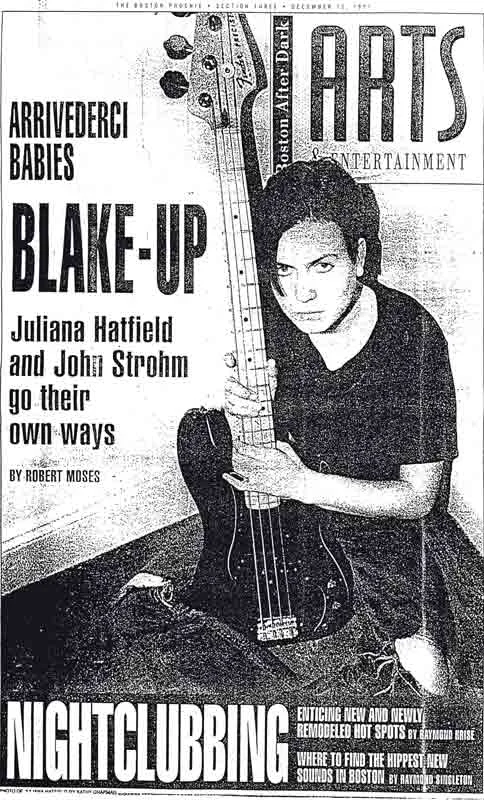
The Boston Phoenix reports the Blake Babies split - December 1991
Show transcriptHide transcript
Blake break
Hatfield and Strohm launch their solo careers
By Robert Moses
When John Strohm brought his new band, Antenna, to the College Music Journal convention in New York this summer, he experienced a revelation. “There was a big article in the New York Times about college rock,” he recalls. “It was talking about how there were 800 guitar bands descending on New York in the same week, and I thought, ‘Jesus, we’re one of 800 guitar bands! We’re part of a movement now!’ I never had that sense with the Blake Babies.”
After six years with the beguiling, Boston-based Blake Babies, and five records that helped popularize a genre now codified as college rock, Strohm faces the task of separating himself from the guitar-wielding hordes with a new band, a new record, Sway (Mammoth Records), and a new home, Bloomington, Indiana. His former songwriting partner and bandmate, Juliana Hatfield, maintains her Boston base and is readying her own solo debut record, Hey, Babe, also on Mammoth. A packed house at T.T. the Bear’s this summer witnessed what they thought was the Blake Babies’ last performance. The show wasn’t billed that way by the band, who knew that they had a slate of Midwestern appearances planned. But the street buzz must have caused concern at their label, Mammoth. The Blakes had a winning, poppy sound that maintained just enough of an off-kilter edge to make them regular entrants in the college-radio charts as well as the label’s biggest sellers. Mammoth still plans to release a new Blake Babies record in the spring, a possibility that seems remote to the band members.
“We’re not going to make records anymore,” Strohm maintains, though later admits the potential still exists. “Mainly it’s just that we live here in Indiana and Juliana lives there. We’re on splendid terms, but there were definitely periods of wanting to do different things. I was writing a lot of songs that weren’t right for Blake Babies and that Juliana didn’t really want to do. I made a demo tape of about eight songs and played it for her, and she liked only one of them. I was writing very prolifically, and I didn’t want the songs to sit around for years.”
When Hatfield is told that Mammoth expects a new Blake Babies record, she responds, “They probably do. I don’t know what’s going to happen. There’s nothing on my horizon. I’ll probably want to tour after my album comes out, if I can get a band together. T.T.’s wasn’t supposed to be the last Blake Babies show. What we’re doing is taking a break for an indefinite period of time.”
Although the future of the Blake Babies remains undetermined, Strohm and Hatfield have promising projects of their own. Strohm and Blakes’ drummer Freda Love (formerly Freda Boner) decamped for their home town of Bloomington after being financially frustrated in Boston. “It was getting hard to find work, and it’s very expensive,” says Strohm. “Boston didn’t logistically work; there’s no way we were going to make a living from the band. This is where we grew up, and I really like the local music here. I’m also getting interested in producing, and I think this is a good place to tap some fresh talent.” The two transplants also tapped some new energy when they began working with bassist Jake Smith and Freda’s brother Zirque Boner on organ, Vess Ruhtenberg on guitar, and producer Paul Mahern.
Sway makes a convincing case for Antenna’s ability to break the lock-step of the 800-guitar-band marching society. Filled with hooks, soaring choruses, and smart versifying, the album takes the guitar-bass-drums raw material of college rock and adds polished songcraft and a certain winsome charm. “7 Times,” for example, sweeps upward to a sunburst crescendo at the chorus (aided by violinist and John Mellencamp back-up Lisa Germano, and a beautiful guitar solo). Strohm clearly loves psychedelia, and he throws in swirling organs, wah-wah guitars, and, in the middle of “All I Need,” a blissed-out incantation of Donna Summer’s “I’m in Love.” He says he wanted to make a record like the 13th Floor Elevators, but he came up with something far better. Not an echo of distant ancestry, but a fresh demonstration of classic songspinning for a new generation. Antenna will tour in the spring, and they have already begun readying their next record.
As if feeling some latent genetic imperative, college radio bands who get tarred by the jangle brush invariably exhibit a need to rock. Hatfield, once one of Boston’s leading purveyors of strummy pop, has felt the calling, and, by her account, Hey, Babe will rock. With the participation of players like Bullet LaVolta’s Clay Tarver and Todd Philips, it could hardly miss.
“Some of it’s maybe kind of difficult to listen to,” admits Hatfield. “Some tunes are hooky and catchy, some are long and weird.” She shrugs and smiles like a kid who just got caught twisting the knobs on the stereo. “It’s definitely an experiment, a transition to something else, with or without the Blake Babies. Everyone thinks you have to make a choice, but I can do whatever I want, play with them sometimes, play with other people other times.”
Although the recording was done on a slim budget and with patchy rehearsals, Hatfield credits ace pop producer Gary Smith with smoothing out the rough edges, even maintaining that the tracks sound “slicker than a Blake Babies record.” Hey, Babe is due for release in February, and Hatfield wants to tour with it. Then what? “I’d like to get a rock band together, but it’s not finished yet.” Nothing ever is, including the story that the Blake Babies started, whether alone or together.
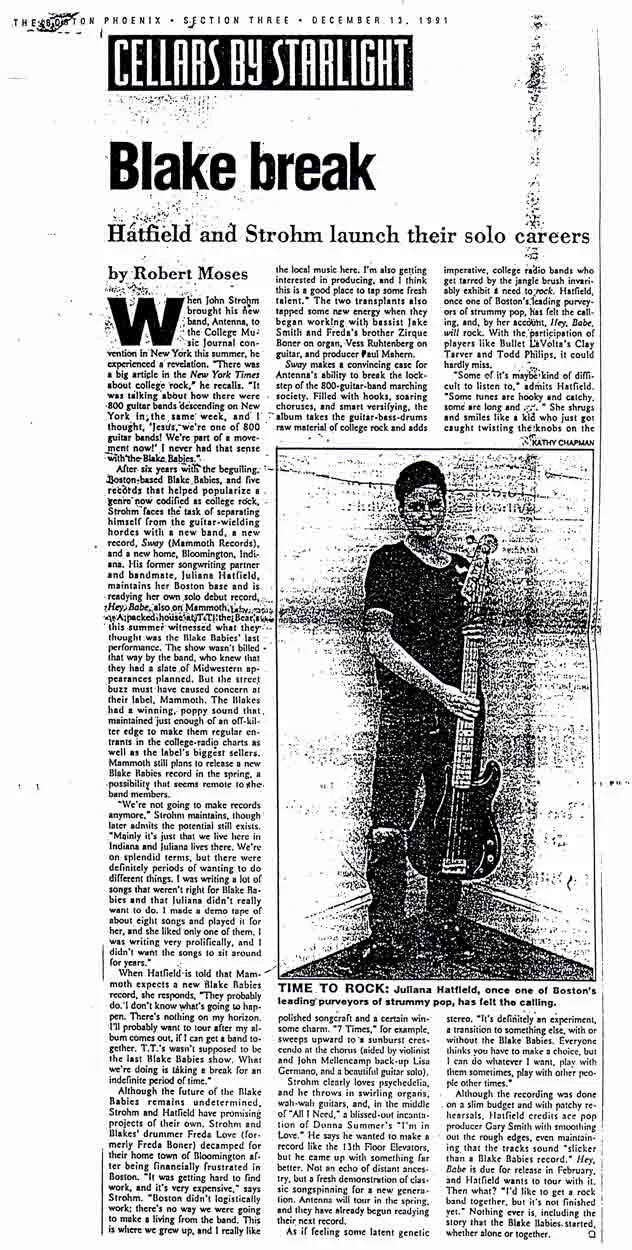
Photo caption: TIME TO ROCK: Juliana Hatfield, once one of Boston’s leading purveyors of strummy pop, has felt the calling. Photo by Kathy Chapman.
Discorder 1992
Interview with Discorder magazine from 1992.
"I think I would be better suited to songs that are simpler and tougher, I'm trying to get away from that soppy pop stuff....It's too much to try to handle my voice with that kind of music."
Show transcriptHide transcript
Juliana Hatfield Interview
Discorder, 1992
“Before that [X] I was into stuff like Olivia Newton-John and Donnie & Marie, so when I heard X, I was totally blown away, they could be really hard but with harmonies.”
After several false starts, I sat down with Miss Hatfield in the bandroom/basement of the Town Pump. Ex of the Blake Babies, that power pop trio from Boston that set college radio on fire B.N. (before N-Band), she has recently released her first solo effort, Hey Babe, a collection of ten fair to excellent songs. Buy it.
Did you have much time to relax?
I was relaxing for a couple of days kind of. I was in L.A. and I got to hang around the pool a little bit.
When you’re on the road how do you keep yourself entertained?
Just... I don’t know, just play shows, you know?
Do any writing?
Not much, I can’t really concentrate very much on the road.
What is your songwriting process?
It’s changed a lot. I used to write a song all at once, like in a night, but now it’s a real drawn out process. I write bits and pieces whenever I feel like it and eventually I have a song.
An article in Entertainment Weekly stated that you personified “alternative cool.” Who would that be for you?
Oh, I don’t know, like Sonic Youth is so cool. They’re like the coolest. I mean not necessarily in a good way, but that’s who I think of....
Did you wince when you read that description of yourself?
No, ’cos I don’t really care what people think of me, you know?
So when you read your voice being described as precocious or childlike does that bother you?
Nah, ’cos it’s true to the uninformed listener. I mean, it’s even true if you know what I’m trying to do or what I’m all about...my voice is childlike and weak. I’m learning how to appreciate its difference, it’s uniqueness.
The cover of “Loose” that the Blake Babies did was a real way to use your voice.
Yeah, see I wish I could write songs like that ’cos I think I would be better suited to songs that are simpler and tougher. I’m trying to get away from that soppy pop stuff... It’s too much to try to handle my voice with that kind of music, like “Forever Baby.” These days I’m trying to work with the limitations of my voice rather than stretching it really far; trying to be a little more laid back and heavier at the same time. Yeah, my upper register’s really weak and I have to sing softer, and I think that’s really annoying.
Do you do any voice exercises?
Yeah. I went to school for four years, music college, just to learn how to sing better. And whenever I can I do exercises.
That’s where you met the rest of the Blake Babies?
Yeah. That’s why I went there really, to find people to start a band.
X (the band) was a big turning point for you?
Yeah, they were my favorite band in high school. They were really the first kind of punk rock music that I ever heard. Before that I was into stuff like Olivia Newton-John and Donnie & Marie, so when I heard X, I was totally blown away, they could be really hard but with harmonies. I’m a real sucker for vocal harmonies but I love heavy music and that was the first combination of the two that I really heard. Plus, the songs were so good and Exene’s so cool.
Do you remember the first time you heard X?
Yeah! From this girl, she was a nanny, I guess she was living with us. I lived in this pretty small, sheltered town and nobody knew any punk rock bands down there. And this girl, she was twenty-four or something, I was sixteen, came to live with us and she brought her records. One day I was making dinner and she put on the song “Motel Room in My Bed” and I said “What is that?” It was like the gods were singing and I couldn’t believe it was so good. Then I explored her record collection. She had everything good: Mission of Burma, the Replacements....
Do you find that there are many taboos left for women in the music industry, things you have to think twice about doing?
No, I feel total freedom. I feel like I’m in a position of, “Now’s the time to really act, to really do it.” People’s ears are wide open for women in rawk right now, they’re waiting for something. I don’t feel any pressure, I can do whatever I want. I just have to figure out what it is fast ’cos the opportunity is there now. But then again it’s still a man’s world, music and everything, EVERYTHING, really.
For instance, all those record company weasels up there...
They’re all men, yeah, all those big guys upstairs. And it’s so hard to have confidence ’cos rock is a guy’s thing and it’s really hard to get up and do it. But I don’t believe in feeling oppressed, and you’re oppressing yourself if you believe it... I’m not truly oppressed, I don’t think. So I feel like I have every opportunity in the world and all I need is the confidence. That’s the only thing that could hold me back.
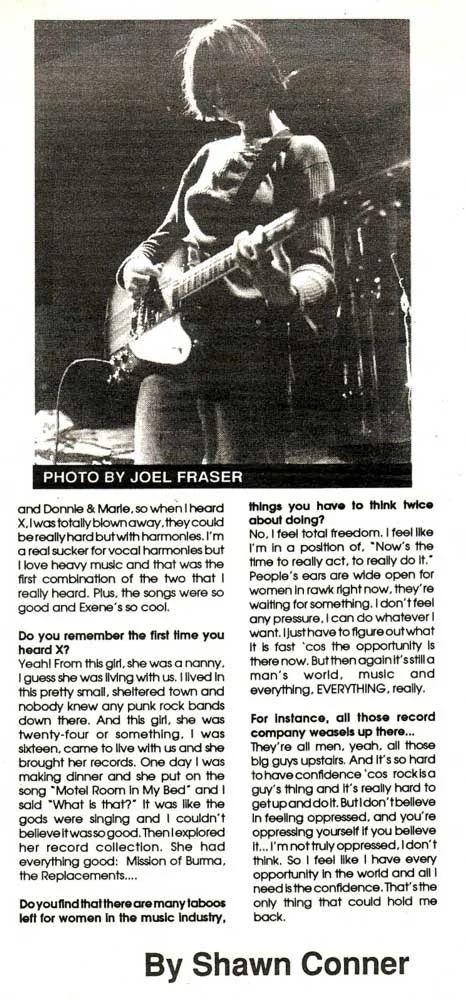
Photo by Joel Fraser
By Shawn Conner
Siren 1992
Blake Babies interviewed by English magazine Siren in 1992.
"A lot of pop music is too formalised. But one thing I think is good is that the kids just wanna rock again!"
Show transcriptHide transcript
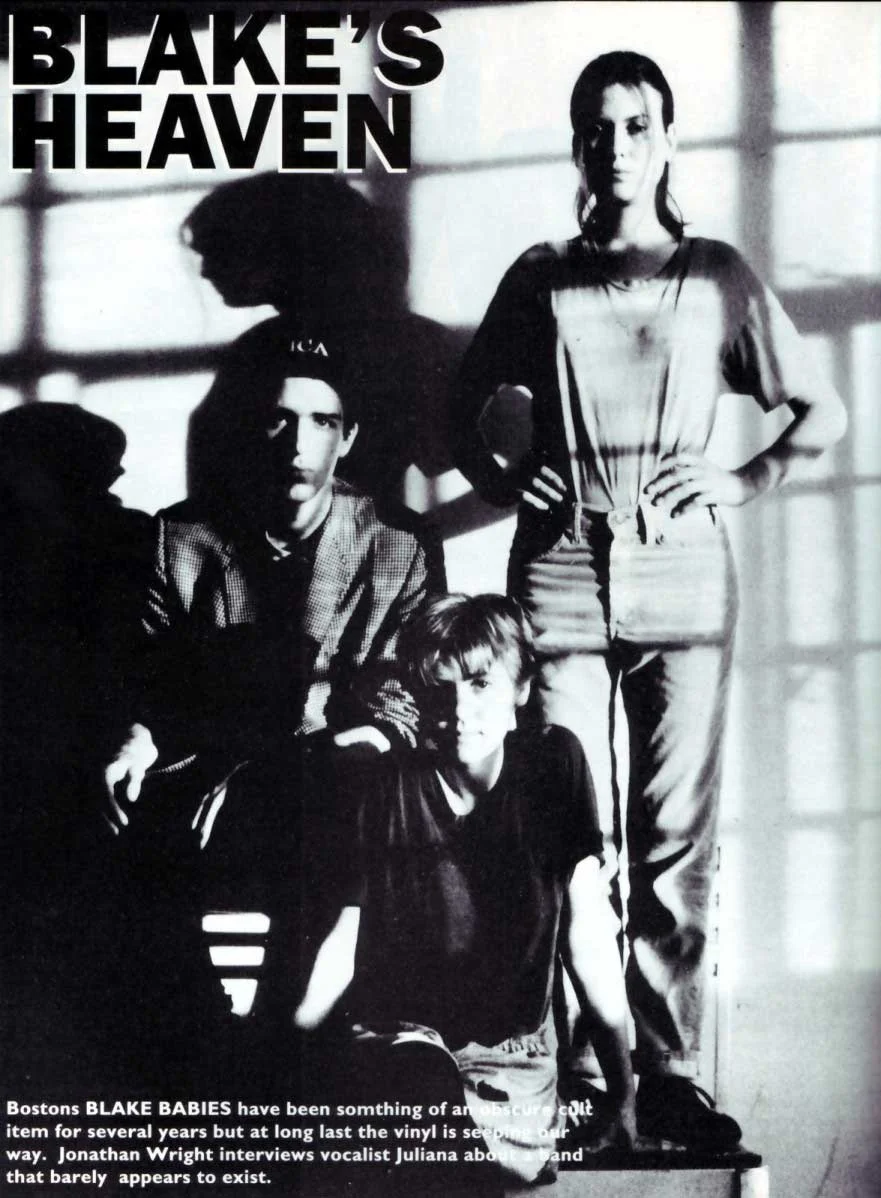
Blake’s Heaven
Bostons BLAKE BABIES have been something of an obscure cult item for several years but at long last the vinyl is seeping our way. Jonathan Wright interviews vocalist Juliana about a band that barely appears to exist.
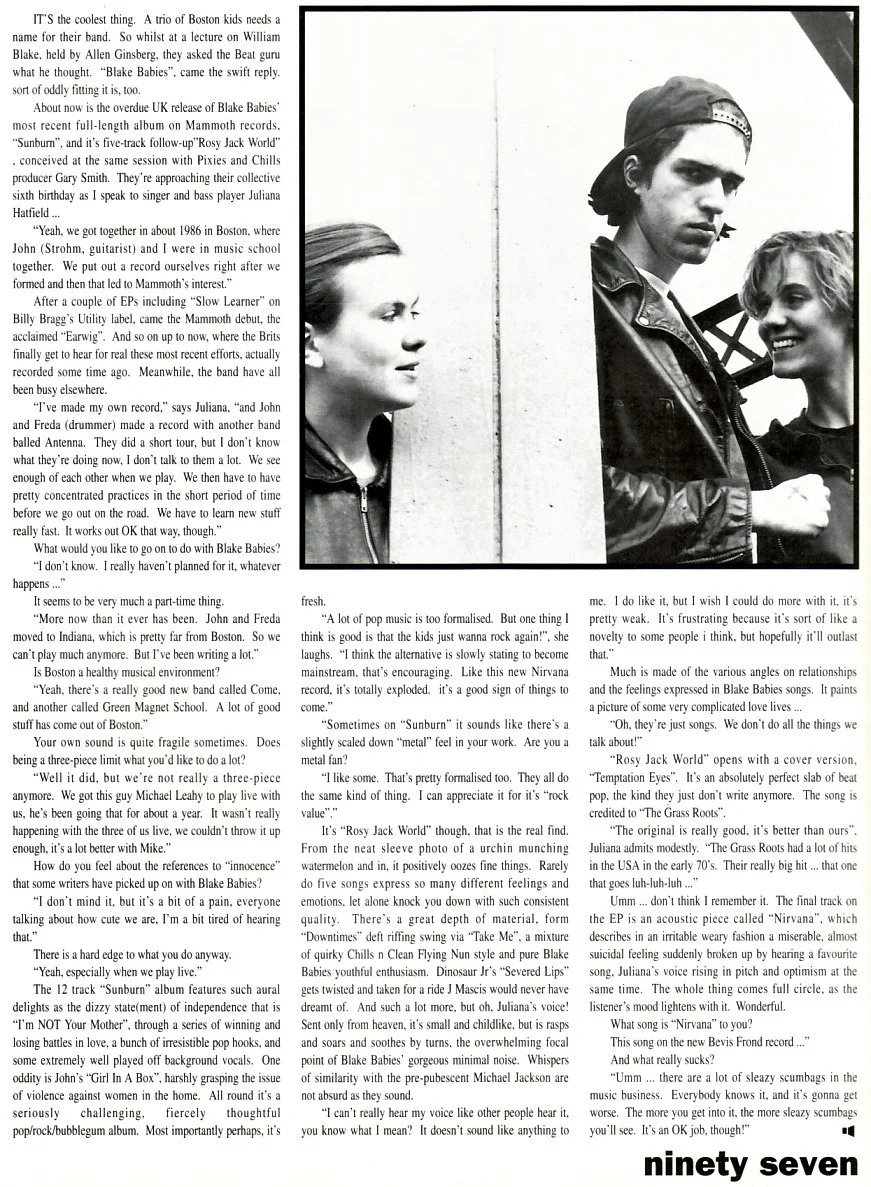
IT’S the coolest thing. A trio of Boston kids needs a name for their band. So whilst at a lecture on William Blake, held by Allen Ginsberg, they asked the Beat guru what he thought. “Blake Babies”, came the swift reply. sort of oddly fitting it is, too.
About now is the overdue UK release of Blake Babies’ most recent full-length album on Mammoth records, “Sunburn”, and it’s five-track follow-up “Rosy Jack World”, conceived at the same session with Pixies and Chills producer Gary Smith. They’re approaching their collective sixth birthday as I speak to singer and bass player Juliana Hatfield ...
“Yeah, we got together in about 1986 in Boston, where John (Strohm, guitarist) and I were in music school together. We put out a record ourselves right after we formed and then that led to Mammoth’s interest.”
After a couple of EPs including “Slow Learner” on Billy Bragg’s Utility label, came the Mammoth debut, the acclaimed “Earwig”. And so on up to now, where the Brits finally get to hear for real these most recent efforts, actually recorded some time ago. Meanwhile, the band have all been busy elsewhere.
“I’ve made my own record,” says Juliana, “and John and Freda (drummer) made a record with another band balled Antenna. They did a short tour, but I don’t know what they’re doing now, I don’t talk to them a lot. We see enough of each other when we play. We then have to have pretty concentrated practices in the short period of time before we go out on the road. We have to learn new stuff really fast. It works out OK that way, though.”
What would you like to go on to do with Blake Babies?
“I don’t know. I really haven’t planned for it, whatever happens ...”
It seems to be very much a part-time thing.
“More now than it ever has been. John and Freda moved to Indiana, which is pretty far from Boston. So we can’t play much anymore. But I’ve been writing a lot.”
Is Boston a healthy musical environment?
“Yeah, there’s a really good new band called Come, and another called Green Magnet School. A lot of good stuff has come out of Boston.”
Your own sound is quite fragile sometimes. Does being a three-piece limit what you’d like to do a lot?
“Well it did, but we’re not really a three-piece anymore. We got this guy Michael Leahy to play live with us, he’s been going that for about a year. It wasn’t really happening with the three of us live, we couldn’t throw it up enough, it’s a lot better with Mike.”
How do you feel about the references to “innocence” that some writers have picked up on with Blake Babies?
“I don’t mind it, but it’s a bit of a pain, everyone talking about how cute we are, I’m a bit tired of hearing that.”
There is a hard edge to what you do anyway.
“Yeah, especially when we play live.”
The 12 track “Sunburn” album features such aural delights as the dizzy state(ment) of independence that is “I’m NOT Your Mother”, through a series of winning and losing battles in love, a bunch of irresistible pop hooks, and some extremely well played off background vocals. One oddity is John’s “Girl In A Box”, harshly grasping the issue of violence against women in the home. All round it’s a seriously challenging, fiercely thoughtful pop/rock/bubblegum album. Most importantly perhaps, it’s fresh.
“A lot of pop music is too formalised. But one thing I think is good is that the kids just wanna rock again!”, she laughs. “I think the alternative is slowly stating to become mainstream, that’s encouraging. Like this new Nirvana record, it’s totally exploded. it’s a good sign of things to come.”
“Sometimes on “Sunburn” it sounds like there’s a slightly scaled down “metal” feel in your work. Are you a metal fan?
“I like some. That’s pretty formalised too. They all do the same kind of thing. I can appreciate it for it’s “rock value”.”
It’s “Rosy Jack World” though, that is the real find. From the neat sleeve photo of a urchin munching watermelon and in, it positively oozes fine things. Rarely do five songs express so many different feelings and emotions, let alone knock you down with such consistent quality. There’s a great depth of material, form “Downtimes” deft riffing swing via “Take Me”, a mixture of quirky Chills n Clean Flying Nun style and pure Blake Babies youthful enthusiasm. Dinosaur Jr’s “Severed Lips” gets twisted and taken for a ride J Mascis would never have dreamt of. And such a lot more, but oh, Juliana’s voice! Sent only from heaven, it’s small and childlike, but is rasps and soars and soothes by turns, the overwhelming focal point of Blake Babies’ gorgeous minimal noise. Whispers of similarity with the pre-pubescent Michael Jackson are not absurd as they sound.
“I can’t really hear my voice like other people hear it, you know what I mean? It doesn’t sound like anything to me. I do like it, but I wish I could do more with it, it’s pretty weak. It’s frustrating because it’s sort of like a novelty to some people i think, but hopefully it’ll outlast that.”
Much is made of the various angles on relationships and the feelings expressed in Blake Babies songs. It paints a picture of some very complicated love lives ...
“Oh, they’re just songs. We don’t do all the things we talk about!”
“Rosy Jack World” opens with a cover version, “Temptation Eyes”. It’s an absolutely perfect slab of beat pop, the kind they just don’t write anymore. The song is credited to “The Grass Roots”.
“The original is really good, it’s better than ours”, Juliana admits modestly. “The Grass Roots had a lot of hits in the USA in the early 70’s. Their really big hit ... that one that goes luh-luh-luh ...”
Umm ... don’t think I remember it. The final track on the EP is an acoustic piece called “Nirvana”, which describes in an irritable weary fashion a miserable, almost suicidal feeling suddenly broken up by hearing a favourite song, Juliana’s voice rising in pitch and optimism at the same time. The whole thing comes full circle, as the listener’s mood lightens with it. Wonderful.
What song is “Nirvana” to you?
This song on the new Bevis Frond record ...”
And what really sucks?
“Umm ... there are a lot of sleazy scumbags in the music business. Everybody knows it, and it’s gonna get worse. The more you get into it, the more sleazy scumbags you’ll see. It’s an OK job, though!”
NME - August 1992
NME interview - August 1992
"What I do isn't singing about myself. I kinda make up these little stories. I don't know where they come from....I'm not as pathetic as the protagonist in those songs."
Show transcriptHide transcript
Babe Alone’s Burning
NME, 29 August 1992
From the Blake Babies to ‘Hey Babe’, JULIANA HATFIELD has been crafting a deceptively sweet, unnervingly direct antidote to foxcore screaming. DELE FADELE gets some long-distance information
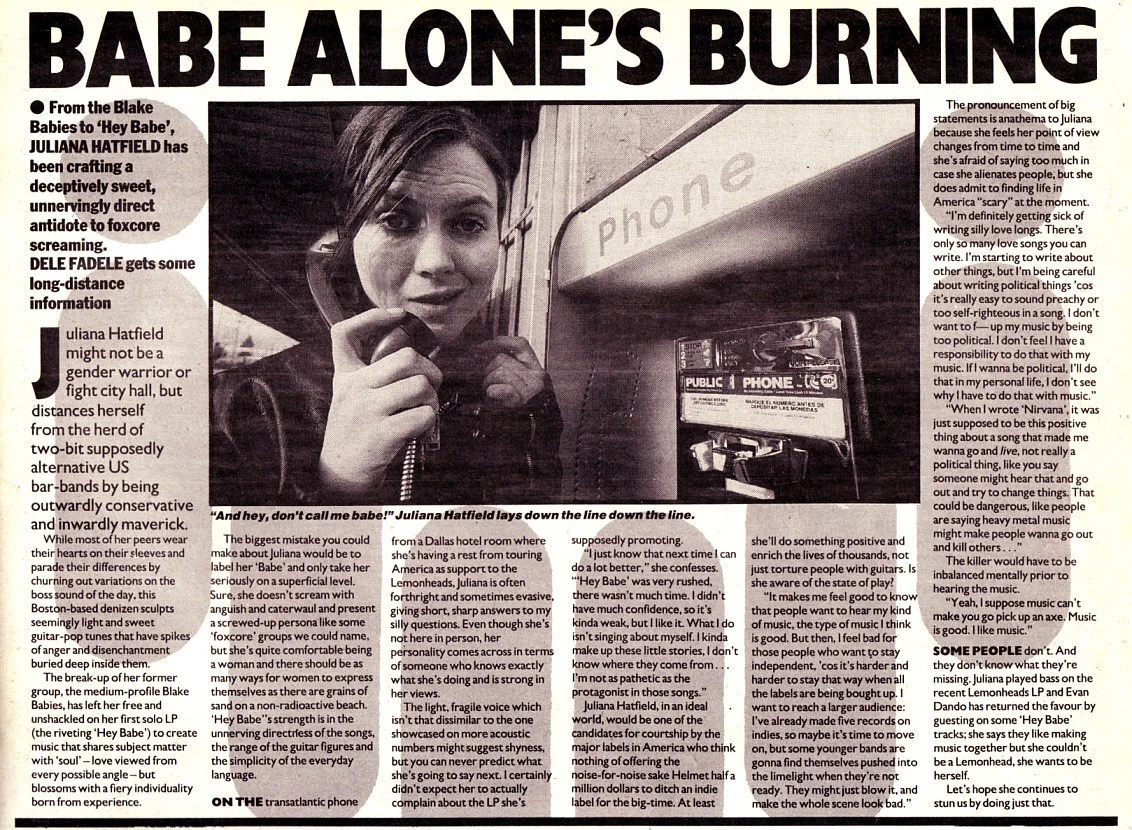
“And hey, don’t call me babe!” Juliana Hatfield lays down the line down the line.
Juliana Hatfield might not be a gender warrior or fight city hall, but distances herself from the herd of two-bit supposedly alternative US bar-bands by being outwardly conservative and inwardly maverick.
While most of her peers wear their hearts on their sleeves and parade their differences by churning out variations on the boss sound of the day, this Boston-based denizen sculpts seemingly light and sweet guitar-pop tunes that have spikes of anger and disenchantment buried deep inside them.
The break-up of her former group, the medium-profile Blake Babies, has left her free and unshackled on her first solo LP (the riveting ‘Hey Babe’) to create music that shares subject matter with ‘soul’ — love viewed from every possible angle — but blossoms with a fiery individuality born from experience.
The biggest mistake you could make about Juliana would be to label her ‘Babe’ and only take her seriously on a superficial level. Sure, she doesn’t scream with anguish and caterwaul and present a screwed-up persona like some ‘foxcore’ groups we could name, but she’s quite comfortable being a woman and there should be as many ways for women to express themselves as there are grains of sand on a non-radioactive beach. ‘Hey Babe’’s strength is in the unnerving directness of the songs, the range of the guitar figures and the simplicity of the everyday language.
ON THE transatlantic phone from a Dallas hotel room where she’s having a rest from touring America as support to the Lemonheads, Juliana is often forthright and sometimes evasive, giving short, sharp answers to my silly questions. Even though she’s not here in person, her personality comes across in terms of someone who knows exactly what she’s doing and is strong in her views.
The light, fragile voice which isn’t that dissimilar to the one showcased on more acoustic numbers might suggest shyness, but you can never predict what she’s going to say next. I certainly didn’t expect her to actually complain about the LP she’s supposedly promoting.
“I just know that next time I can do a lot better,” she confesses. “‘Hey Babe’ was very rushed, there wasn’t much time. I didn’t have much confidence, so it’s kinda weak, but I like it. What I do isn’t singing about myself. I kinda make up these little stories, I don’t know where they come from… I’m not as pathetic as the protagonist in those songs.”
Juliana Hatfield, in an ideal world, would be one of the candidates for courtship by the major labels in America who think nothing of offering the noise-for-noise sake Helmet half a million dollars to ditch an indie label for the big-time. At least she’ll do something positive and enrich the lives of thousands, not just torture people with guitars. Is she aware of the state of play?
“It makes me feel good to know that people want to hear my kind of music, the type of music I think is good. But then, I feel bad for those people who want to stay independent, ’cos it’s harder and harder to stay that way when all the labels are being bought up. I want to reach a larger audience: I’ve already made five records on indies, so maybe it’s time to move on, but some younger bands are gonna find themselves pushed into the limelight when they’re not ready. They might just blow it, and make the whole scene look bad.”
The pronouncement of big statements is anathema to Juliana because she feels her point of view changes from time to time and she’s afraid of saying too much in case she alienates people, but she does admit to finding life in America “scary” at the moment.
“I’m definitely getting sick of writing silly love songs. There’s only so many love songs you can write. I’m starting to write about other things, but I’m being careful about writing political things ’cos it’s really easy to sound preachy or too self-righteous in a song. I don’t want to f— up my music by being too political. I don’t feel I have a responsibility to do that with my music. If I wanna be political, I’ll do that in my personal life. I don’t see why I have to do that with music.”
“When I wrote ‘Nirvana’, it was just supposed to be this positive thing about a song that made me wanna go and live, not really a political thing, like you say someone might hear that and go out and try to change things. That could be dangerous, like people are saying heavy metal music might make people wanna go out and kill others…”
The killer would have to be imbalanced mentally prior to hearing the music.
“Yeah, I suppose music can’t make you go pick up an axe. Music is good. I like music.”
SOME PEOPLE don’t. And they don’t know what they’re missing. Juliana played bass on the recent Lemonheads LP and Evan Dando has returned the favour by guesting on some ‘Hey Babe’ tracks; she says they like making music together but she couldn’t be a Lemonhead, she wants to be herself.
Let’s hope she continues to stun us by doing just that.
Lime Lizard - May 1992
Blake Babies interviewed by English music magazine Lime Lizard in May 1992.
"We like My Bloody Valentine. I think there's something really organic about their sound."
Show transcriptHide transcript
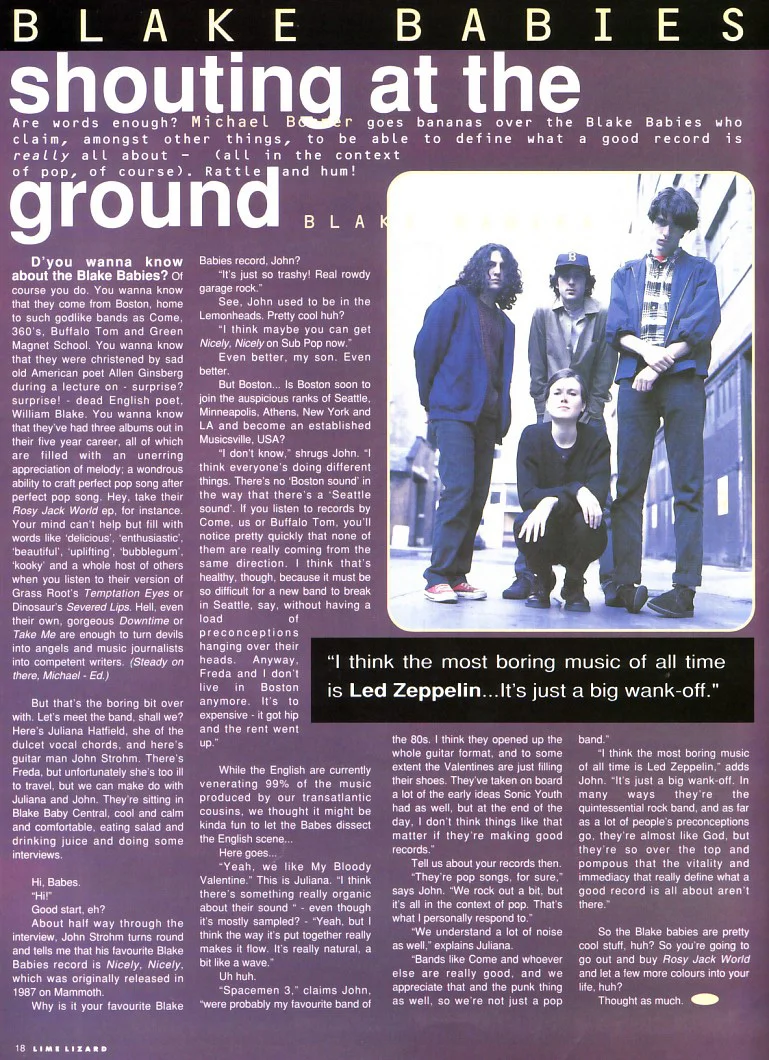
shouting at the ground
Are words enough? Michael Bonner goes bananas over the Blake Babies who claim, amongst other things, to be able to define what a good record is really all about — (all in the context of pop, of course). Rattle and hum!
D’you wanna know about the Blake Babies? Of course you do. You wanna know that they come from Boston, home to such godlike bands as Come, 360’s, Buffalo Tom and Green Magnet School. You wanna know that they were christened by sad old American poet Allen Ginsberg during a lecture on — surprise? surprise! — dead English poet, William Blake. You wanna know that they’ve had three albums out in their five year career, all of which are filled with an unerring appreciation of melody; a wondrous ability to craft perfect pop song after perfect pop song. Hey, take their Rosy Jack World ep, for instance. Your mind can’t help but fill with words like ‘delicious’, ‘enthusiastic’, ‘beautiful’, ‘uplifting’, ‘bubblegum’, ‘kooky’ and a whole host of others when you listen to their version of Grass Root’s Temptation Eyes or Dinosaur’s Severed Lips. Hell, even their own, gorgeous Downtime or Take Me are enough to turn devils into angels and music journalists into competent writers. (Steady on there, Michael — Ed.)
But that’s the boring bit over with. Let’s meet the band, shall we? Here’s Juliana Hatfield, she of the dulcet vocal chords, and here’s guitar man John Strohm. There’s Freda, but unfortunately she’s too ill to travel, but we can make do with Juliana and John. They’re sitting in Blake Baby Central, cool and calm and comfortable, eating salad and drinking juice and doing some interviews.
Hi, Babes.
“Hi!”
Good start, eh?
About half way through the interview, John Strohm turns round and tells me that his favourite Blake Babies record is Nicely, Nicely, which was originally released in 1987 on Mammoth.
Why is it your favourite Blake Babies record, John?
“It’s just so trashy! Real rowdy garage rock.”
See, John used to be in the Lemonheads. Pretty cool huh?
“I think maybe you can get Nicely, Nicely on Sub Pop now.”
Even better, my son. Even better.
But Boston… Is Boston soon to join the auspicious ranks of Seattle, Minneapolis, Athens, New York and LA and become an established Musicsville, USA?
“I don’t know,” shrugs John. “I think everyone’s doing different things. There’s no ‘Boston sound’ in the way that there’s a ‘Seattle sound’. If you listen to records by Come, us or Buffalo Tom, you’ll notice pretty quickly that none of them are really coming from the same direction. I think that’s healthy, though, because it must be so difficult for a new band to break in Seattle, say, without having a load of preconceptions hanging over their heads. Anyway, Freda and I don’t live in Boston anymore. It’s to expensive — it got hip and the rent went up.”
While the English are currently venerating 99% of the music produced by our transatlantic cousins, we thought it might be kinda fun to let the Babes dissect the English scene…
Here goes…
“Yeah, we like My Bloody Valentine.” This is Juliana. “I think there’s something really organic about their sound” — even though it’s mostly sampled? — “Yeah, but I think the way it’s put together really makes it flow. It’s really natural, a bit like a wave.”
Uh huh.
“Spacemen 3,” claims John, “were probably my favourite band of the 80s. I think they opened up the whole guitar format, and to some extent the Valentines are just filling their shoes. They’ve taken on board a lot of the early ideas Sonic Youth had as well, but at the end of the day, I don’t think things like that matter if they’re making good records.”
Tell us about your records then.
“They’re pop songs, for sure,” says John. “We rock out a bit, but it’s all in the context of pop. That’s what I personally respond to.”
“We understand a lot of noise as well,” explains Juliana.
“Bands like Come and whoever else are really good, and we appreciate that and the punk thing as well, so we’re not just a pop band.”
“I think the most boring music of all time is Led Zeppelin…It’s just a big wank-off.”
“I think the most boring music of all time is Led Zeppelin,” adds John. “It’s just a big wank-off. In many ways they’re the quintessential rock band, and as far as a lot of people’s preconceptions go, they’re almost like God, but they’re so over the top and pompous that the vitality and immediacy that really define what a good record is all about aren’t there.”
So the Blake babies are pretty cool stuff, huh? So you’re going to go out and buy Rosy Jack World and let a few more colours into your life, huh?
Thought as much.
Alternative Press 1992
Alternative Press 1992
"For me it's really hard to write a three chord song, and I've been trying for so long."
Show transcriptHide transcript
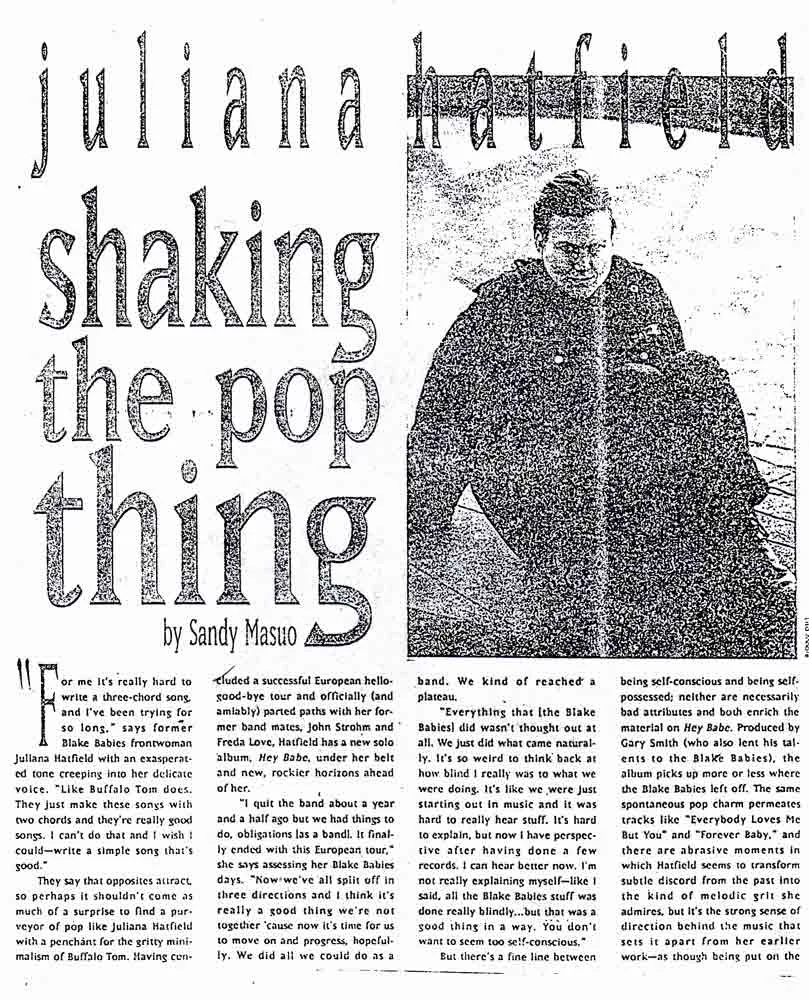
Shaking the Pop Thing
Juliana Hatfield
By Sandy Masuo
Alternative Press, 1992
“For me it’s really hard to write a three-chord song, and I’ve been trying for so long,” says former Blake Babies frontwoman Juliana Hatfield with an exasperated tone creeping into her delicate voice. “Like Buffalo Tom does. They just make these songs with two chords and they’re really good songs. I can’t do that and I wish I could—write a simple song that’s good.”
They say that opposites attract, so perhaps it shouldn’t come as much of a surprise to find a purveyor of pop like Juliana Hatfield with a penchant for the gritty minimalism of Buffalo Tom. Having concluded a successful European hello-good-bye tour and officially (and amiably) parted paths with her former band mates, John Strohm and Freda Love, Hatfield has a new solo album, Hey Babe, under her belt and new, rockier horizons ahead of her.
“I quit the band about a year and a half ago but we had things to do, obligations as a band. It finally ended with this European tour,” she says assessing her Blake Babies days. “Now we’ve all split off in three directions and I think it’s really a good thing we’re not together ’cause now it’s time for us to move on and progress, hopefully. We did all we could do as a band. We kind of reached a plateau.
“Everything that [the Blake Babies] did wasn’t thought out at all. We just did what came naturally. It’s so weird to think back at how blind I really was to what we were doing. It’s like we were just starting out in music and it was hard to really hear stuff. It’s hard to explain, but now I have perspective after having done a few records. I can hear better now. I’m not really explaining myself—like I said, all the Blake Babies stuff was done really blindly...but that was a good thing in a way. You don’t want to seem too self-conscious.”
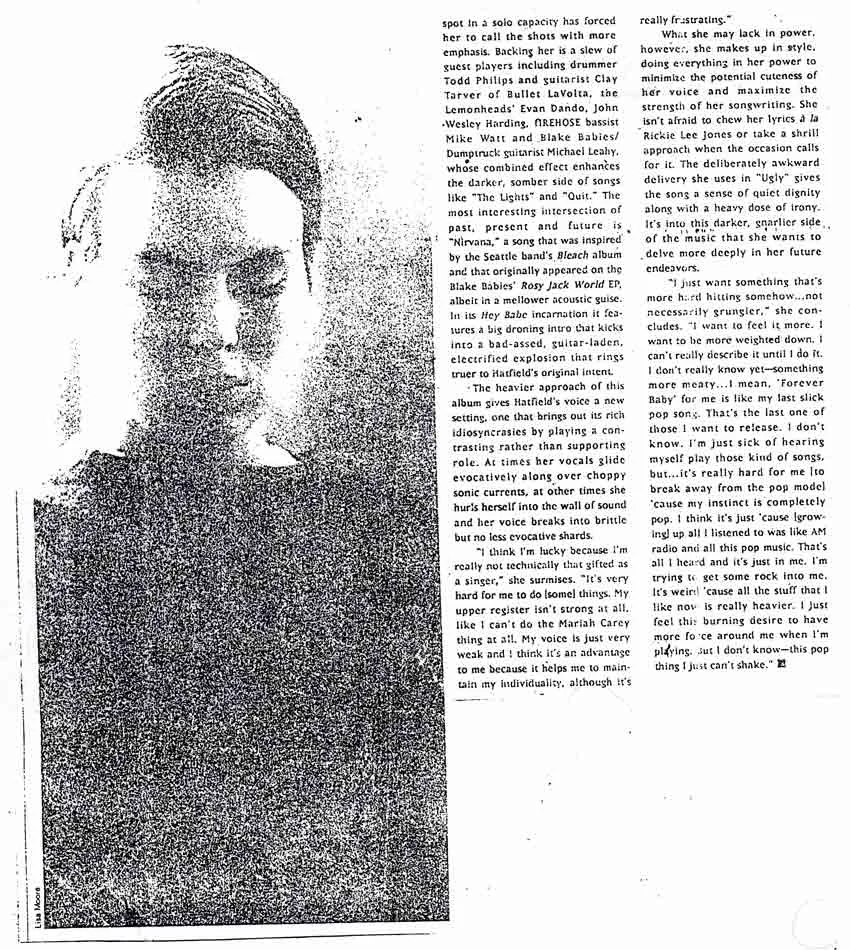
But there’s a fine line between being self-conscious and being self-possessed; neither are necessarily bad attributes and both enrich the material on Hey Babe. Produced by Gary Smith (who also lent his talents to the Blake Babies), the album picks up more or less where the Blake Babies left off. The same spontaneous pop charm permeates tracks like “Everybody Loves Me But You” and “Forever Baby,” and there are abrasive moments in which Hatfield seems to transform subtle discord from the past into the kind of melodic grit she admires, but it’s the strong sense of direction behind the music that sets it apart from her earlier work—as though being put on the spot in a solo capacity has forced her to call the shots with more emphasis. Backing her is a slew of guest players including drummer Todd Philips and guitarist Clay Tarver of Bullet LaVolta, the Lemonheads’ Evan Dando, John Wesley Harding, fIREHOSE bassist Mike Watt and Blake Babies/Dumptruck guitarist Michael Leahy, whose combined effect enhances the darker, somber side of songs like “The Lights” and “Quit.” The most interesting intersection of past, present and future is “Nirvana,” a song that was inspired by the Seattle band’s Bleach album and that originally appeared on the Blake Babies’ Rosy Jack World EP, albeit in a mellower acoustic guise. In its Hey Babe incarnation it features a big droning intro that kicks into a bad-assed, guitar-laden, electrified explosion that rings truer to Hatfield’s original intent.
The heavier approach of this album gives Hatfield’s voice a new setting, one that brings out its rich idiosyncrasies by playing a contrasting rather than supporting role. At times her vocals glide evocatively along over choppy sonic currents, at other times she hurls herself into the wall of sound and her voice breaks into brittle but no less evocative shards.
“I think I’m lucky because I’m really not technically that gifted as a singer,” she surmises. “It’s very hard for me to do [some] things. My upper register isn’t strong at all, like I can’t do the Mariah Carey thing at all. My voice is just very weak and I think it’s an advantage to me because it helps me to maintain my individuality, although it’s really frustrating.”
What she may lack in power, however, she makes up in style, doing everything in her power to minimize the potential cuteness of her voice and maximize the strength of her songwriting. She isn’t afraid to chew her lyrics a la Rickie Lee Jones or take a shrill approach when the occasion calls for it. The deliberately awkward delivery she uses in “Ugly” gives the song a sense of quiet dignity along with a heavy dose of irony. It’s into this darker, gnarlier side of the music that she wants to delve more deeply in her future endeavors.
“I just want something that’s more hard hitting somehow...not necessarily grungier,” she concludes. “I want to feel it more. I want to be more weighted down. I can’t really describe it until I do it. I don’t really know yet—something more meaty...I mean, ‘Forever Baby’ for me is like my last slick pop song. That’s the last one of those I want to release. I don’t know. I’m just sick of hearing myself play those kind of songs, but...it’s really hard for me to break away from the pop model ’cause my instinct is completely pop. I think it’s just ’cause [growing] up all I listened to was like AM radio and all this pop music. That’s all I heard and it’s just in me. I’m trying to get some rock into me. It’s weird ’cause all the stuff that I like now is really heavier. I just feel this burning desire to have more force around me when I’m playing, but I don’t know—this pop thing I just can’t shake.”
Melody Maker - January 1993
An excellent interview with the Melody Maker at the beginning of 'The Juliana Hatfield Three' - January 1993
"(My) Sister is about what it might be like if I had a sister, and, I guess, also what I think my brothers think about me."
Show transcriptHide transcript
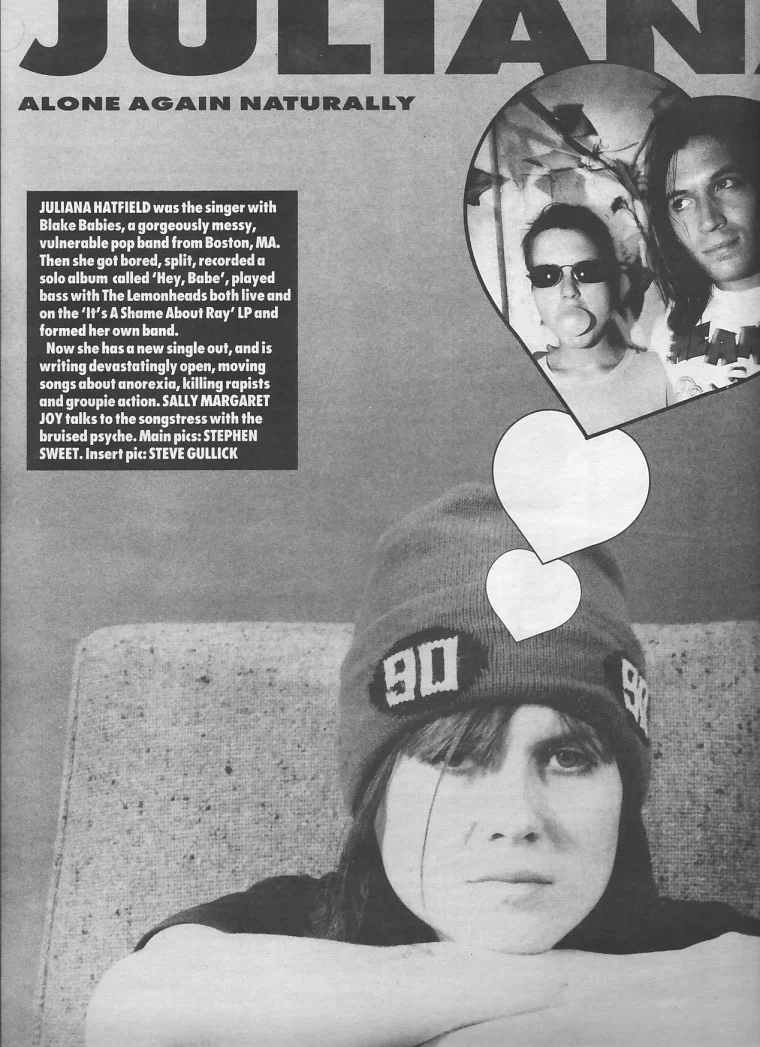
Alone Again Naturally
Melody Maker, January 9, 1993
JULIANA HATFIELD was the singer with Blake Babies, a gorgeously messy, vulnerable pop band from Boston, MA. Then she got bored, split, recorded a solo album called ‘Hey, Babe’, played bass with The Lemonheads both live and on the ‘It’s A Shame About Ray’ LP and formed her own band.
Now she has a new single out, and is writing devastatingly open, moving songs about anorexia, killing rapists and groupie action. SALLY MARGARET JOY talks to the songstress with the bruised psyche. Main pics: STEPHEN SWEET. Insert pic: STEVE GULLICK
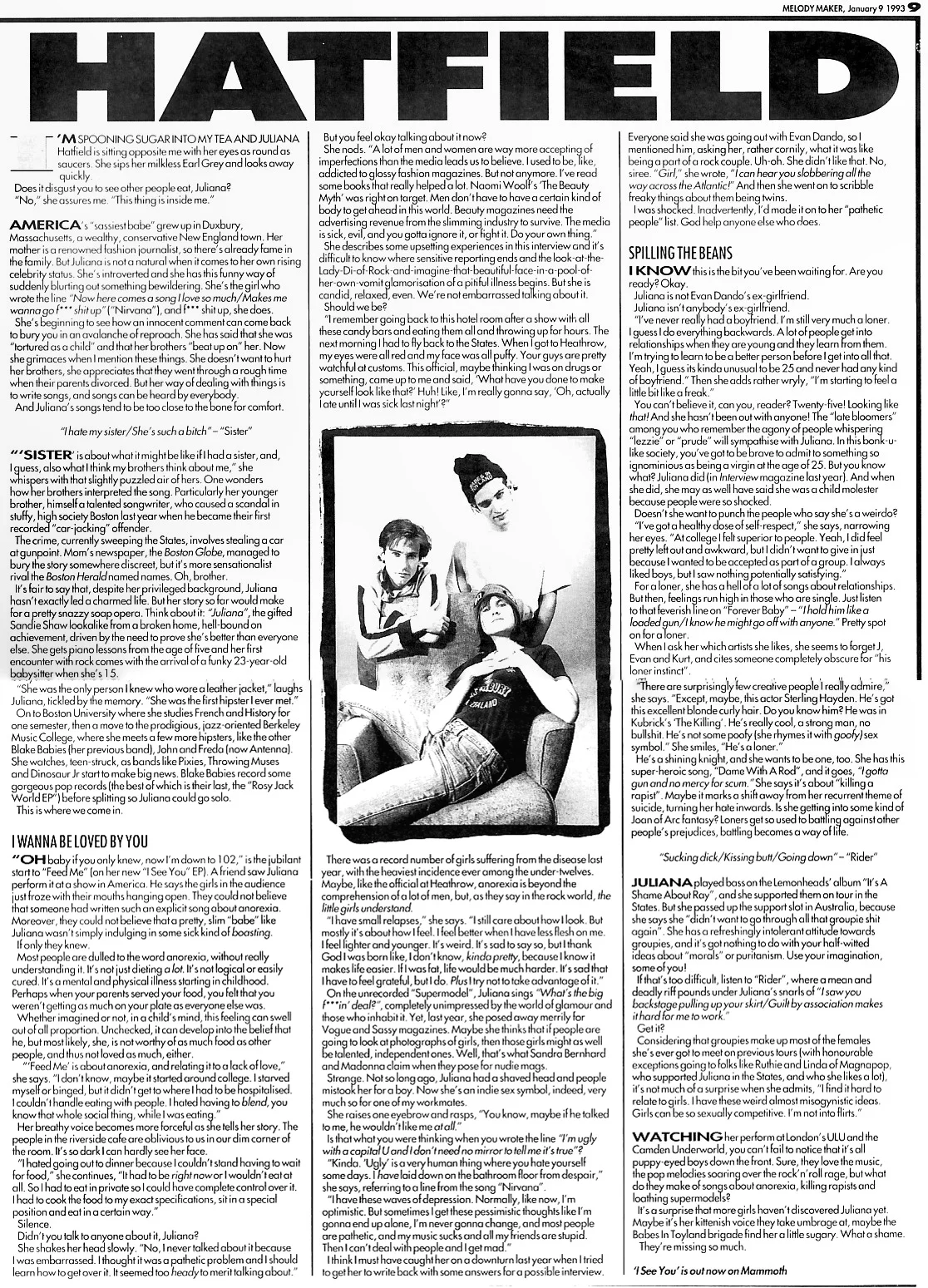
“I’M SPOONING SUGAR INTO MY TEA AND JULIANA Hatfield is sitting opposite me with her eyes as round as saucers. She sips her milkless Earl Grey and looks away quickly.
Does it disgust you to see other people eat, Juliana?
“No,” she assures me. “This thing is inside me.”
AMERICA’s “sassiest babe” grew up in Duxbury, Massachusetts, a wealthy, conservative New England town. Her mother is a renowned fashion journalist, so there’s already fame in the family. But Juliana is not a natural when it comes to her own rising celebrity status. She’s introverted and she has this funny way of suddenly blurting out something bewildering. She’s the girl who wrote the line “Now here comes a song I love so much/Makes me wanna go f*** shit up” (“Nirvana”), and f*** shit up, she does.
She’s beginning to see how an innocent comment can come back to bury you in an avalanche of reproach. She has said that she was “tortured as a child” and that her brothers “beat up on” her. Now she grimaces when I mention these things. She doesn’t want to hurt her brothers, she appreciates that they went through a rough time when their parents divorced. But her way of dealing with things is to write songs, and songs can be heard by everybody.
And Juliana’s songs tend to be too close to the bone for comfort.
“I hate my sister/She’s such a bitch” — “Sister”
“SISTER” is about what it might be like if I had a sister, and, I guess, also what I think my brothers think about me,” she whispers with that slightly puzzled air of hers. One wonders how her brothers interpreted the song. Particularly her younger brother, himself a talented songwriter, who caused a scandal in stuffy, high society Boston last year when he became their first recorded “car-jacking” offender.
The crime, currently sweeping the States, involves stealing a car at gunpoint. Mom’s newspaper, the Boston Globe, managed to bury the story somewhere discreet, but it’s more sensationalist rival the Boston Herald named names. Oh, brother.
It’s fair to say that, despite her privileged background, Juliana hasn’t exactly led a charmed life. But her story so far would make for a pretty snazzy soap opera. Think about it: “Juliana”, the gifted Sandie Shaw lookalike from a broken home, hell-bound on achievement, driven by the need to prove she’s better than everyone else. She gets piano lessons from the age of five and her first encounter with rock comes with the arrival of a funky 23-year-old babysitter when she’s 15.
“She was the only person I knew who wore a leather jacket,” laughs Juliana, tickled by the memory. “She was the first hipster I ever met.”
On to Boston University where she studies French and History for one semester, then a move to the prodigious, jazz-oriented Berkeley Music College, where she meets a few more hipsters, like the other Blake Babies (her previous band), John and Freda (now Antenna). She watches, teen-struck, as bands like Pixies, Throwing Muses and Dinosaur Jr start to make big news. Blake Babies record some gorgeous pop records (the best of which is their last, the “Rosy Jack World EP”) before splitting so Juliana could go solo.
This is where we come in.
I Wanna Be Loved By You
“OH baby if you only knew, now I’m down to 102,” is the jubilant start to “Feed Me” (on her new “I See You” EP). A friend saw Juliana perform it at a show in America. He says the girls in the audience just froze with their mouths hanging open. They could not believe that someone had written such an explicit song about anorexia. Moreover, they could not believe that a pretty, slim “babe” like Juliana wasn’t simply indulging in some sick kind of boasting.
If only they knew.
Most people are dulled to the word anorexia, without really understanding it. It’s not just dieting a lot. It’s not logical or easily cured. It’s a mental and physical illness starting in childhood. Perhaps when your parents served your food, you felt that you weren’t getting as much on your plate as everyone else was.
Whether imagined or not, in a child’s mind, this feeling can swell out of all proportion. Unchecked, it can develop into the belief that he, but most likely, she, is not worthy of as much food as other people, and thus not loved as much, either.
“‘Feed Me’ is about anorexia, and relating it to a lack of love,” she says. “I don’t know, maybe it started around college. I starved myself or binged, but it didn’t get to where I had to be hospitalised. I couldn’t handle eating with people. I hated having to blend, you know that whole social thing, while I was eating.”
Her breathy voice becomes more forceful as she tells her story. The people in the riverside cafe are oblivious to us in our dim corner of the room. It’s so dark I can hardly see her face.
“I hated going out to dinner because I couldn’t stand having to wait for food,” she continues, “It had to be right now or I wouldn’t eat at all. So I had to eat in private so I could have complete control over it. I had to cook the food to my exact specifications, sit in a special position and eat in a certain way.”
Silence.
Didn’t you talk to anyone about it, Juliana?
She shakes her head slowly. “No, I never talked about it because I was embarrassed. I thought it was a pathetic problem and I should learn how to get over it. It seemed too heady to merit talking about.”
But you feel okay talking about it now?
She nods. “A lot of men and women are way more accepting of imperfections than the media leads us to believe. I used to be, like, addicted to glossy fashion magazines. But not anymore. I’ve read some books that really helped a lot. Naomi Woolf’s ‘The Beauty Myth’ was right on target. Men don’t have to have a certain kind of body to get ahead in this world. Beauty magazines need the advertising revenue from the slimming industry to survive. The media is sick, evil, and you gotta ignore it, or fight it. Do your own thing.”
She describes some upsetting experiences in this interview and it’s difficult to know where sensitive reporting ends and the look-at-the-Lady-Di-of-Rock-and-imagine-that-beautiful-face-in-a-pool-of-her-own-vomit glamorisation of a pitiful illness begins. But she is candid, relaxed, even. We’re not embarrassed talking about it.
Should we be?
“I remember going back to this hotel room after a show with all these candy bars and eating them all and throwing up for hours. The next morning I had to fly back to the States. When I got to Heathrow, my eyes were all red and my face was all puffy. Your guys are pretty watchful at customs. This official, maybe thinking I was on drugs or something, came up to me and said, ‘What have you done to make yourself look like that?’ Huh! Like, I’m really gonna say, ‘Oh, actually I ate until I was sick last night’?”
There was a record number of girls suffering from the disease last year, with the heaviest incidence ever among the under-twelves. Maybe, like the official at Heathrow, anorexia is beyond the comprehension of a lot of men, but, as they say in the rock world, the little girls understand.
“I have small relapses,” she says. “I still care about how I look. But mostly it’s about how I feel. I feel better when I have less flesh on me. I feel lighter and younger. It’s weird. It’s sad to say so, but I thank God I was born like, I don’t know, kinda pretty, because I know it makes life easier. If I was fat, life would be much harder. It’s sad that I have to feel grateful, but I do. Plus I try not to take advantage of it.”
On the unrecorded “Supermodel”, Juliana sings “What’s the big f***in’ deal?”, completely unimpressed by the world of glamour and those who inhabit it. Yet, last year, she posed away merrily for Vogue and Sassy magazines. Maybe she thinks that if people are going to look at photographs of girls, then those girls might as well be talented, independent ones. Well, that’s what Sandra Bernhard and Madonna claim when they pose for nudie mags.
Strange. Not so long ago, Juliana had a shaved head and people mistook her for a boy. Now she’s an indie sex symbol, indeed, very much so for one of my workmates.
She raises one eyebrow and rasps, “You know, maybe if he talked to me, he wouldn’t like me at all.”
Is that what you were thinking when you wrote the line “I’m ugly with a capital U and I don’t need no mirror to tell me it’s true”?
“Kinda. ‘Ugly’ is a very human thing where you hate yourself some days. I have laid down on the bathroom floor from despair,” she says, referring to a line from the song “Nirvana”.
“I have these waves of depression. Normally, like now, I’m optimistic. But sometimes I get these pessimistic thoughts like I’m gonna end up alone, I’m never gonna change, and most people are pathetic, and my music sucks and all my friends are stupid. Then I can’t deal with people and I get mad.”
I think I must have caught her on a downturn last year when I tried to get her to write back with some answers for a possible interview.
Everyone said she was going out with Evan Dando, so I mentioned him, asking her, rather cornily, what it was like being a part of a rock couple. Uh-oh. She didn’t like that. No, siree. “Girl,” she wrote, “I can hear you slobbering all the way across the Atlantic!” And then she went on to scribble freaky things about them being twins.
I was shocked. Inadvertently, I’d made it on to her “pathetic people” list. God help anyone else who does.
Spilling The Beans
I KNOW this is the bit you’ve been waiting for. Are you ready? Okay.
Juliana is not Evan Dando’s ex-girlfriend.
Juliana isn’t anybody’s ex-girlfriend.
“I’ve never really had a boyfriend. I’m still very much a loner.
I guess I do everything backwards. A lot of people get into relationships when they are young and they learn from them. I’m trying to learn to be a better person before I get into all that. Yeah, I guess its kinda unusual to be 25 and never had any kind of boyfriend.” Then she adds rather wryly, “I’m starting to feel a little bit like a freak.”
You can’t believe it, can you, reader? Twenty-five! Looking like that! And she hasn’t been out with anyone! The “late bloomers” among you who remember the agony of people whispering “lezzie” or “prude” will sympathise with Juliana. In this bonk-u-like society, you’ve got to be brave to admit to something so ignominious as being a virgin at the age of 25. But you know what? Juliana did (in Interview magazine last year). And when she did, she may as well have said she was a child molester because people were so shocked.
Doesn’t she want to punch the people who say she’s a weirdo?
“I’ve got a healthy dose of self-respect,” she says, narrowing her eyes. “At college I felt superior to people. Yeah, I did feel pretty left out and awkward, but I didn’t want to give in just because I wanted to be accepted as part of a group. I always liked boys, but I saw nothing potentially satisfying.”
For a loner, she has a hell of a lot of songs about relationships. But then, feelings run high in those who are single. Just listen to that feverish line on “Forever Baby” — “I hold him like a loaded gun/I know he might go off with anyone.” Pretty spot on for a loner.
When I ask her which artists she likes, she seems to forget J, Evan and Kurt, and cites someone completely obscure for “his loner instinct”.
“There are surprisingly few creative people I really admire,” she says. “Except, maybe, this actor Sterling Hayden. He’s got this excellent blonde curly hair. Do you know him? He was in Kubrick’s ‘The Killing’. He’s really cool, a strong man, no bullshit. He’s not some poofy (she rhymes it with goofy) sex symbol.” She smiles, “He’s a loner.”
He’s a shining knight, and she wants to be one, too. She has this super-heroic song, “Dame With A Rod”, and it goes, “I gotta gun and no mercy for scum.” She says it’s about “killing a rapist”. Maybe it marks a shift away from her recurrent theme of suicide, turning her hate inwards. Is she getting into some kind of Joan of Arc fantasy? Loners get so used to battling against other people’s prejudices, battling becomes a way of life.
“Sucking dick/Kissing butt/Going down” — “Rider”
JULIANA played bass on the Lemonheads’ album “It’s A Shame About Ray”, and she supported them on tour in the States. But she passed up the support slot in Australia, because she says she “didn’t want to go through all that groupie shit again”. She has a refreshingly intolerant attitude towards groupies, and it’s got nothing to do with your half-witted ideas about “morals” or puritanism. Use your imagination, some of you!
If that’s too difficult, listen to “Rider”, where a mean and deadly riff pounds under Juliana’s snarls of “I saw you backstage pulling up your skirt/Guilt by association makes it hard for me to work.”
Get it?
Considering that groupies make up most of the females she’s ever got to meet on previous tours (with honourable exceptions going to folks like Ruthie and Linda of Magnapop, who supported Juliana in the States, and who she likes a lot), it’s not much of a surprise when she admits, “I find it hard to relate to girls. I have these weird almost misogynistic ideas. Girls can be so sexually competitive. I’m not into flirts.”
WATCHING her perform at London’s ULU and the Camden Underworld, you can’t fail to notice that it’s all puppy-eyed boys down the front. Sure, they love the music, the pop melodies soaring over the rock’n’roll rage, but what do they make of songs about anorexia, killing rapists and loathing supermodels?
It’s a surprise that more girls haven’t discovered Juliana yet. Maybe it’s her kittenish voice they take umbrage at, maybe the Babes In Toyland brigade find her a little sugary. What a shame.
They’re missing so much.
‘I See You’ is out now on Mammoth
NME - August 1993
NME interview - August 1993
"With the new record, it's still me in the songs but I tried to show people I think about other things than just boys and myself."
Show transcriptHide transcript
Juliana Hatfield Interview
NME, 7 August 1993
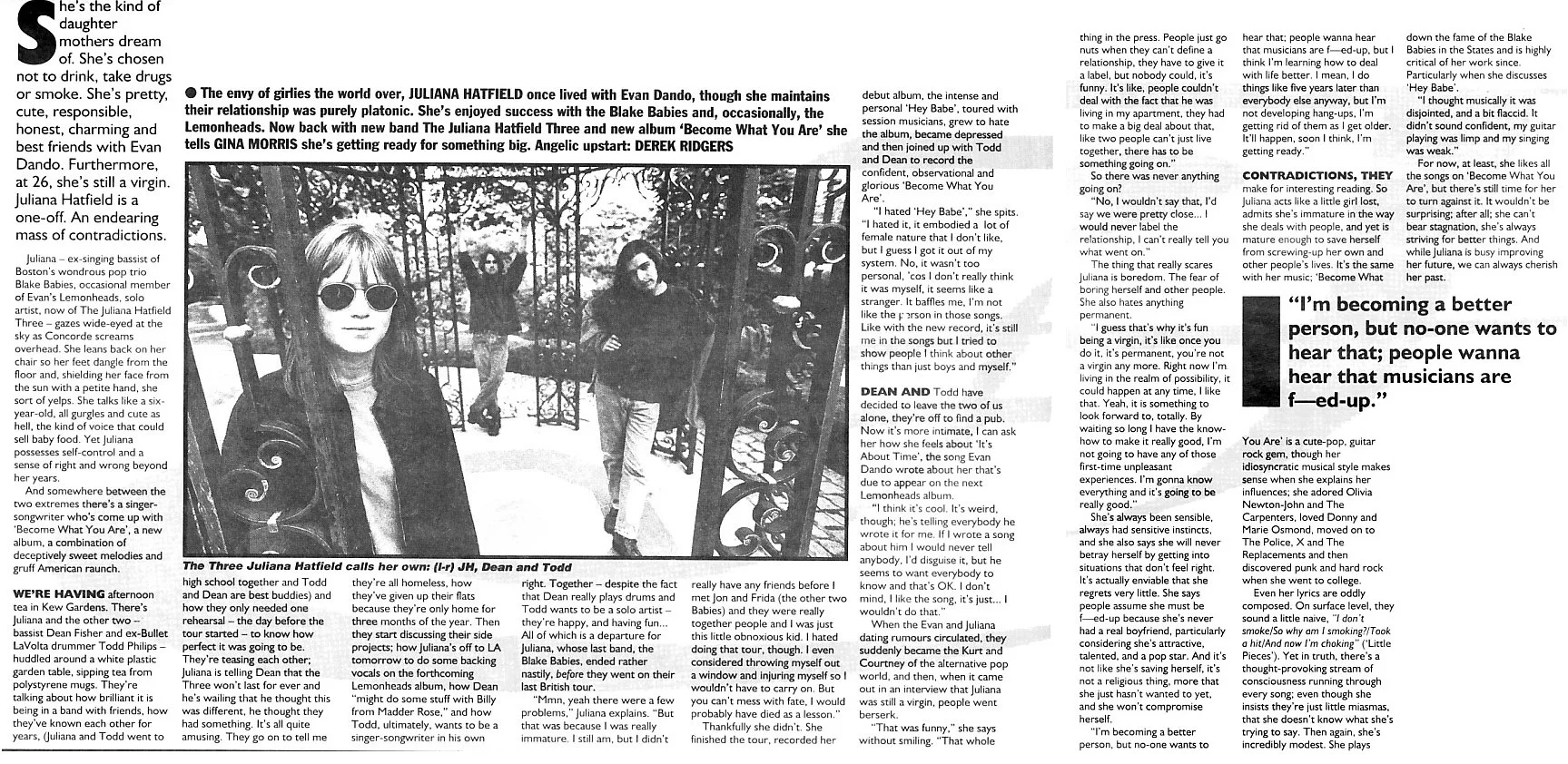
She's the kind of daughter mothers dream of. She's chosen not to drink, take drugs or smoke. She's pretty, cute, responsible, honest, charming and best friends with Evan Dando. Furthermore, at 26, she's still a virgin. Juliana Hatfield is a one-off. An endearing mass of contradictions.
Juliana — ex-singing bassist of Boston's wondrous pop trio Blake Babies, occasional member of Evan's Lemonheads, solo artist, now of The Juliana Hatfield Three — gazes wide-eyed at the sky as Concorde screams overhead. She leans back on her chair so her feet dangle from the floor and, shielding her face from the sun with a petite hand, she sort of yelps. She talks like a six-year-old, all gurgles and cute as hell, the kind of voice that could sell baby food. Yet Juliana possesses self-control and a sense of right and wrong beyond her years.
And somewhere between the two extremes there's a singer-songwriter who's come up with Become What You Are, a new album, a combination of deceptively sweet melodies and gruff American raunch.
The envy of girlies the world over, JULIANA HATFIELD once lived with Evan Dando, though she maintains their relationship was purely platonic. She's enjoyed success with the Blake Babies and, occasionally, the Lemonheads. Now back with new band The Juliana Hatfield Three and new album Become What You Are she tells GINA MORRIS she's getting ready for something big. Angelic upstart: DEREK RIDGERS
The Three Juliana Hatfield calls her own: (l-r) JH, Dean and Todd
WE'RE HAVING afternoon tea in Kew Gardens. There's Juliana and the other two — bassist Dean Fisher and ex-Bullet LaVolta drummer Todd Philips — huddled around a white plastic garden table, sipping tea from polystyrene mugs. They're talking about how brilliant it is being in a band with friends, how they've known each other for years, (Juliana and Todd went to high school together and Todd and Dean are best buddies) and how they only needed one rehearsal — the day before the tour started — to know how perfect it was going to be.
They're teasing each other; Juliana is telling Dean that the Three won't last for ever and he's wailing that he thought this was different, he thought they had something. It's all quite amusing. They go on to tell me they're all homeless, how they've given up their flats because they're only home for three months of the year. Then they start discussing their side projects; how Juliana's off to LA tomorrow to do some backing vocals on the forthcoming Lemonheads album, how Dean might do some stuff with Billy from Madder Rose, and how Todd, ultimately, wants to be a singer-songwriter in his own right. Together — despite the fact that Dean really plays drums and Todd wants to be a solo artist — they're happy, and having fun...
All of which is a departure for Juliana, whose last band, the Blake Babies, ended rather nastily, before they went on their last British tour.
“Mmn, yeah there were a few problems,” Juliana explains. “But that was because I was really immature. I still am, but I didn't really have any friends before I met Jon and Frida (the other two Babies) and they were really together people and I was just this little obnoxious kid. I hated doing that tour, though. I even considered throwing myself out a window and injuring myself so I wouldn't have to carry on. But you can't mess with fate, I would probably have died as a lesson.”
Thankfully she didn't. She finished the tour, recorded her debut album, the intense and personal Hey Babe, toured with session musicians, grew to hate the album, became depressed and then joined up with Todd and Dean to record the confident, observational and glorious Become What You Are.
“I hated Hey Babe,” she spits. “I hated it, it embodied a lot of female nature that I don't like, but I guess I got it out of my system. No, it wasn't too personal, 'cos I don't really think it was myself, it seems like a stranger. It baffles me, I'm not like the person in those songs. Like with the new record, it's still me in the songs but I tried to show people I think about other things than just boys and myself.”
DEAN AND Todd have decided to leave the two of us alone, they're off to find a pub. Now it's more intimate, I can ask her how she feels about It's About Time, the song Evan Dando wrote about her that's due to appear on the next Lemonheads album.
“I think it's cool. It's weird, though; he's telling everybody he wrote it for me. If I wrote a song about him I would never tell anybody, I'd disguise it, but he seems to want everybody to know and that's OK. I don't mind, I like the song, it's just... I wouldn't do that.”
When the Evan and Juliana dating rumours circulated, they suddenly became the Kurt and Courtney of the alternative pop world, and then, when it came out in an interview that Juliana was still a virgin, people went berserk.
“That was funny,” she says without smiling. “That whole thing in the press. People just go nuts when they can't define a relationship, they have to give it a label, but nobody could, it's funny. It's like, people couldn't deal with the fact that he was living in my apartment, they had to make a big deal about that, like two people can't just live together, there has to be something going on.”
So there was never anything going on?
“No, I wouldn't say that, I'd say we were pretty close... I would never label the relationship, I can't really tell you what went on.”
The thing that really scares Juliana is boredom. The fear of boring herself and other people. She also hates anything permanent.
“I guess that's why it's fun being a virgin, it's like once you do it, it's permanent, you're not a virgin any more. Right now I'm living in the realm of possibility, it could happen at any time, I like that. Yeah, it is something to look forward to, totally. By waiting so long I have the know-how to make it really good, I'm not going to have any of those first-time unpleasant experiences. I'm gonna know everything and it's going to be really good.”
She's always been sensible, always had sensitive instincts, and she also says she will never betray herself by getting into situations that don't feel right. It's actually enviable that she regrets very little. She says people assume she must be f—ed-up because she's never had a real boyfriend, particularly considering she's attractive, talented, and a pop star. And it's not like she's saving herself, it's not a religious thing, more that she just hasn't wanted to yet, and she won't compromise herself.
“I'm becoming a better person, but no-one wants to hear that; people wanna hear that musicians are f—ed-up, but I think I'm learning how to deal with life better. I mean, I do things like five years later than everybody else anyway, but I'm not developing hang-ups, I'm getting rid of them as I get older. It'll happen, soon I think, I'm getting ready.”
CONTRADICTIONS, THEY make for interesting reading. So Juliana acts like a little girl lost, admits she's immature in the way she deals with people, and yet is mature enough to save herself from screwing-up her own and other people's lives. It's the same with her music; Become What You Are is a cute-pop, guitar rock gem, though her idiosyncratic musical style makes sense when she explains her influences; she adored Olivia Newton-John and The Carpenters, loved Donny and Marie Osmond, moved on to The Police, X and The Replacements and then discovered punk and hard rock when she went to college.
Even her lyrics are oddly composed. On surface level, they sound a little naive, “I don't smoke/So why am I smoking?/Took a hit/And now I'm choking” (Little Pieces). Yet in truth, there's a thought-provoking stream of consciousness running through every song; even though she insists they're just little miasmas, that she doesn't know what she's trying to say. Then again, she's incredibly modest. She plays down the fame of the Blake Babies in the States and is highly critical of her work since. Particularly when she discusses Hey Babe.
“I thought musically it was disjointed, and a bit flaccid. It didn't sound confident, my guitar playing was limp and my singing was weak.”
For now, at least, she likes all the songs on Become What You Are, but there's still time for her to turn against it. It wouldn't be surprising; after all, she can't bear stagnation, she's always striving for better things. And while Juliana is busy improving her future, we can always cherish her past.
Rolling Stone - September 1993
"I can't stand auditioning people. It's so depressing 'cause most people suck. And, um, most people suck. It's just much more fun to play with friends."
Show transcriptHide transcript
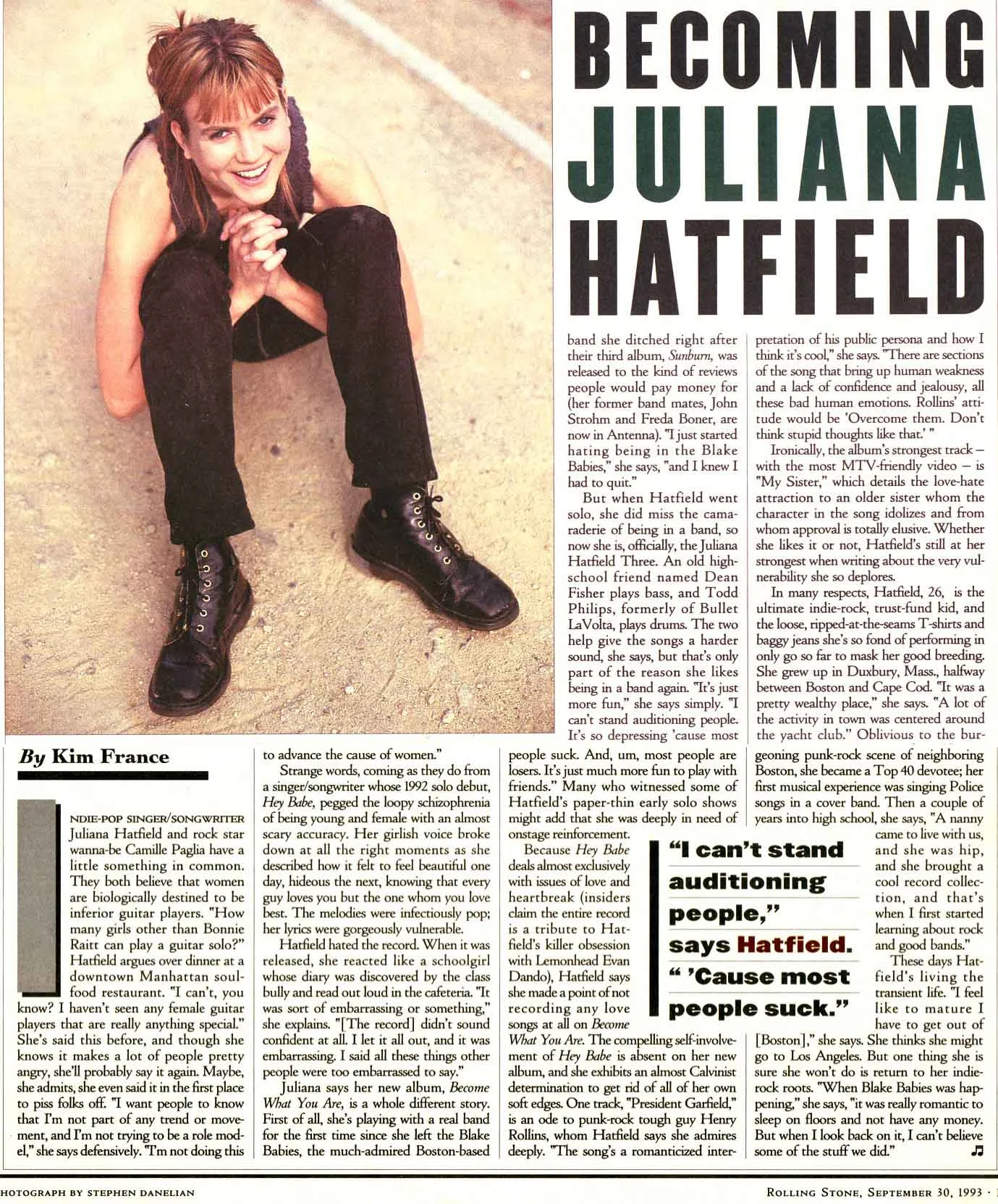
Becoming Juliana Hatfield
Rolling Stone, September 30, 1993
By Kim France
Indie-pop singer/songwriter Juliana Hatfield and rock star wanna-be Camille Paglia have a little something in common. They both believe that women are biologically destined to be inferior guitar players. “How many girls other than Bonnie Raitt can play a guitar solo?” Hatfield argues over dinner at a downtown Manhattan soul-food restaurant. “I can’t, you know? I haven’t seen any female guitar players that are really anything special.”
She’s said this before, and though she knows it makes a lot of people pretty angry, she’ll probably say it again. Maybe, she admits, she even said it in the first place to piss folks off. “I want people to know that I’m not part of any trend or movement, and I’m not trying to be a role model,” she says defensively. “I’m not doing this to advance the cause of women.”
Strange words, coming as they do from a singer/songwriter whose 1992 solo debut, Hey Babe, pegged the loopy schizophrenia of being young and female with an almost scary accuracy. Her girlish voice broke down at all the right moments as she described how it felt to feel beautiful one day, hideous the next, knowing that every guy loves you but the one whom you love best. The melodies were infectiously pop; her lyrics were gorgeously vulnerable.
Hatfield hated the record. When it was released, she reacted like a schoolgirl whose diary was discovered by the class bully and read out loud in the cafeteria. “It was sort of embarrassing or something,” she explains. “[The record] didn’t sound confident at all. I let it all out, and it was embarrassing. I said all these things other people were too embarrassed to say.”
Juliana says her new album, Become What You Are, is a whole different story. First of all, she’s playing with a real band for the first time since she left the Blake Babies, the much-admired Boston-based band she ditched right after their third album, Sunburn, was released to the kind of reviews people would pay money for (her former band mates, John Strohm and Freda Boner, are now in Antenna). “I just started hating being in the Blake Babies,” she says, “and I knew I had to quit.”
But when Hatfield went solo, she did miss the camaraderie of being in a band, so now she is, officially, the Juliana Hatfield Three. An old high-school friend named Dean Fisher plays bass, and Todd Philips, formerly of Bullet LaVolta, plays drums. The two help give the songs a harder sound, she says, but that’s only part of the reason she likes being in a band again. “It’s just more fun,” she says simply. “I can’t stand auditioning people. It’s so depressing ’cause most people suck. And, um, most people are losers. It’s just much more fun to play with friends.” Many who witnessed some of Hatfield’s paper-thin early solo shows might add that she was deeply in need of onstage reinforcement.
Because Hey Babe deals almost exclusively with issues of love and heartbreak (insiders claim the entire record is a tribute to Hatfield’s killer obsession with Lemonhead Evan Dando), Hatfield says she made a point of not recording any love songs at all on Become What You Are. The compelling self-involvement of Hey Babe is absent on her new album, and she exhibits an almost Calvinist determination to get rid of all of her own soft edges. One track, “President Garfield,” is an ode to punk-rock tough guy Henry Rollins, whom Hatfield says she admires deeply. “The song’s a romanticized interpretation of his public persona and how I think it’s cool,” she says. “There are sections of the song that bring up human weakness and a lack of confidence and jealousy, all these bad human emotions. Rollins’ attitude would be ‘Overcome them. Don’t think stupid thoughts like that.’ ”
Ironically, the album’s strongest track—with the most MTV-friendly video—is “My Sister,” which details the love-hate attraction to an older sister whom the character in the song idolizes and from whom approval is totally elusive. Whether she likes it or not, Hatfield’s still at her strongest when writing about the very vulnerability she so deplores.
In many respects, Hatfield, 26, is the ultimate indie-rock, trust-fund kid, and the loose, ripped-at-the-seams T-shirts and baggy jeans she’s so fond of performing in only go so far to mask her good breeding. She grew up in Duxbury, Mass., halfway between Boston and Cape Cod. “It was a pretty wealthy place,” she says. “A lot of the activity in town was centered around the yacht club.” Oblivious to the burgeoning punk-rock scene of neighboring Boston, she became a Top 40 devotee; her first musical experience was singing Police songs in a cover band. Then a couple of years into high school, she says, “A nanny came to live with us, and she was hip, and she brought a cool record collection, and that’s when I first started learning about rock and good bands.”
These days Hatfield’s living the transient life. “I feel like to mature I have to get out of [Boston],” she says. She thinks she might go to Los Angeles. But one thing she is sure she won’t do is return to her indie-rock roots. “When Blake Babies was happening,” she says, “it was really romantic to sleep on floors and not have any money. But when I look back on it, I can’t believe some of the stuff we did.”
Photograph by Stephen Danelian
Mojo - 1993
A short news piece circa Become What You Are.
Thanks to Rob for scanning this.
Show transcriptHide transcript
This Just In…
Mojo, 1993
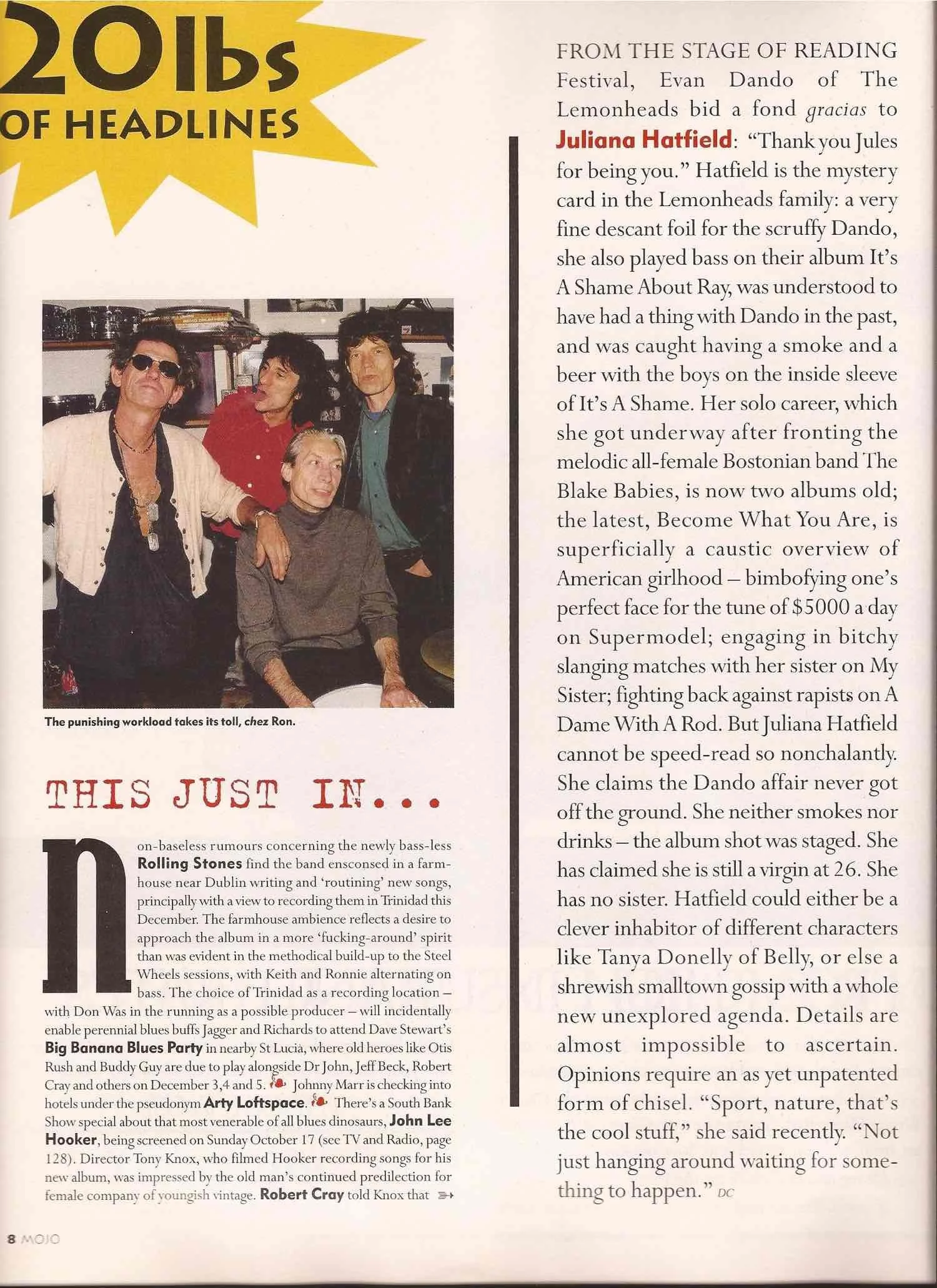
From the stage of Reading Festival, Evan Dando of The Lemonheads bid a fond gracias to Juliana Hatfield: “Thank you Jules for being you.” Hatfield is the mystery card in the Lemonheads family: a very fine descant foil for the scruffy Dando, she also played bass on their album It’s A Shame About Ray, was understood to have had a thing with Dando in the past, and was caught having a smoke and a beer with the boys on the inside sleeve of It’s A Shame. Her solo career, which she got underway after fronting the melodic all-female Bostonian band The Blake Babies, is now two albums old; the latest, Become What You Are, is superficially a caustic overview of American girlhood — bimbofying one’s perfect face for the tune of $5000 a day on Supermodel; engaging in bitchy slanging matches with her sister on My Sister; fighting back against rapists on A Dame With A Rod. But Juliana Hatfield cannot be speed-read so nonchalantly.
She claims the Dando affair never got off the ground. She neither smokes nor drinks — the album shot was staged. She has claimed she is still a virgin at 26. She has no sister. Hatfield could either be a clever inhabitor of different characters like Tanya Donelly of Belly, or else a shrewish smalltown gossip with a whole new unexplored agenda. Details are almost impossible to ascertain.
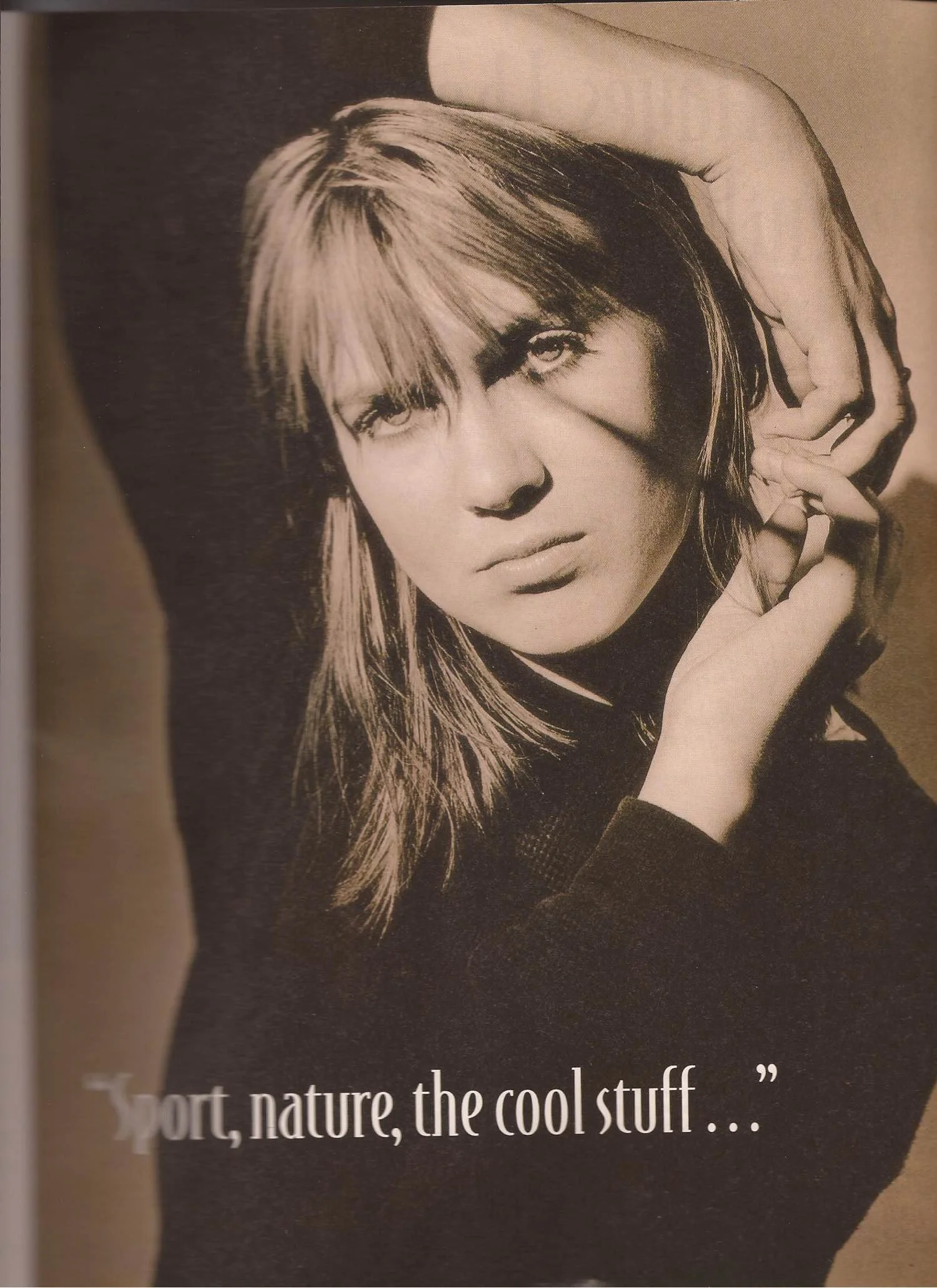
Opinions require an as yet unpatented form of chisel. “Sport, nature, that’s the cool stuff,” she said recently. “Not just hanging around waiting for something to happen.”
— DC
Melody Maker - August 1993
Juliana talks about 10 of her favourite songs
"When (Dinosaur Jr - You're Living All Over Me) first came out, it sounded so otherworldly, like J was an alien that had created a new kind of music on another planet and they'd dropped it on us earthlings like a bomb."
Show transcriptHide transcript
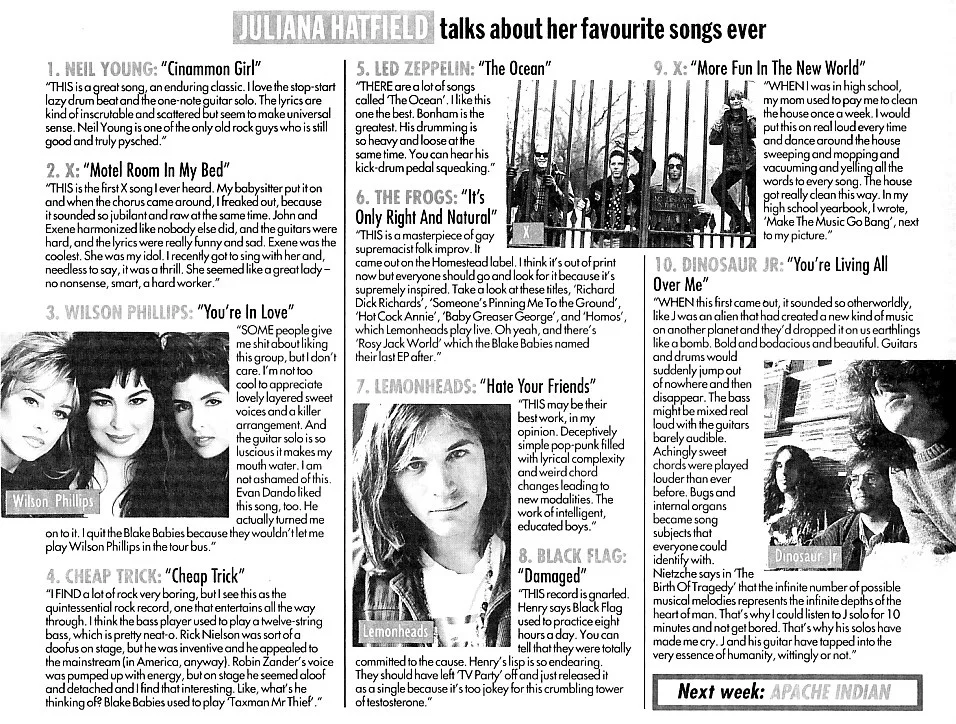
Juliana Hatfield Talks About Her Favourite Songs Ever
Melody Maker, 28 August 1993
1. Neil Young: “Cinnamon Girl”
“THIS is a great song, an enduring classic. I love the stop-start lazy drum beat and the one-note guitar solo. The lyrics are kind of inscrutable and scattered but seem to make universal sense. Neil Young is one of the only old rock guys who is still good and truly psyched.”
2. X: “Motel Room In My Bed”
“THIS is the first X song I ever heard. My babysitter put it on and when the chorus came around, I freaked out, because it sounded so jubilant and raw at the same time. John and Exene harmonized like nobody else did, and the guitars were hard, and the lyrics were really funny and sad. Exene was the coolest. She was my idol. I recently got to sing with her and, needless to say, it was a thrill. She seemed like a great lady—no nonsense, smart, a hard worker.”
3. Wilson Phillips: “You’re In Love”
“SOME people give me shit about liking this group, but I don’t care. I’m not too cool to appreciate lovely layered sweet voices and a killer arrangement. And the guitar solo is so luscious it makes my mouth water. I am not ashamed of this. Evan Dando liked this song, too. He actually turned me on to it. I quit the Blake Babies because they wouldn’t let me play Wilson Phillips in the tour bus.”
4. Cheap Trick: “Cheap Trick”
“I FIND a lot of rock very boring, but I see this as the quintessential rock record, one that entertains all the way through. I think the bass player used to play a twelve-string bass, which is pretty neat-o. Rick Nielson was sort of a doofus on stage, but he was inventive and he appealed to the mainstream (in America, anyway). Robin Zander’s voice was pumped up with energy, but on stage he seemed aloof and detached and I find that interesting. Like, what’s he thinking of? Blake Babies used to play ‘Taxman Mr Thief’.”
5. Led Zeppelin: “The Ocean”
“THERE are a lot of songs called ‘The Ocean’. I like this one the best. Bonham is the greatest. His drumming is so heavy and loose at the same time. You can hear his kick-drum pedal squeaking.”
6. The Frogs: “It’s Only Right And Natural”
“THIS is a masterpiece of gay supremacist folk improv. It came out on the Homestead label. I think it’s out of print now but everyone should go and look for it because it’s supremely inspired. Take a look at these titles, ‘Richard Dick Richards’, ‘Someone’s Pinning Me To the Ground’, ‘Hot Cock Annie’, ‘Baby Greaser George’, and ‘Homos’, which Lemonheads play live. Oh yeah, and there’s ‘Rosy Jack World’ which the Blake Babies named their last EP after.”
7. Lemonheads: “Hate Your Friends”
“THIS may be their best work, in my opinion. Deceptively simple pop-punk filled with lyrical complexity and weird chord changes leading to new modalities. The work of intelligent, educated boys.”
8. Black Flag: “Damaged”
“THIS record is gnarled. Henry says Black Flag used to practice eight hours a day. You can tell that they were totally committed to the cause. Henry’s lisp is so endearing. They should have left ‘TV Party’ off and just released it as a single because it’s too jokey for this crumbling tower of testosterone.”
9. X: “More Fun In The New World”
“WHEN I was in high school, my mom used to pay me to clean the house once a week. I would put this on real loud every time and dance around the house sweeping and mopping and vacuuming and yelling all the words to every song. The house got really clean this way. In my high school yearbook, I wrote, ‘Make The Music Go Bang’, next to my picture.”
10. Dinosaur Jr.: “You’re Living All Over Me”
“WHEN this first came out, it sounded so otherworldly, like J was an alien that had created a new kind of music on another planet and they’d dropped it on us earthlings like a bomb. Bold and bodacious and beautiful. Guitars and drums would suddenly jump out of nowhere and then disappear. The bass might be mixed real loud with the guitars barely audible. Achingly sweet chords were played louder than ever before. Bugs and internal organs became song subjects that everyone could identify with. Nietzsche says in ‘The Birth Of Tragedy’ that the infinite number of possible musical melodies represents the infinite depths of the heart of man. That’s why I could listen to J solo for 10 minutes and not get bored. That’s why his solos have made me cry. J and his guitar have tapped into the very essence of humanity, wittingly or not.”
Next week: Apache Indian
Select - September 1993
Select magazine interview with The Juliana Hatfield Three
"I find a lot of English music really lets me down. There's a lot of style but not a great deal of substance. I love Radiohead and I love PJ Harvey though. I love early Smiths."
Show transcriptHide transcript
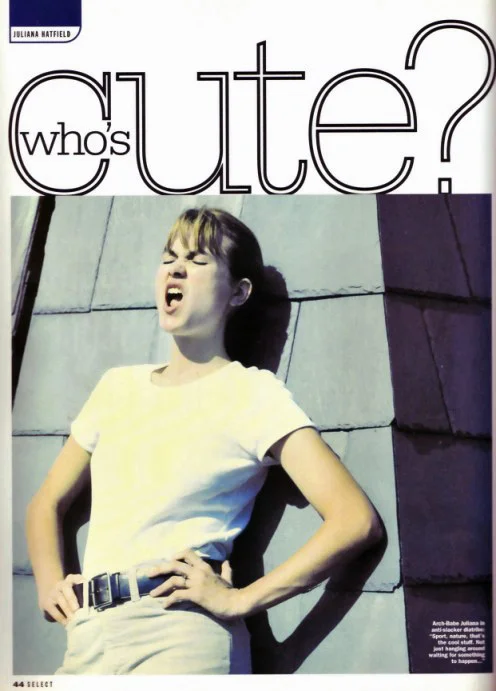
Who's Cute?
Arch-Babe Juliana in anti-slacker diatribe: “Sport, nature, that's the cool stuff. Not just hanging around waiting for something to happen...”
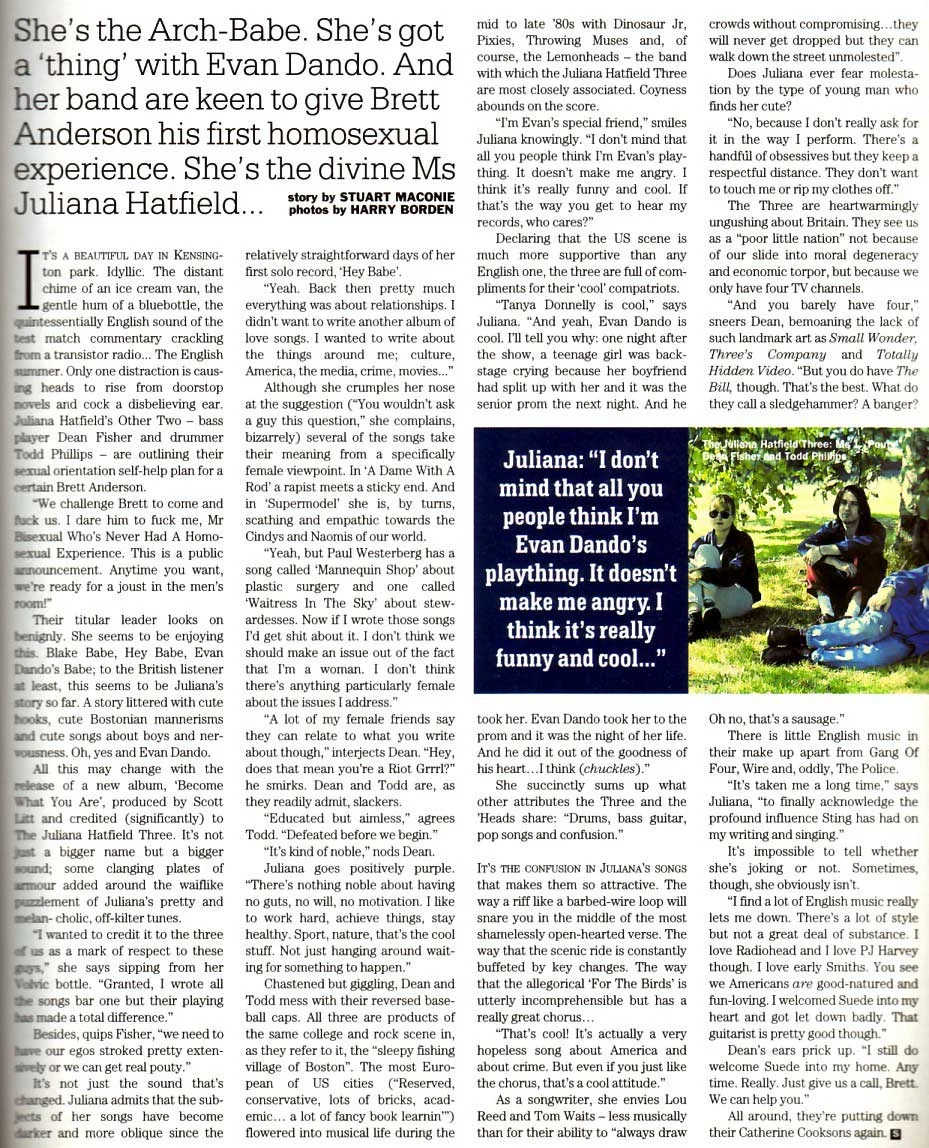
She's the Arch-Babe. She's got a ‘thing’ with Evan Dando. And her band are keen to give Brett Anderson his first homosexual experience. She's the divine Ms Juliana Hatfield...
Story by Stuart Maconie
Photos by Harry Borden
It's a beautiful day in Kensington park. Idyllic. The distant chime of an ice cream van, the gentle hum of a bluebottle, the quintessentially English sound of the test match commentary crackling from a transistor radio... The English summer. Only one distraction is causing heads to rise from doorstep novels and cock a disbelieving ear. Juliana Hatfield's Other Two — bass player Dean Fisher and drummer Todd Phillips — are outlining their sexual orientation self-help plan for a certain Brett Anderson.
“We challenge Brett to come and fuck us. I dare him to fuck me, Mr Bisexual Who's Never Had A Homosexual Experience. This is a public announcement. Anytime you want, we're ready for a joust in the men's room!”
Their titular leader looks on benignly. She seems to be enjoying this. Blake Babe, Hey Babe, Evan Dando's Babe; to the British listener at least, this seems to be Juliana's story so far. A story littered with cute looks, cute Bostonian mannerisms and cute songs about boys and nervousness. Oh, yes and Evan Dando.
All this may change with the release of a new album, ‘Become What You Are’, produced by Scott Litt and credited (significantly) to The Juliana Hatfield Three. It's not just a bigger name but a bigger sound; some clanging plates of armour added around the waiflike puzzlement of Juliana's pretty and melancholic, off-kilter tunes.
“I wanted to credit it to the three of us as a mark of respect to these guys,” she says sipping from her Volvic bottle. “Granted, I wrote all the songs bar one but their playing has made a total difference.”
Besides, quips Fisher, “we need to have our egos stroked pretty extensively or we can get real pouty.”
It's not just the sound that's changed. Juliana admits that the subjects of her songs have become darker and more oblique since the relatively straightforward days of her first solo record, ‘Hey Babe’.
“Yeah. Back then pretty much everything was about relationships. I didn't want to write another album of love songs. I wanted to write about the things around me; culture, America, the media, crime, movies...”
Although she crumples her nose at the suggestion (“You wouldn't ask a guy this question,” she complains, bizarrely) several of the songs take their meaning from a specifically female viewpoint. In ‘A Dame With A Rod’ a rapist meets a sticky end. And in ‘Supermodel’ she is, by turns, scathing and empathic towards the Cindys and Naomis of our world.
“Yeah, but Paul Westerberg has a song called ‘Mannequin Shop’ about plastic surgery and one called ‘Waitress In The Sky’ about stewardesses. Now if I wrote those songs I'd get shit about it. I don't think we should make an issue out of the fact that I'm a woman. I don't think there's anything particularly female about the issues I address.”
“A lot of my female friends say they can relate to what you write about though,” interjects Dean. “Hey, does that mean you're a Riot Grrrl?” he smirks. Dean and Todd are, as they readily admit, slackers.
“Educated but aimless,” agrees Todd. “Defeated before we begin.”
“It's kind of noble,” nods Dean.
Juliana goes positively purple. “There's nothing noble about having no guts, no will, no motivation. I like to work hard, achieve things, stay healthy. Sport, nature, that's the cool stuff. Not just hanging around waiting for something to happen.”
Chastened but giggling, Dean and Todd mess with their reversed baseball caps. All three are products of the same college and rock scene in, as they refer to it, the “sleepy fishing village of Boston”. The most European of US cities (“Reserved, conservative, lots of bricks, academic... a lot of fancy book learnin'”) flowered into musical life during the mid to late ’80s with Dinosaur Jr, Pixies, Throwing Muses and, of course, the Lemonheads — the band with which the Juliana Hatfield Three are most closely associated. Coyness abounds on the score.
“I'm Evan's special friend,” smiles Juliana knowingly. “I don't mind that all you people think I'm Evan's plaything. It doesn't make me angry. I think it's really funny and cool. If that's the way you get to hear my records, who cares?”
Declaring that the US scene is much more supportive than any English one, the three are full of compliments for their ‘cool’ compatriots.
“Tanya Donnelly is cool,” says Juliana. “And yeah, Evan Dando is cool. I'll tell you why: one night after the show, a teenage girl was backstage crying because her boyfriend had split up with her and it was the senior prom the next night. And he took her. Evan Dando took her to the prom and it was the night of her life. And he did it out of the goodness of his heart... I think (chuckles).”
Photo caption: The Juliana Hatfield Three — Ms H, Dean Fisher and Todd Phillips.
Juliana: “I don't mind that all you people think I'm Evan Dando's plaything. It doesn't make me angry. I think it's really funny and cool...”
She succinctly sums up what other attributes the Three and the ‘Heads share: “Drums, bass guitar, pop songs and confusion.”
It's the confusion in Juliana's songs that makes them so attractive. The way a riff like a barbed-wire loop will snare you in the middle of the most shamelessly open-hearted verse. The way that the scenic ride is constantly buffeted by key changes. The way that the allegorical ‘For The Birds’ is utterly incomprehensible but has a really great chorus...
“That's cool! It's actually a very hopeless song about America and about crime. But even if you just like the chorus, that's a cool attitude.”
As a songwriter, she envies Lou Reed and Tom Waits — less musically than for their ability to “always draw crowds without compromising... they will never get dropped but they can walk down the street unmolested”.
Does Juliana ever fear molestation by the type of young man who finds her cute?
“No, because I don't really ask for it in the way I perform. There's a handful of obsessives but they keep a respectful distance. They don't want to touch me or rip my clothes off.”
The Three are heartwarmingly ungushing about Britain. They see us as a “poor little nation” not because of our slide into moral degeneracy and economic torpor, but because we only have four TV channels.
“And you barely have four,” sneers Dean, bemoaning the lack of such landmark art as Small Wonder, Three's Company and Totally Hidden Video. “But you do have The Bill, though. That's the best. What do they call a sledgehammer? A banger?”
“Oh no, that's a sausage.”
There is little English music in their make up apart from Gang Of Four, Wire and, oddly, The Police.
“It's taken me a long time,” says Juliana, “to finally acknowledge the profound influence Sting has had on my writing and singing.”
It's impossible to tell whether she's joking or not. Sometimes, though, she obviously isn't.
“I find a lot of English music really lets me down. There's a lot of style but not a great deal of substance. I love Radiohead and I love PJ Harvey though. I love early Smiths. You see we Americans are good-natured and fun-loving. I welcomed Suede into my heart and got let down badly. That guitarist is pretty good though.”
Dean's ears prick up. “I still do welcome Suede into my home. Any time. Really. Just give us a call, Brett. We can help you.”
All around, they're putting down their Catherine Cooksons again. ■
Lime Lizard - October 1993
Interview with English magazine Lime Lizard
"People don't have tach, they don't realise that you don't want to answer questions about music at certain times, like after you've just played a bad show."
Show transcriptHide transcript
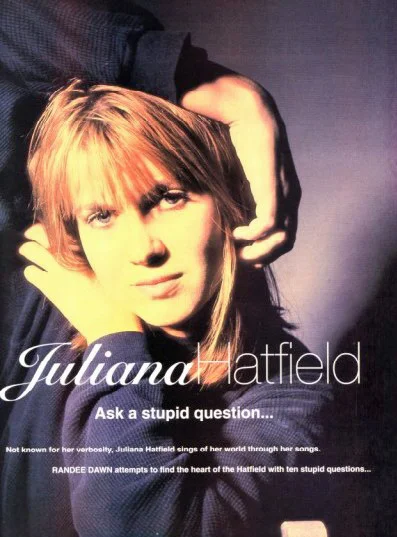
Juliana Hatfield
Ask a stupid question…
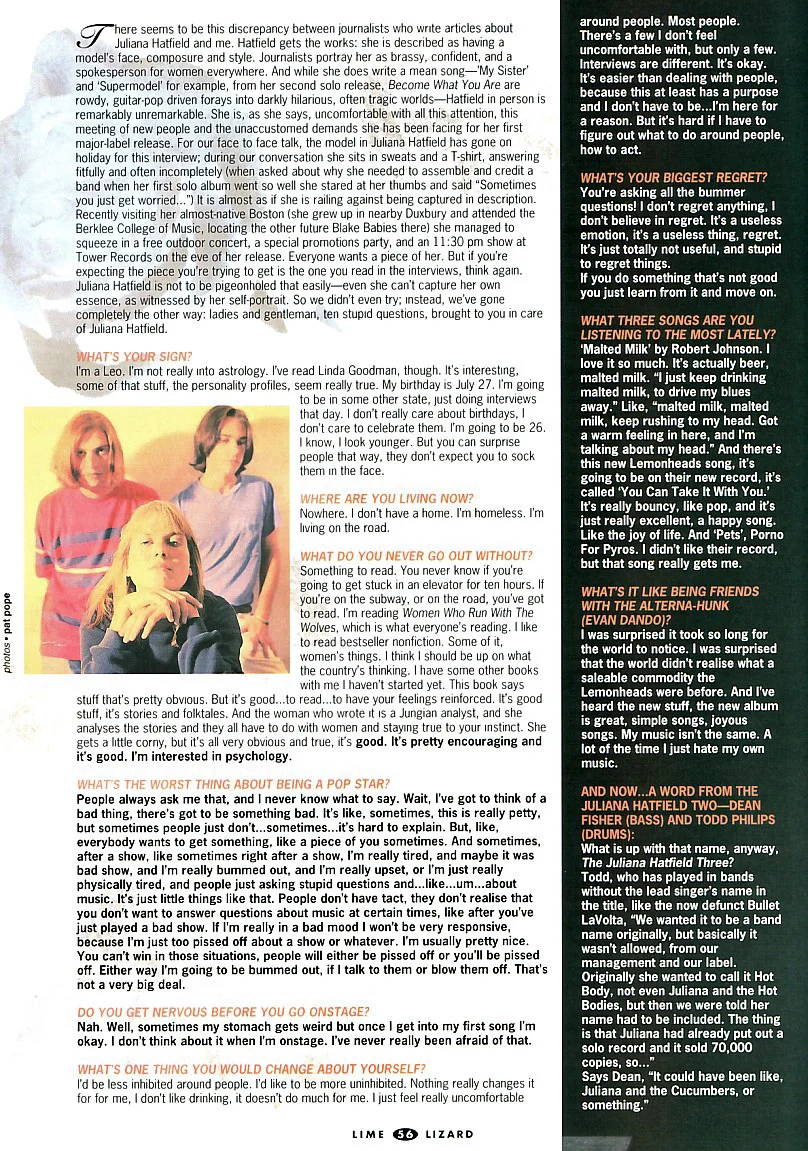
Not known for her verbosity, Juliana Hatfield sings of her world through her songs.
Randee Dawn attempts to find the heart of the Hatfield with ten stupid questions…
There seems to be this discrepancy between journalists who write articles about Juliana Hatfield and me. Hatfield gets the works: she is described as having a model’s face, composure and style. Journalists portray her as brassy, confident, and a spokesperson for women everywhere. And while she does write a mean song—‘My Sister’ and ‘Supermodel’ for example, from her second solo release, Become What You Are are rowdy, guitar-pop driven forays into darkly hilarious, often tragic worlds—Hatfield in person is remarkably unremarkable. She is, as she says, uncomfortable with all this attention, this meeting of new people and the unaccustomed demands she has been facing for her first major-label release. For our face to face talk, the model in Juliana Hatfield has gone on holiday for this interview; during our conversation she sits in sweats and a T-shirt, answering fitfully and often incompletely (when asked about why she needed to assemble and credit a band when her first solo album went so well she stared at her thumbs and said “Sometimes you just get worried…”) It is almost as if she is railing against being captured in description.
Recently visiting her almost-native Boston (she grew up in nearby Duxbury and attended the Berklee College of Music, locating the other future Blake Babies there) she managed to squeeze in a free outdoor concert, a special promotions party, and an 11:30 pm show at Tower Records on the eve of her release. Everyone wants a piece of her. But if you’re expecting the piece you’re trying to get is the one you read in the interviews, think again. Juliana Hatfield is not to be pigeonholed that easily—even she can’t capture her own essence, as witnessed by her self-portrait. So we didn’t even try; instead, we’ve gone completely the other way: ladies and gentleman, ten stupid questions, brought to you in care of Juliana Hatfield.
What’s your sign?
I’m a Leo. I’m not really into astrology. I’ve read Linda Goodman, though. It’s interesting, some of that stuff, the personality profiles, seem really true. My birthday is July 27. I’m going to be in some other state, just doing interviews that day. I don’t really care about birthdays, I don’t care to celebrate them. I’m going to be 26. I know, I look younger. But you can surprise people that way, they don’t expect you to sock them in the face.
Where are you living now?
Nowhere. I don’t have a home. I’m homeless. I’m living on the road.
What do you never go out without?
Something to read. You never know if you’re going to get stuck in an elevator for ten hours. If you’re on the subway, or on the road, you’ve got to read. I’m reading Women Who Run With The Wolves, which is what everyone’s reading. I like to read bestseller nonfiction. Some of it, women’s things. I think I should be up on what the country’s thinking. I have some other books with me I haven’t started yet. This book says stuff that’s pretty obvious. But it’s good…to read…to have your feelings reinforced. It’s good stuff, it’s stories and folktales. And the woman who wrote it is a Jungian analyst, and she analyses the stories and they all have to do with women and staying true to your instinct. She gets a little corny, but it’s all very obvious and true, it’s good. It’s pretty encouraging and it’s good. I’m interested in psychology.
What’s the worst thing about being a pop star?
People always ask me that, and I never know what to say. Wait, I’ve got to think of a bad thing, there’s got to be something bad. It’s like, sometimes, this is really petty, but sometimes people just don’t…sometimes…it’s hard to explain. But, like, everybody wants to get something, like a piece of you sometimes. And sometimes, after a show, like sometimes right after a show, I’m really tired, and maybe it was bad show, and I’m really bummed out, and I’m really upset, or I’m just really physically tired, and people just asking stupid questions and…like…um…about music. It’s just little things like that. People don’t have tact, they don’t realise that you don’t want to answer questions about music at certain times, like after you’ve just played a bad show. If I’m really in a bad mood I won’t be very responsive, because I’m just too pissed off about a show or whatever. I’m usually pretty nice. You can’t win in those situations, people will either be pissed off or you’ll be pissed off. Either way I’m going to be bummed out, if I talk to them or blow them off. That’s not a very big deal.
Do you get nervous before you go onstage?
Nah. Well, sometimes my stomach gets weird but once I get into my first song I’m okay. I don’t think about it when I’m onstage. I’ve never really been afraid of that.
What’s one thing you would change about yourself?
I’d be less inhibited around people. I’d like to be more uninhibited. Nothing really changes it for for me, I don’t like drinking, it doesn’t do much for me. I just feel really uncomfortable around people. Most people. There’s a few I don’t feel uncomfortable with, but only a few. Interviews are different. It’s okay. It’s easier than dealing with people, because this at least has a purpose and I don’t have to be…I’m here for a reason. But it’s hard if I have to figure out what to do around people, how to act.
What’s your biggest regret?
You’re asking all the bummer questions! I don’t regret anything, I don’t believe in regret. It’s a useless emotion, it’s a useless thing, regret. It’s just totally not useful, and stupid to regret things. If you do something that’s not good you just learn from it and move on.
What three songs are you listening to the most lately?
‘Malted Milk’ by Robert Johnson. I love it so much. It’s actually beer, malted milk. “I just keep drinking malted milk, to drive my blues away.” Like, “malted milk, malted milk, keep rushing to my head. Got a warm feeling in here, and I’m talking about my head.” And there’s this new Lemonheads song, it’s going to be on their new record, it’s called ‘You Can Take It With You.’ It’s really bouncy, like pop, and it’s just really excellent, a happy song. Like the joy of life. And ‘Pets’, Porno For Pyros. I didn’t like their record, but that song really gets me.
What’s it like being friends with the alterna-hunk (Evan Dando)?
I was surprised it took so long for the world to notice. I was surprised that the world didn’t realise what a saleable commodity the Lemonheads were before. And I’ve heard the new stuff, the new album is great, simple songs, joyous songs. My music isn’t the same. A lot of the time I just hate my own music.
And now…a word from the Juliana Hatfield Two—Dean Fisher (bass) and Todd Philips (drums):
What is up with that name, anyway, The Juliana Hatfield Three?
Todd, who has played in bands without the lead singer’s name in the title, like the now defunct Bullet LaVolta, “We wanted it to be a band name originally, but basically it wasn’t allowed, from our management and our label. Originally she wanted to call it Hot Body, not even Juliana and the Hot Bodies, but then we were told her name had to be included. The thing is that Juliana had already put out a solo record and it sold 70,000 copies, so…”
Says Dean, “It could have been like, Juliana and the Cucumbers, or something.”
Photos: Pat Pope.
Discorder - October 1993
"(On The Juliana Hatfield Three) I wanted people to know there was a band but I can't deal with band names."
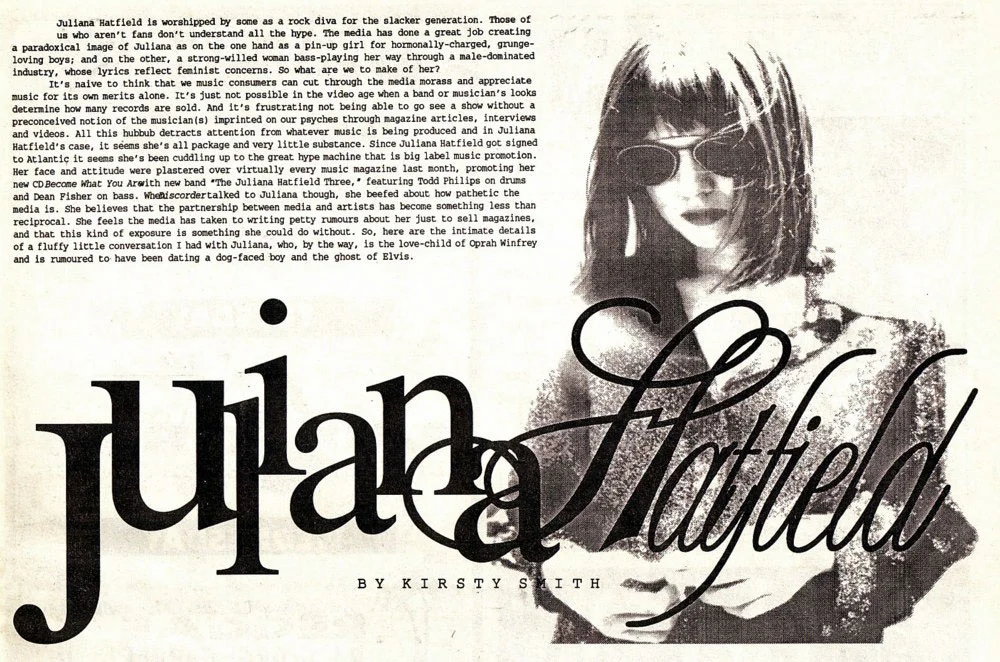
Show transcriptHide transcript
Juliana Hatfield
By Kirsty Smith
Discorder, October 1993
Juliana Hatfield is worshipped by some as a rock diva for the slacker generation. Those of us who aren’t fans don’t understand all the hype. The media has done a great job creating a paradoxical image of Juliana as on the one hand as a pin-up girl for hormonally-charged, grunge-loving boys; and on the other, a strong-willed woman bass-playing her way through a male-dominated industry, whose lyrics reflect feminist concerns. So what are we to make of her?
It’s naive to think that we music consumers can cut through the media morass and appreciate music for its own merits alone. It’s just not possible in the video age when a band or musician’s looks determine how many records are sold. And it’s frustrating not being able to go see a show without a preconceived notion of the musician(s) imprinted on our psyches through magazine articles, interviews and videos. All this hubbub detracts attention from whatever music is being produced and in Juliana Hatfield’s case, it seems she’s all package and very little substance. Since Juliana Hatfield got signed to Atlantic it seems she’s been cuddling up to the great hype machine that is big label music promotion. Her face and attitude were plastered over virtually every music magazine last month, promoting her new CD Become What You Are with new band “The Juliana Hatfield Three,” featuring Todd Philips on drums and Dean Fisher on bass. When Discorder talked to Juliana though, she beefed about how pathetic the media is. She believes that the partnership between media and artists has become something less than reciprocal. She feels the media has taken to writing petty rumours about her just to sell magazines, and that this kind of exposure is something she could do without. So, here are the intimate details of a fluffy little conversation I had with Juliana, who, by the way, is the love-child of Oprah Winfrey and is rumoured to have been dating a dog-faced boy and the ghost of Elvis.
DISCORDER: You sound groggy.
JULIANA HATFIELD: No...my voice just gets like that.
Did you have a good night’s sleep?
Naww...about four hours. That’s about average these days, I can’t sleep much.
Too much stress?
I think it’s just because I’ve been travelling so much, like all over the world, that my body just doesn’t know when sleeping time is.
Does it bother you that you have to do interviews? Do you sometimes think that the music should be all you have to say?
Sometimes I think that, yeah. But interviews are a good opportunity to explain things that people might not have understood correctly.
Who thought up the name “The Juliana Hatfield Three?”
I think it was my idea. I think it’s kind of a bad name because it’s hard to say, it’s so long. I wanted people to know there was a band but I can’t deal with band names. I just think they’re all stupid and they get old really fast. I couldn’t live with any name.
What kind of job would you get if tomorrow all your musical ability was shot to hell?
I’d probably do some kind of physical labour where you can see the fruits of your work, like window washing or ditch digging or brick laying.
Why?
Cuz, I think it’s cool....,when you work physically....,(long drawn out pause of an incomplete thought)....,that kind of thing is hypnotizing.
What does “Riot Grrrl” mean to you?
I have no idea. I think it’s just a term the media made up. It’s just a label the media made up...so they can talk about something...(vague drift off).
Well, okay...this is kind of a personal question but what do you think of sex without love?
(Lotsa deliberation)...I think that for some people it works but I can’t do it. People are just different. Some people are just really sensitive that way and you know, whatever...people are just different.
What do you feel about women carrying guns for self-defence?
Well, I feel kind of torn about guns because you never know, if you have a gun maybe it will help to protect you but it could backfire, not literally, but, well...literally also, but the whole idea could backfire and the gun might fuck things up. You know what I mean? Someone else might get his hands on it or you might kill somebody you don’t want to kill. I don’t know, I feel weird about guns. They’re probably bad.
Yeah, they’re bad. But I walk in my neighbourhood sometimes with keys between my fingers and I think to myself “what’s this going to do if I’m really attacked or have a gun pointing at me?” Well, yeah, I’ve fantasized about that. That’s what the song “Dame With a Rod” is about. It’s about being able to defend myself if I’m attacked. It’s about killing the motherfucker who attacks me and that’s a fantasy but I don’t know if in the real world it could ever be so simple and perfect. I understand the feeling though. If you’re ever victimized you just want to shoot the motherfucker because he deserves it.
(At this point a small discussion ensued about “Take Back the Night” happening in Vancouver on Friday, Sept. 24 which led to talking about feeling safe on the streets as a woman, about Mia Zapata, lead singer of the Gits who was murdered not long ago. Juliana is a big fan of the Gits.)
Does it bother you that in virtually every article about you, you’re are referred to or inferred to be the girlfriend of Evan Dando (lead singer of the Lemonheads), when in articles on Evan you’re not mentioned....
No, it’s okay cuz I don’t see it in every article. I must read more articles than you. I think people are off the girlfriend thing... Evan and I collaborate musically a lot, so I think that people just mention us together because we do music together a lot. We are connected that way.
I guess you don’t see it but sometimes there’ll be these ridiculous graphics with, for example, you sitting in a chair with bubble hearts coming out of your head and a picture of Evan Dando in the top bubble...
Yeah, I’ve seen one picture like that. One. Have you seen more than one?
I’ve only seen one that graphic, but I’ve seen others equally as silly.
Yeah, that one was really stupid. (Juliana is getting heated) That one was really lame. But when things like that happen I try to forget about them. Because the media...I don’t want to give the media that much credit. I don’t want to let this upset me cuz they’re just pathetic and why should I let this pathetic stuff upset me? I have a more laid back attitude toward the media these days.
You just let it do what it wants?
It’s not reality and they’re lame. They have an impossible job. You can’t write about music. Writing about music doesn’t do it justice; the job is futile. I feel sorry for these people.
But it’s not so much talking about music, the media talks about you.
Yeah, but that’s cuz the job of describing music in words is impossible and nobody, only a few people can do it well and ummm...so they have to resort to writing about petty rumours and things. My attitude is like, I feel sorry for these people, they must have a lot of bitterness cuz they can’t do their job. If they have to write nasty things, I understand it cuz they’re bitter. They have to get readers, so they write about cheap thrills—that’s how you get people to read you.
Then why does it happen? Why do you have to do it? Does your record label put pressure on you?
No, I don’t have to do anything I don’t want to do. I just...I feel like if I do a lot of press now at this stage, it’ll help to sell records and then after a while I can stop doing it. Plus, I think it gives me an opportunity to explain misconceptions people have about me and so every once in a while I’m able to clear something up and that’s okay.
What are you going to do today?
Today? Okay, I have a schedule. I have to do one more interview, then I’m gonna go lie in the sun by the pool for an hour cuz I need sun...and then I have to go buy a guitar. I have to get another SG cuz I broke one and I need it and then I have to go to the radio station here (in L.A.) called KROC and then I go to soundcheck.
Alright Julie, thanks for talking and we’ll be seeing you in Vancouver in mid-September...
Yup. (click).
So there you have it folks. A snippet of conversational heaven with our beloved Juliana. Cut it out and sleep with it or take Juliana’s advice and trash it because it’s not really anyway. Juliana did open up a juicy debate about music criticism though. It is true that music is indescribable. How do you describe art? At best it’s an approximation, an interpretation, and completely subjective. But then, how do you ever describe anything? Words and letters are only constructs meant to help communicate ideas. They are at best approximations of reality but without them we’d be grunting, rutting, frustrated animals, wouldn’t we? So in describing music one is trying to communicate ideas about the music, opinions, not rigid definitions.
Juliana strikes me as a shrewd businesswoman who knows how to milk the media for all it’s worth, which is probably a wise thing since it’s likely we’ll be seeing Juliana laying some bricks in the near future. Then again, with her kind of press and the way it sells records she could be playing for a long time. The sad fact is she’s filling a niche; there aren’t a lot of women headlining their own pop/rock trios...so until then...
Melody Maker - November 1993
Juliana and Evan Dando interviewed by Melody Maker in November 1993 at what was probably the height of the annoying representation of Juliana in the music papers.
"Last night, there was a girl crying at our show. I always really love when people cry at my music....It's real. There's no faking it."
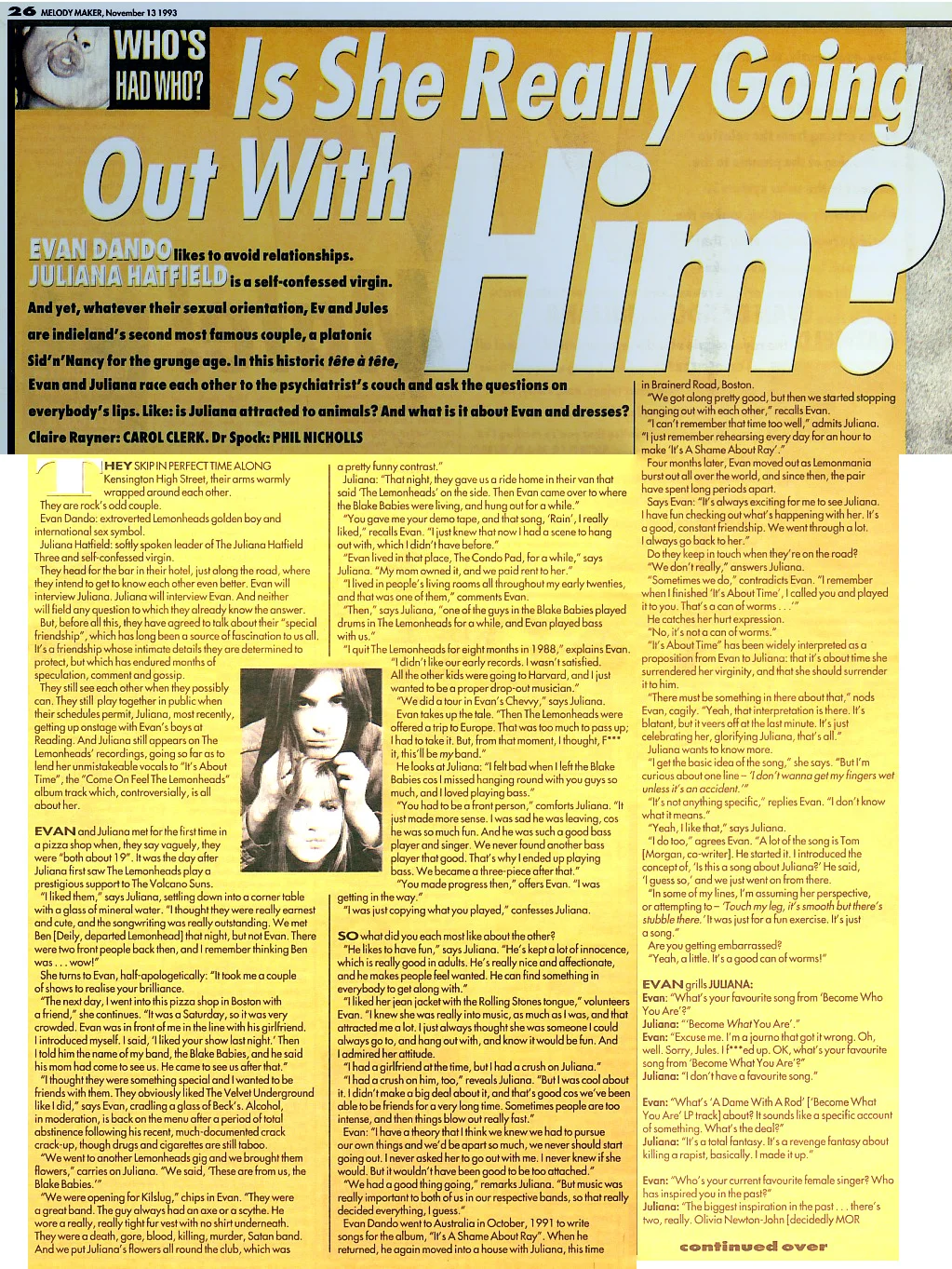
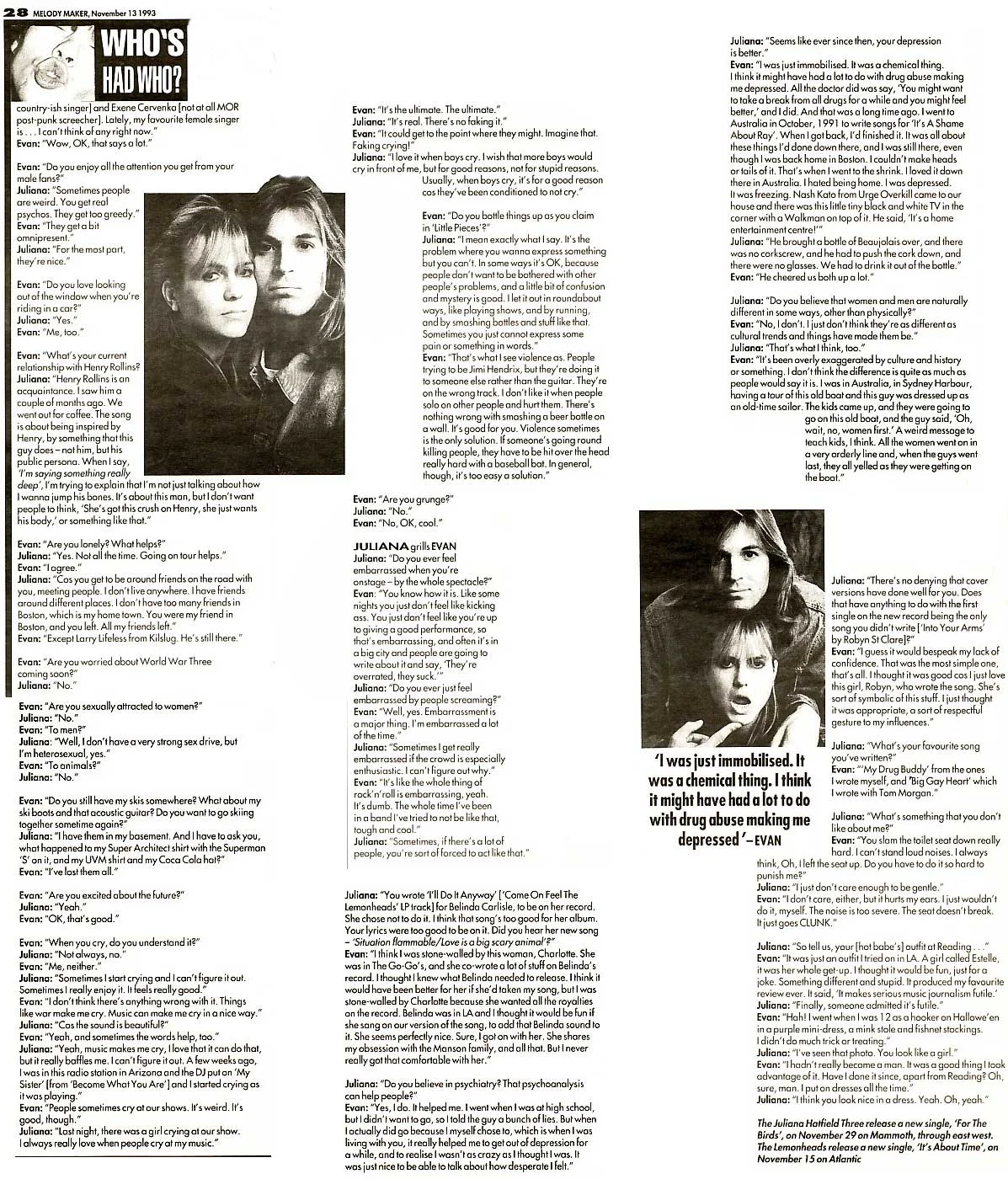
Show transcriptHide transcript
Is She Really Going Out With Him?
EVAN DANDO likes to avoid relationships.
JULIANA HATFIELD is a self-confessed virgin.
And yet, whatever their sexual orientation, Ev and Jules are indieland’s second most famous couple, a platonic Sid ’n’ Nancy for the grunge age. In this historic tête à tête, Evan and Juliana race each other to the psychiatrist’s couch and ask the questions on everybody’s lips. Like: is Juliana attracted to animals? And what is it about Evan and dresses?
Claire Rayner: CAROL CLERK. Dr Spock: PHIL NICHOLLS
THEY SKIP IN PERFECT TIME ALONG Kensington High Street, their arms warmly wrapped around each other.
They are rock’s odd couple.
Evan Dando: extroverted Lemonheads golden boy and international sex symbol.
Juliana Hatfield: softly spoken leader of The Juliana Hatfield Three and self-confessed virgin.
They head for the bar in their hotel, just along the road, where they intend to get to know each other even better. Evan will interview Juliana. Juliana will interview Evan. And neither will field any question to which they already know the answer.
But, before all this, they have agreed to talk about their “special friendship”, which has long been a source of fascination to us all. It’s a friendship whose intimate details they are determined to protect, but which has endured months of speculation, comment and gossip.
They still see each other when they possibly can. They still play together in public when their schedules permit, Juliana, most recently, getting up onstage with Evan’s boys at Reading. And Juliana still appears on The Lemonheads’ recordings, going so far as to lend her unmistakeable vocals to “It’s About Time”, the “Come On Feel The Lemonheads” album track which, controversially, is all about her.
EVAN and Juliana met for the first time in a pizza shop when, they say vaguely, they were “both about 19”. It was the day after Juliana first saw The Lemonheads play a prestigious support to The Volcano Suns.
“I liked them,” says Juliana, settling down into a corner table with a glass of mineral water. “I thought they were really earnest and cute, and the songwriting was really outstanding. We met Ben [Deily, departed Lemonhead] that night, but not Evan. There were two front people back then, and I remember thinking Ben was . . . wow!”
She turns to Evan, half-apologetically: “It took me a couple of shows to realise your brilliance.
“The next day, I went into this pizza shop in Boston with a friend,” she continues. “It was a Saturday, so it was very crowded. Evan was in front of me in the line with his girlfriend. I introduced myself. I said, ‘I liked your show last night.’ Then I told him the name of my band, the Blake Babies, and he said his mom had come to see us. He came to see us after that.”
“I thought they were something special and I wanted to be friends with them. They obviously liked The Velvet Underground like I did,” says Evan, cradling a glass of Beck’s. Alcohol, in moderation, is back on the menu after a period of total abstinence following his recent, much-documented crack crack-up, though drugs and cigarettes are still taboo.
“We went to another Lemonheads gig and we brought them flowers,” carries on Juliana. “We said, ‘These are from us, the Blake Babies.’”
“We were opening for Kilslug,” chips in Evan. “They were a great band. The guy always had an axe or a scythe. He wore a really, really tight fur vest with no shirt underneath. They were a death, gore, blood, killing, murder, Satan band. And we put Juliana’s flowers all round the club, which was a pretty funny contrast.”
Juliana: “That night, they gave us a ride home in their van that said ‘The Lemonheads’ on the side. Then Evan came over to where the Blake Babies were living, and hung out for a while.”
“You gave me your demo tape, and that song, ‘Rain’, I really liked,” recalls Evan. “I just knew that now I had a scene to hang out with, which I didn’t have before.”
“Evan lived in that place, The Condo Pad, for a while,” says Juliana. “My mom owned it, and we paid rent to her.”
“I lived in people’s living rooms all throughout my early twenties, and that was one of them,” comments Evan.
“Then,” says Juliana, “one of the guys in the Blake Babies played drums in The Lemonheads for a while, and Evan played bass with us.”
“I quit The Lemonheads for eight months in 1988,” explains Evan. “I didn’t like our early records. I wasn’t satisfied. All the other kids were going to Harvard, and I just wanted to be a proper drop-out musician.”
“We did a tour in Evan’s Chevy,” says Juliana.
Evan takes up the tale. “Then The Lemonheads were offered a trip to Europe. That was too much to pass up; I had to take it. But, from that moment, I thought, F*** it, this’ll be my band.”
He looks at Juliana: “I felt bad when I left the Blake Babies cos I missed hanging round with you guys so much, and I loved playing bass.”
“You had to be a front person,” comforts Juliana. “It just made more sense. I was sad he was leaving, cos he was so much fun. And he was such a good bass player and singer. We never found another bass player that good. That’s why I ended up playing bass. We became a three-piece after that.”
“You made progress then,” offers Evan. “I was getting in the way.”
“I was just copying what you played,” confesses Juliana.
SO what did you each most like about the other?
“He likes to have fun,” says Juliana. “He’s kept a lot of innocence, which is really good in adults. He’s really nice and affectionate, and he makes people feel wanted. He can find something in everybody to get along with.”
“I liked her jean jacket with the Rolling Stones tongue,” volunteers Evan. “I knew she was really into music, as much as I was, and that attracted me a lot. I just always thought she was someone I could always go to, and hang out with, and know it would be fun. And I admired her attitude.
“I had a girlfriend at the time, but I had a crush on Juliana.”
“I had a crush on him, too,” reveals Juliana. “But I was cool about it. I didn’t make a big deal about it, and that’s good cos we’ve been able to be friends for a very long time. Sometimes people are too intense, and then things blow out really fast.”
Evan: “I have a theory that I think we knew we had to pursue our own things and we’d be apart so much, we never should start going out. I never asked her to go out with me. I never knew if she would. But it wouldn’t have been good to be too attached.”
“We had a good thing going,” remarks Juliana. “But music was really important to both of us in our respective bands, so that really decided everything, I guess.”
Evan Dando went to Australia in October, 1991 to write songs for the album, “It’s A Shame About Ray”. When he returned, he again moved into a house with Juliana, this time in Brainerd Road, Boston.
“We got along pretty good, but then we started stopping hanging out with each other,” recalls Evan.
“I can’t remember that time too well,” admits Juliana. “I just remember rehearsing every day for an hour to make ‘It’s A Shame About Ray’.”
Four months later, Evan moved out as Lemonmania burst out all over the world, and since then, the pair have spent long periods apart.
Says Evan: “It’s always exciting for me to see Juliana. I have fun checking out what’s happening with her. It’s a good, constant friendship. We went through a lot. I always go back to her.”
Do they keep in touch when they’re on the road?
“We don’t really,” answers Juliana.
“Sometimes we do,” contradicts Evan. “I remember when I finished ‘It’s About Time’, I called you and played it to you. That’s a can of worms . . .”
He catches her hurt expression.
“No, it’s not a can of worms.”
“It’s About Time” has been widely interpreted as a proposition from Evan to Juliana: that it’s about time she surrendered her virginity, and that she should surrender it to him.
“There must be something in there about that,” nods Evan, cagily. “Yeah, that interpretation is there. It’s blatant, but it veers off at the last minute. It’s just celebrating her, glorifying Juliana, that’s all.”
Juliana wants to know more.
“I get the basic idea of the song,” she says. “But I’m curious about one line — ‘I don’t wanna get my fingers wet unless it’s an accident.’”
“It’s not anything specific,” replies Evan. “I don’t know what it means.”
“Yeah, I like that,” says Juliana.
“I do too,” agrees Evan. “A lot of the song is Tom [Morgan, co-writer]. He started it. I introduced the concept of, ‘Is this a song about Juliana?’ He said, ‘I guess so,’ and we just went on from there.
“In some of my lines, I’m assuming her perspective, or attempting to — ‘Touch my leg, it’s smooth but there’s stubble there.’ It was just for a fun exercise. It’s just a song.”
Are you getting embarrassed?
“Yeah, a little. It’s a good can of worms!”
EVAN grills JULIANA
Evan: “What’s your favourite song from ‘Become Who You Are’?”
Juliana: “‘Become What You Are’.”
Evan: “Excuse me. I’m a journo that got it wrong. Oh, well. Sorry, Jules. I f***ed up. OK, what’s your favourite song from ‘Become What You Are’?”
Juliana: “I don’t have a favourite song.”
Evan: “What’s ‘A Dame With A Rod’ [‘Become What You Are’ LP track] about? It sounds like a specific account of something. What’s the deal?”
Juliana: “It’s a total fantasy. It’s a revenge fantasy about killing a rapist, basically. I made it up.”
Evan: “Who’s your current favourite female singer? Who has inspired you in the past?”
Juliana: “The biggest inspiration in the past . . . there’s two, really. Olivia Newton-John [decidedly MOR country-ish singer] and Exene Cervenka [not at all MOR post-punk screecher]. Lately, my favourite female singer is . . . I can’t think of any right now.”
Evan: “Wow, OK, that says a lot.”
Evan: “Do you enjoy all the attention you get from your male fans?”
Juliana: “Sometimes people are weird. You get real psychos. They get too greedy.”
Evan: “They get a bit omnipresent.”
Juliana: “For the most part, they’re nice.”
Evan: “Do you love looking out of the window when you’re riding in a car?”
Juliana: “Yes.”
Evan: “Me, too.”
Evan: “What’s your current relationship with Henry Rollins?”
Juliana: “Henry Rollins is an acquaintance. I saw him a couple of months ago. We went out for coffee. The song is about being inspired by Henry, by something that this guy does — not him, but his public persona. When I say, ‘I’m saying something really deep’, I’m trying to explain that I’m not just talking about how I wanna jump his bones. It’s about this man, but I don’t want people to think, ‘She’s got this crush on Henry, she just wants his body,’ or something like that.”
Evan: “Are you lonely? What helps?”
Juliana: “Yes. Not all the time. Going on tour helps.”
Evan: “I agree.”
Juliana: “Cos you get to be around friends on the road with you, meeting people. I don’t live anywhere. I have friends around different places. I don’t have too many friends in Boston, which is my home town. You were my friend in Boston, and you left. All my friends left.”
Evan: “Except Larry Lifeless from Kilslug. He’s still there.”
Evan: “Are you worried about World War Three coming soon?”
Juliana: “No.”
Evan: “Are you sexually attracted to women?”
Juliana: “No.”
Evan: “To men?”
Juliana: “Well, I don’t have a very strong sex drive, but I’m heterosexual, yes.”
Evan: “To animals?”
Juliana: “No.”
Evan: “Do you still have my skis somewhere? What about my ski boots and that acoustic guitar? Do you want to go skiing together sometime again?”
Juliana: “I have them in my basement. And I have to ask you, what happened to my Super Architect shirt with the Superman ‘S’ on it, and my UVM shirt and my Coca Cola hat?”
Evan: “I’ve lost them all.”
Evan: “Are you excited about the future?”
Juliana: “Yeah.”
Evan: “OK, that’s good.”
Evan: “When you cry, do you understand it?”
Juliana: “Not always, no.”
Evan: “Me, neither.”
Juliana: “Sometimes I start crying and I can’t figure it out. Sometimes I really enjoy it. It feels really good.”
Evan: “I don’t think there’s anything wrong with it. Things like war make me cry. Music can make me cry in a nice way.”
Juliana: “Cos the sound is beautiful?”
Evan: “Yeah, and sometimes the words help, too.”
Juliana: “Yeah, music makes me cry, I love that it can do that, but it really baffles me. I can’t figure it out. A few weeks ago, I was in this radio station in Arizona and the DJ put on ‘My Sister’ [from ‘Become What You Are’] and I started crying as it was playing.”
Evan: “People sometimes cry at our shows. It’s weird. It’s good, though.”
Juliana: “Last night, there was a girl crying at our show. I always really love when people cry at my music.”
Evan: “It’s the ultimate. The ultimate.”
Juliana: “It’s real. There’s no faking it.”
Evan: “It could get to the point where they might. Imagine that. Faking crying!”
Juliana: “I love it when boys cry. I wish that more boys would cry in front of me, but for good reasons, not for stupid reasons. Usually, when boys cry, it’s for a good reason cos they’ve been conditioned to not cry.”
Evan: “Do you bottle things up as you claim in ‘Little Pieces’?”
Juliana: “I mean exactly what I say. It’s the problem where you wanna express something but you can’t. In some ways it’s OK, because people don’t want to be bothered with other people’s problems, and a little bit of confusion and mystery is good. I let it out in roundabout ways, like playing shows, and by running, and by smashing bottles and stuff like that. Sometimes you just cannot express some pain or something in words.”
Evan: “That’s what I see violence as. People trying to be Jimi Hendrix, but they’re doing it to someone else rather than the guitar. They’re on the wrong track. I don’t like it when people solo on other people and hurt them. There’s nothing wrong with smashing a beer bottle on a wall. It’s good for you. Violence sometimes is the only solution. If someone’s going round killing people, they have to be hit over the head really hard with a baseball bat. In general, though, it’s too easy a solution.”
Evan: “Are you grunge?”
Juliana: “No.”
Evan: “No, OK, cool.”
JULIANA grills EVAN
Juliana: “Do you ever feel embarrassed when you’re onstage — by the whole spectacle?”
Evan: “You know how it is. Like some nights you just don’t feel like kicking ass. You just don’t feel like you’re up to giving a good performance, so that’s embarrassing, and often it’s in a big city and people are going to write about it and say, ‘They’re overrated, they suck.’”
Juliana: “Do you ever just feel embarrassed by people screaming?”
Evan: “Well, yes. Embarrassment is a major thing. I’m embarrassed a lot of the time.”
Juliana: “Sometimes I get really embarrassed if the crowd is especially enthusiastic. I can’t figure out why.”
Evan: “It’s like the whole thing of rock ’n’ roll is embarrassing, yeah. It’s dumb. The whole time I’ve been in a band I’ve tried to not be like that, tough and cool.”
Juliana: “Sometimes, if there’s a lot of people, you’re sort of forced to act like that.”
Juliana: “You wrote ‘I’ll Do It Anyway’ [‘Come On Feel The Lemonheads’ LP track] for Belinda Carlisle, to be on her record. She chose not to do it. I think that song’s too good for her album. Your lyrics were too good to be on it. Did you hear her new song — ‘Situation flammable/Love is a big scary animal’?”
Evan: “I think I was stone-walled by this woman, Charlotte. She was in The Go-Go’s, and she co-wrote a lot of stuff on Belinda’s record. I thought I knew what Belinda needed to release. I think it would have been better for her if she’d taken my song, but I was stone-walled by Charlotte because she wanted all the royalties on the record. Belinda was in LA and I thought it would be fun if she sang on our version of the song, to add that Belinda sound to it. She seems perfectly nice. Sure, I got on with her. She shares my obsession with the Manson family, and all that. But I never really got that comfortable with her.”
Juliana: “Do you believe in psychiatry? That psychoanalysis can help people?”
Evan: “Yes, I do. It helped me. I went when I was at high school, but I didn’t want to go, so I told the guy a bunch of lies. But when I actually did go because I myself chose to, which is when I was living with you, it really helped me to get out of depression for a while, and to realise I wasn’t as crazy as I thought I was. It was just nice to be able to talk about how desperate I felt.”
Juliana: “Seems like ever since then, your depression is better.”
Evan: “I was just immobilised. It was a chemical thing. I think it might have had a lot to do with drug abuse making me depressed. All the doctor did was say, ‘You might want to take a break from all drugs for a while and you might feel better,’ and I did. And that was a long time ago. I went to Australia in October, 1991 to write songs for ‘It’s A Shame About Ray’. When I got back, I’d finished it. It was all about these things I’d done down there, and I was still there, even though I was back home in Boston. I couldn’t make heads or tails of it. That’s when I went to the shrink. I loved it down there in Australia. I hated being home. I was depressed. It was freezing. Nash Kato from Urge Overkill came to our house and there was this little tiny black and white TV in the corner with a Walkman on top of it. He said, ‘It’s a home entertainment centre!’”
Juliana: “He brought a bottle of Beaujolais over, and there was no corkscrew, and he had to push the cork down, and there were no glasses. We had to drink it out of the bottle.”
Evan: “He cheered us both up a lot.”
Juliana: “Do you believe that women and men are naturally different in some ways, other than physically?”
Evan: “No, I don’t. I just don’t think they’re as different as cultural trends and things have made them be.”
Juliana: “That’s what I think, too.”
Evan: “It’s been overly exaggerated by culture and history or something. I don’t think the difference is quite as much as people would say it is. I was in Australia, in Sydney Harbour, having a tour of this old boat and this guy was dressed up as an old-time sailor. The kids came up, and they were going to go on this old boat, and the guy said, ‘Oh, wait, no, women first.’ A weird message to teach kids, I think. All the women went on in a very orderly line and, when the guys went last, they all yelled as they were getting on the boat.”
Juliana: “There’s no denying that cover versions have done well for you. Does that have anything to do with the first single on the new record being the only song you didn’t write [‘Into Your Arms’ by Robyn St Clare]?”
Evan: “I guess it would bespeak my lack of confidence. That was the most simple one, that’s all. I thought it was good cos I just love this girl, Robyn, who wrote the song. She’s sort of symbolic of this stuff. I just thought it was appropriate, a sort of respectful gesture to my influences.”
Juliana: “What’s your favourite song you’ve written?”
Evan: “‘My Drug Buddy’ from the ones I wrote myself, and ‘Big Gay Heart’ which I wrote with Tom Morgan.”
Juliana: “What’s something that you don’t like about me?”
Evan: “You slam the toilet seat down really hard. I can’t stand loud noises. I always think, Oh, I left the seat up. Do you have to do it so hard to punish me?”
Juliana: “I just don’t care enough to be gentle.”
Evan: “I don’t care, either, but it hurts my ears. I just wouldn’t do it, myself. The noise is too severe. The seat doesn’t break. It just goes CLUNK.”
Juliana: “So tell us, your [hot babe’s] outfit at Reading . . .”
Evan: “It was just an outfit I tried on in LA. A girl called Estelle, it was her whole get-up. I thought it would be fun, just for a joke. Something different and stupid. It produced my favourite review ever. It said, ‘It makes serious music journalism futile.’”
Juliana: “Finally, someone admitted it’s futile.”
Evan: “Hah! I went when I was 12 as a hooker on Hallowe’en in a purple mini-dress, a mink stole and fishnet stockings. I didn’t do much trick or treating.”
Juliana: “I’ve seen that photo. You look like a girl.”
Evan: “I hadn’t really become a man. It was a good thing I took advantage of it. Have I done it since, apart from Reading? Oh, sure, man. I put on dresses all the time.”
Juliana: “I think you look nice in a dress. Yeah. Oh, yeah.”
The Juliana Hatfield Three release a new single, ‘For The Birds’, on November 29 on Mammoth, through east west. The Lemonheads release a new single, ‘It’s About Time’, on November 15 on Atlantic.
NME - December 1993
"It's so full of shit, the expectations people have of female artists. Basically you're either Belinda Carlisle or Courtney Love, and that sucks."
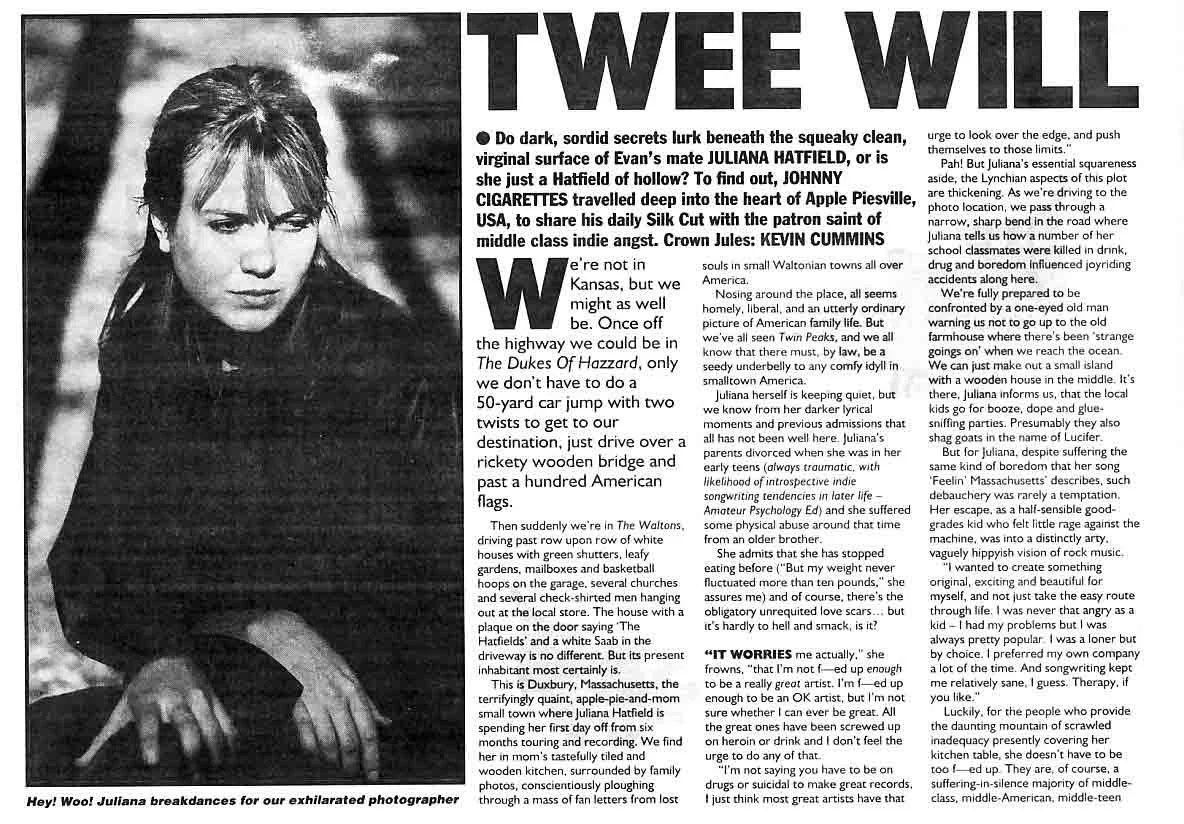
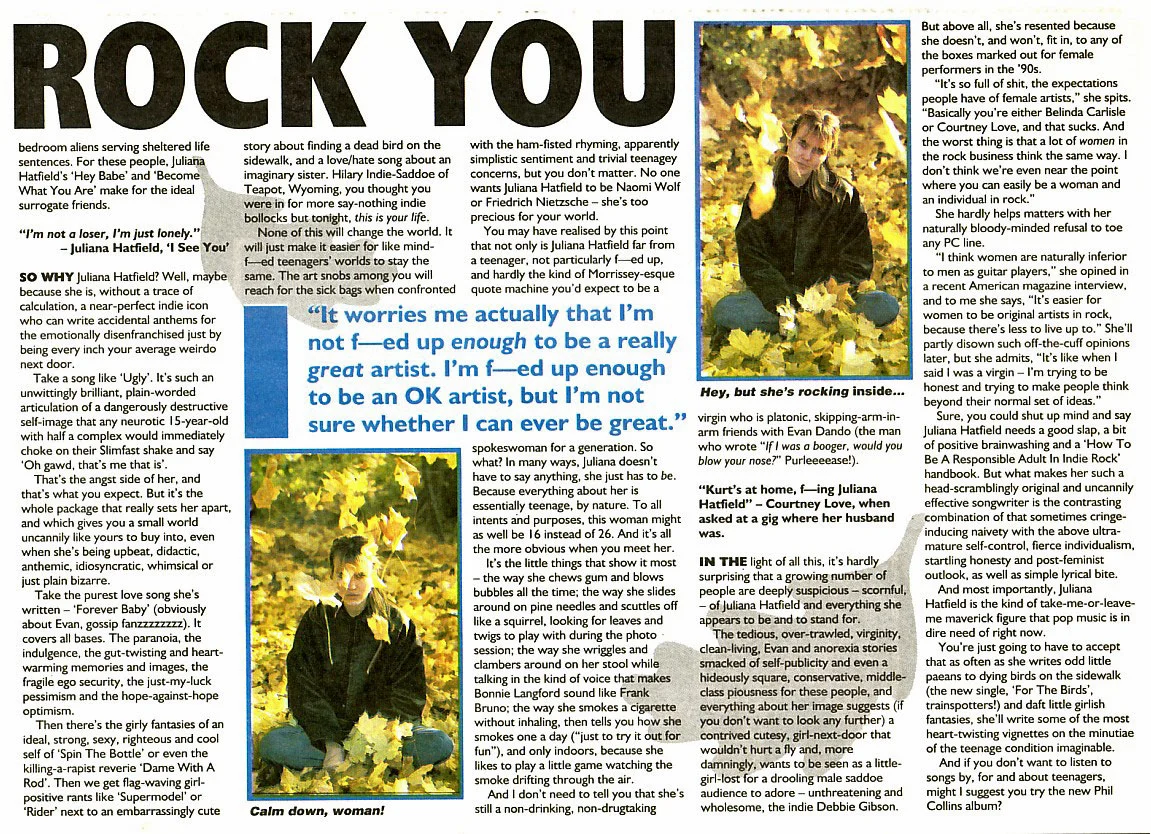
Show transcriptHide transcript
Twee Will Rock You
NME, 4 December 1993 — Johnny Cigarettes. Crown Jules: Kevin Cummins.
Do dark, sordid secrets lurk beneath the squeaky clean, virginal surface of Evan’s mate Juliana Hatfield, or is she just a Hatfield of hollow? To find out, Johnny Cigarettes travelled deep into the heart of Apple Piesville, USA, to share his daily Silk Cut with the patron saint of middle class indie angst.
We’re not in Kansas, but we might as well be. Once off the highway we could be in The Dukes Of Hazzard, only we don’t have to do a 50-yard car jump with two twists to get to our destination, just drive over a rickety wooden bridge and past a hundred American flags.
Then suddenly we’re in The Waltons, driving past row upon row of white houses with green shutters, leafy gardens, mailboxes and basketball hoops on the garage, several churches and several check-shirted men hanging out at the local store. The house with a plaque on the door saying ‘The Hatfields’ and a white Saab in the driveway is no different. But its present inhabitant most certainly is.
This is Duxbury, Massachusetts, the terrifyingly quaint, apple-pie-and-mom small town where Juliana Hatfield is spending her first day off from six months touring and recording. We find her in mom’s tastefully tiled and wooden kitchen, surrounded by family photos, conscientiously ploughing through a mass of fan letters from lost souls in small Waltonian towns all over America.
Nosing around the place, all seems homely, liberal, and an utterly ordinary picture of American family life. But we’ve all seen Twin Peaks, and we all know that there must, by law, be a seedy underbelly to any comfy idyll in smalltown America.
Juliana herself is keeping quiet, but we know from her darker lyrical moments and previous admissions that all has not been well here. Juliana’s parents divorced when she was in her early teens (always traumatic, with likelihood of introspective indie songwriting tendencies in later life — Amateur Psychology Ed) and she suffered some physical abuse around that time from an older brother.
She admits that she has stopped eating before (“But my weight never fluctuated more than ten pounds,” she assures me) and of course, there’s the obligatory unrequited love scars… but it’s hardly to hell and smack, is it?
“It worries me actually,” she frowns, “that I’m not f—ed up enough to be a really great artist. I’m f—ed up enough to be an OK artist, but I’m not sure whether I can ever be great. All the great ones have been screwed up on heroin or drink and I don’t feel the urge to do any of that.
“I’m not saying you have to be on drugs or suicidal to make great records, I just think most great artists have that urge to look over the edge, and push themselves to those limits.”
Pah! But Juliana’s essential squareness aside, the Lynchian aspects of this plot are thickening. As we’re driving to the photo location, we pass through a narrow, sharp bend in the road where Juliana tells us how a number of her school classmates were killed in drink, drug and boredom influenced joyriding accidents along here.
We’re fully prepared to be confronted by a one-eyed old man warning us not to go up to the old farmhouse where there’s been “strange goings on” when we reach the ocean. We can just make out a small island with a wooden house in the middle. It’s there, Juliana informs us, that the local kids go for booze, dope and glue-sniffing parties. Presumably they also shag goats in the name of Lucifer.
But for Juliana, despite suffering the same kind of boredom that her song ‘Feelin’ Massachusetts’ describes, such debauchery was rarely a temptation. Her escape, as a half-sensible good-grades kid who felt little rage against the machine, was into a distinctly arty, vaguely hippyish vision of rock music.
“I wanted to create something original, exciting and beautiful for myself, and not just take the easy route through life. I was never that angry as a kid — I had my problems but I was always pretty popular. I was a loner but by choice. I preferred my own company a lot of the time. And songwriting kept me relatively sane, I guess. Therapy, if you like.”
Luckily, for the people who provide the daunting mountain of scrawled inadequacy presently covering her kitchen table, she doesn’t have to be too f—ed up. They are, of course, a suffering-in-silence majority of middle-class, middle-American, middle-teen bedroom aliens serving sheltered life sentences. For these people, Juliana Hatfield’s Hey Babe and Become What You Are make for the ideal surrogate friends.
“I’m not a loser, I’m just lonely.”
— Juliana Hatfield, ‘I See You’
So why Juliana Hatfield? Well, maybe because she is, without a trace of calculation, a near-perfect indie icon who can write accidental anthems for the emotionally disenfranchised just by being every inch your average weirdo next door.
Take a song like ‘Ugly’. It’s such an unwittingly brilliant, plain-worded articulation of a dangerously destructive self-image that any neurotic 15-year-old with half a complex would immediately choke on their Slimfast shake and say ‘Oh gawd, that’s me that is’.
That’s the angst side of her, and that’s what you expect. But it’s the whole package that really sets her apart, and which gives you a small world uncannily like yours to buy into, even when she’s being upbeat, didactic, anthemic, idiosyncratic, whimsical or just plain bizarre.
Take the purest love song she’s written — ‘Forever Baby’ (obviously about Evan, gossip fanzzzzzzzz). It covers all bases. The paranoia, the indulgence, the gut-twisting and heart-warming memories and images, the fragile ego security, the just-my-luck pessimism and the hope-against-hope optimism.
Then there’s the girly fantasies of an ideal, strong, sexy, righteous and cool self of ‘Spin The Bottle’ or even the killing-a-rapist reverie ‘Dame With A Rod’. Then we get flag-waving girl-positive rants like ‘Supermodel’ or ‘Rider’ next to an embarrassingly cute story about finding a dead bird on the sidewalk, and a love/hate song about an imaginary sister. Hilary Indie-Saddoe of Teapot, Wyoming, you thought you were in for more say-nothing indie bollocks but tonight, this is your life.
None of this will change the world. It will just make it easier for like mind-f—ed teenagers’ worlds to stay the same. The art snobs among you will reach for the sick bags when confronted with the ham-fisted rhyming, apparently simplistic sentiment and trivial teenagey concerns, but you don’t matter. No one wants Juliana Hatfield to be Naomi Wolf or Friedrich Nietzsche — she’s too precious for your world.
“It worries me actually that I’m not f—ed up enough to be a really great artist. I’m f—ed up enough to be an OK artist, but I’m not sure whether I can ever be great.”
You may have realised by this point that not only is Juliana Hatfield far from a teenager, not particularly f—ed up, and hardly the kind of Morrissey-esque quote machine you’d expect to be a spokeswoman for a generation. So what? In many ways, Juliana doesn’t have to say anything, she just has to be. Because everything about her is essentially teenage, by nature. To all intents and purposes, this woman might as well be 16 instead of 26. And it’s all the more obvious when you meet her.
It’s the little things that show it most — the way she chews gum and blows bubbles all the time; the way she slides around on pine needles and scuttles off like a squirrel, looking for leaves and twigs to play with during the photo session; the way she wriggles and clambers around on her stool while talking in the kind of voice that makes Bonnie Langford sound like Frank Bruno; the way she smokes a cigarette without inhaling, then tells you how she smokes one a day (“just to try it out for fun”), and only indoors, because she likes to play a little game watching the smoke drifting through the air.
And I don’t need to tell you that she’s still a non-drinking, non-drug-taking virgin who is platonic, skipping-arm-in-arm friends with Evan Dando (the man who wrote “If I was a booger, would you blow your nose?” Purleeeease!).
“Kurt’s at home, f—ing Juliana Hatfield” — Courtney Love, when asked at a gig where her husband was.
In the light of all this, it’s hardly surprising that a growing number of people are deeply suspicious — scornful, even — of Juliana Hatfield and everything she appears to be and to stand for.
The tedious, over-trawled, virginity, clean-living, Evan and anorexia stories smacked of self-publicity and even a hideously square, conservative, middle-class piousness for these people, and everything about her image suggests (if you don’t want to look any further) a contrived cutesy, girl-next-door that wouldn’t hurt a fly and, more damningly, wants to be seen as a little-girl-lost for a drooling male saddoe audience to adore — unthreatening and wholesome, the indie Debbie Gibson.
But above all, she’s resented because she doesn’t, and won’t, fit in, to any of the boxes marked out for female performers in the ’90s.
“It’s so full of shit, the expectations people have of female artists,” she spits. “Basically you’re either Belinda Carlisle or Courtney Love, and that sucks. And the worst thing is that a lot of women in the rock business think the same way. I don’t think we’re even near the point where you can easily be a woman and an individual in rock.”
She hardly helps matters with her naturally bloody-minded refusal to toe any PC line.
“I think women are naturally inferior to men as guitar players,” she opined in a recent American magazine interview, and to me she says, “It’s easier for women to be original artists in rock, because there’s less to live up to.” She’ll partly disown such off-the-cuff opinions later, but she admits, “It’s like when I said I was a virgin — I’m trying to be honest and trying to make people think beyond their normal set of ideas.”
Sure, you could shut up and say Juliana Hatfield needs a good slap, a bit of positive brainwashing and a ‘How To Be A Responsible Adult In Indie Rock’ handbook. But what makes her such a head-scramblingly original and uncannily effective songwriter is the contrasting combination of that sometimes cringe-inducing naivety with the above ultra-mature self-control, fierce individualism, startling honesty and post-feminist outlook, as well as simple lyrical bite.
And most importantly, Juliana Hatfield is the kind of take-me-or-leave-me maverick figure that pop music is in dire need of right now.
You’re just going to have to accept that as often as she writes odd little paeans to dying birds on the sidewalk — (the new single, ‘For The Birds’, trainspotters!) and daft little girlish fantasies, she’ll write some of the most heart-twisting vignettes on the minutiae of the teenage condition imaginable.
And if you don’t want to listen to songs by, for and about teenagers, might I suggest you try the new Phil Collins album?
Picture captions
- Hey! Woo! Juliana breakdances for our exhilarated photographer
- Calm down, woman!
- Hey, but she’s rocking inside…
Vox - January 1994
Odd fact - the following quote from 1994 appeared in this interview with VOX in January 1994. In 2009 it started showing up on Twitter as a regularly repeated tweet, and which has continued years later. It's not clear how this line was lifted, out of context, but the origin seems to be here.
"If you want to achieve things in life, you've just got to do them, and if you're talented and smart, you'll succeed."
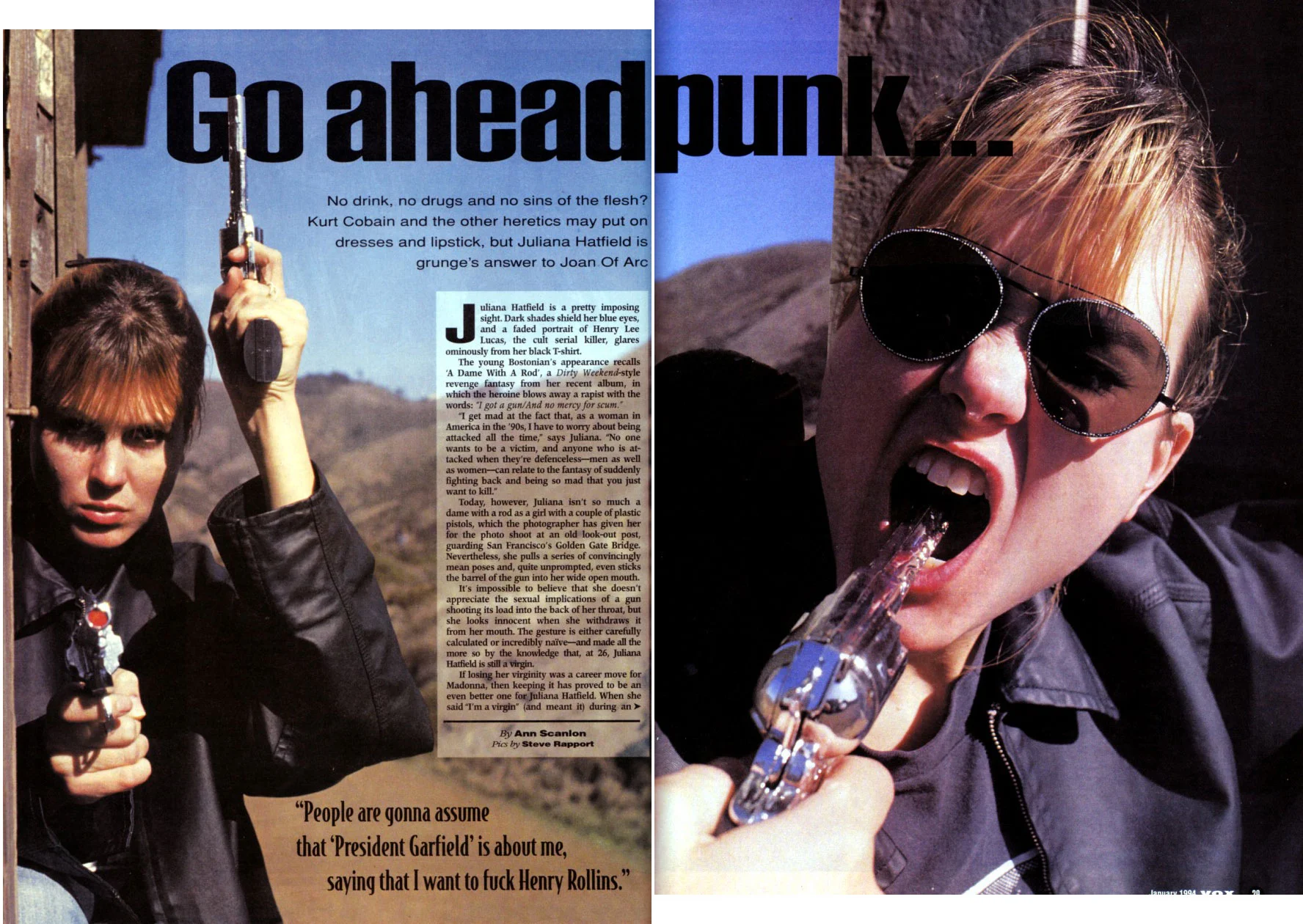
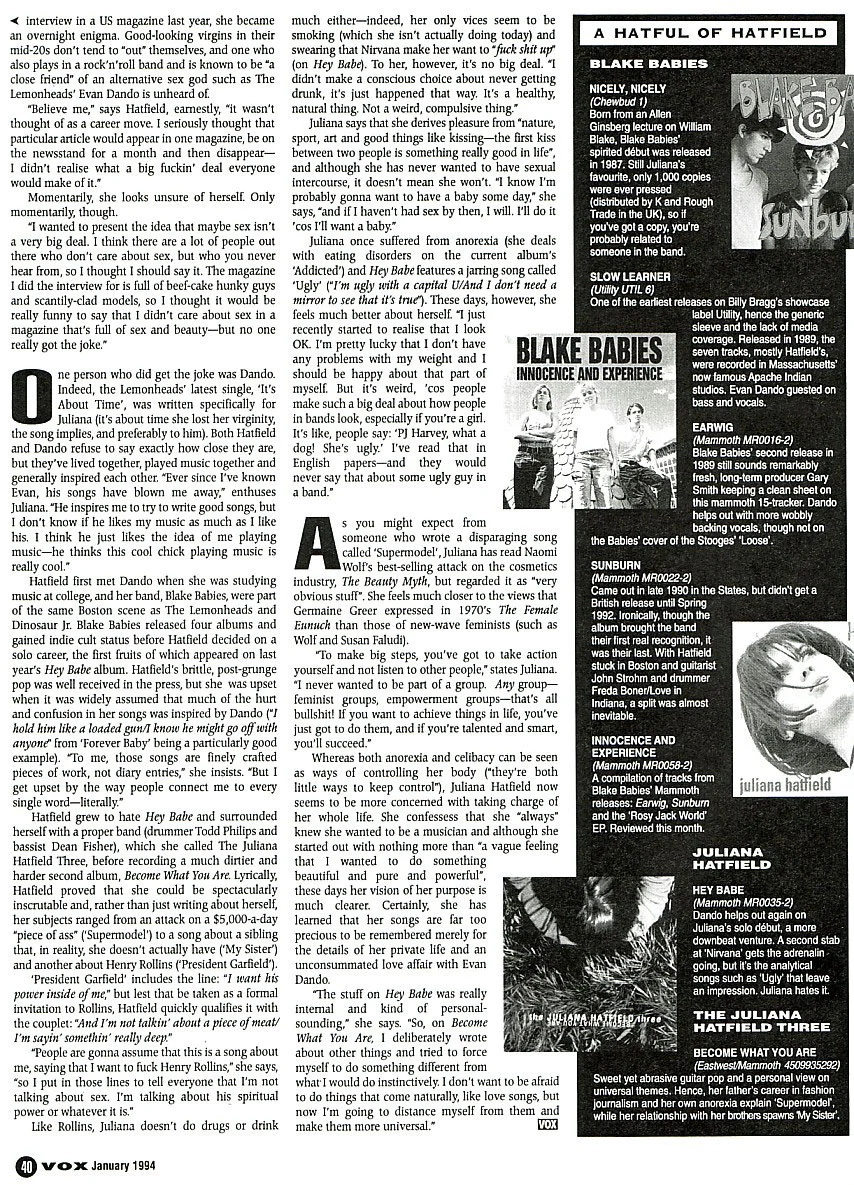
Show transcriptHide transcript
Go ahead punk…
No drink, no drugs and no sins of the flesh? Kurt Cobain and the other heretics may put on dresses and lipstick, but Juliana Hatfield is grunge’s answer to Joan Of Arc.
By Ann Scanlon
Pics by Steve Rapport
Juliana Hatfield is a pretty imposing sight. Dark shades shield her blue eyes, and a faded portrait of Henry Lee Lucas, the cult serial killer, glares ominously from her black T-shirt.
The young Bostonian’s appearance recalls ‘A Dame With A Rod’, a Dirty Weekend-style revenge fantasy from her recent album, in which the heroine blows away a rapist with the words: ‘I got a gun/And no mercy for scum.’
“I get mad at the fact that, as a woman in America in the ’90s, I have to worry about being attacked all the time,” says Juliana. “No one wants to be a victim, and anyone who is attacked when they’re defenceless—men as well as women—can relate to the fantasy of suddenly fighting back and being so mad that you just want to kill.”
Today, however, Juliana isn’t so much a dame with a rod as a girl with a couple of plastic pistols, which the photographer has given her for the photo shoot at an old look-out post, guarding San Francisco’s Golden Gate Bridge. Nevertheless, she pulls a series of convincingly mean poses and, quite unprompted, even sticks the barrel of the gun into her wide open mouth.
It’s impossible to believe that she doesn’t appreciate the sexual implications of a gun shooting its load into the back of her throat, but she looks innocent when she withdraws it from her mouth. The gesture is either carefully calculated or incredibly naïve—and made all the more so by the knowledge that, at 26, Juliana Hatfield is still a virgin.
If losing her virginity was a career move for Madonna, then keeping it has proved to be an even better one for Juliana Hatfield. When she said “I’m a virgin” (and meant it) during an interview in a US magazine last year, she became an overnight enigma. Good-looking virgins in their mid-20s don’t tend to “out” themselves, and one who also plays in a rock’n’roll band and is known to be “a close friend” of an alternative sex god such as The Lemonheads’ Evan Dando is unheard of.
“Believe me,” says Hatfield, earnestly, “it wasn’t thought of as a career move. I seriously thought that particular article would appear in one magazine, be on the newsstand for a month and then disappear—I didn’t realise what a big fuckin’ deal everyone would make of it.”
Momentarily, she looks unsure of herself. Only momentarily, though.
"I wanted to present the idea that maybe sex isn't a very big deal. I think there are a lot of people out there who don't care about sex, but who you never hear from, so I thought I should say it. The magazine I did the interview for is full of beef-cake hunky guys and scantily-clad models, so I thought it would be really funny to say that I didn't care about sex in a magazine that's full of sex and beauty—but no one really got the joke."
One person who did get the joke was Dando. Indeed, The Lemonheads' latest single, 'It's About Time', was written specifically for Juliana (it's about time she lost her virginity, the song implies, and preferably to him). Both Hatfield and Dando refuse to say exactly how close they are, but they've lived together, played music together and generally inspired each other. "Ever since I've known Evan, his songs have blown me away," enthuses Juliana. "He inspires me to try to write good songs, but I don't know if he likes my music as much as I like his. I think he just likes the idea of me playing music—he thinks this cool chick playing music is really cool."
Hatfield first met Dando when she was studying music at college, and her band, Blake Babies, were part of the same Boston scene as The Lemonheads and Dinosaur Jr. Blake Babies released four albums and gained indie cult status before Hatfield decided on a solo career, the first fruits of which appeared on last year's Hey Babe album. Hatfield's brittle, post-grunge pop was well received in the press, but she was upset when it was widely assumed that much of the hurt and confusion in her songs was inspired by Dando ("I hold him like a loaded gun/I know he might go off with anyone" from 'Forever Baby' being a particularly good example). "To me, those songs are finely crafted pieces of work, not diary entries," she insists. "But I get upset by the way people connect me to every single word—literally."
Hatfield grew to hate Hey Babe and surrounded herself with a proper band (drummer Todd Philips and bassist Dean Fisher), which she called The Juliana Hatfield Three, before recording a much dirtier and harder second album, Become What You Are. Lyrically, Hatfield proved that she could be spectacularly inscrutable and, rather than just writing about herself, her subjects ranged from an attack on a $5,000-a-day "piece of ass" ('Supermodel') to a song about a sibling that, in reality, she doesn't actually have ('My Sister') and another about Henry Rollins ('President Garfield').
'President Garfield' includes the line: "I want his power inside of me," but lest that be taken as a formal invitation to Rollins, Hatfield quickly qualifies it with the couplet: "And I'm not talkin' about a piece of meat/I'm sayin' somethin' really deep."
"People are gonna assume that this is a song about me, saying that I want to fuck Henry Rollins," she says, "so I put in those lines to tell everyone that I'm not talking about sex. I'm talking about his spiritual power or whatever it is."
Like Rollins, Juliana doesn't do drugs or drink much either—indeed, her only vices seem to be smoking (which she isn't actually doing today) and swearing that Nirvana make her want to "fuck shit up" (on Hey Babe). To her, however, it's no big deal. "I didn't make a conscious choice about never getting drunk, it's just happened that way. It's a healthy, natural thing. Not a weird, compulsive thing."
Juliana says that she derives pleasure from "nature, sport, art and good things like kissing— the first kiss between two people is something really good in life", and although she has never wanted to have sexual intercourse, it doesn't mean she won't. "I know I'm probably gonna want to have a baby some day," she says, "and if I haven't had sex by then, I will. I'll do it 'cos I'll want a baby."
Juliana once suffered from anorexia (she deals with eating disorders on the current album's 'Addicted') and Hey Babe features a jarring song called 'Ugly' ("I'm ugly with a capital U/And I don't need a mirror to see that it's true"). These days, however, she feels much better about herself. "I just recently started to realise that I look OK. I'm pretty lucky that I don't have any problems with my weight and I should be happy about that part of myself. But it's weird, 'cos people make such a big deal about how people in bands look, especially if you're a girl. It's like, people say: 'PJ Harvey, what a dog! She's ugly.' I've read that in English papers—and they would never say that about some ugly guy in a band."
As you might expect from someone who wrote a disparaging song called 'Supermodel', Juliana has read Naomi Wolf's best-selling attack on the cosmetics industry, The Beauty Myth, but regarded it as "very obvious stuff". She feels much closer to the views that Germaine Greer expressed in 1970's The Female Eunuch than those of new-wave feminists (such as Wolf and Susan Faludi).
"To make big steps, you've got to take action yourself and not listen to other people," states Juliana. "I never wanted to be part of a group. Any group—feminist groups, empowerment groups—that's all bullshit! If you want to achieve things in life, you've just got to do them, and if you're talented and smart, you'll succeed."
Whereas both anorexia and celibacy can be seen as ways of controlling her body ("they're both little ways to keep control"), Juliana Hatfield now seems to be more concerned with taking charge of her whole life. She confesses that she "always" knew she wanted to be a musician and although she started out with nothing more than "a vague feeling that I wanted to do something beautiful and pure and powerful", these days her vision of her purpose is much clearer. Certainly, she has learned that her songs are far too precious to be remembered merely for the details of her private life and an unconsummated love affair with Evan Dando.
"The stuff on Hey Babe was really internal and kind of personal-sounding," she says. "So, on Become What You Are, I deliberately wrote about other things and tried to force myself to do something different from what I would do instinctively. I don't want to be afraid to do things that come naturally, like love songs, but now I'm going to distance myself from them and make them more universal."
A Hatful of Hatfield
Blake Babies
Nicely, Nicely
(Chewbud 1)
Born from an Allen Ginsberg lecture on William Blake, Blake Babies' spirited début was released in 1987. Still Juliana's favourite, only 1,000 copies were ever pressed (distributed by K and Rough Trade in the UK), so if you've got a copy, you're probably related to someone in the band.
Slow Learner
(Utility UTIL 6)
One of the earliest releases on Billy Bragg's showcase label Utility, hence the generic sleeve and the lack of media coverage. Released in 1989, the seven tracks, mostly Hatfield's, were recorded in Massachusetts' now famous Apache Indian studios. Evan Dando guested on bass and vocals.
Earwig
(Mammoth MR0016-2)
Blake Babies' second release in 1989 still sounds remarkably fresh, long-term producer Gary Smith keeping a clean sheet on this mammoth 15-tracker. Dando helps out with more wobbly backing vocals, though not on the Babies' cover of the Stooges' 'Loose'.
Sunburn
(Mammoth MR0022-2)
Came out in late 1990 in the States, but didn't get a British release until Spring 1992. Ironically, though the album brought the band their first real recognition, it was their last. With Hatfield stuck in Boston and guitarist John Strohm and drummer Freda Boner/Love in Indiana, a split was almost inevitable.
Innocence And Experience
(Mammoth MR0058-2)
A compilation of tracks from Blake Babies' Mammoth releases: Earwig, Sunburn and the 'Rosy Jack World' EP. Reviewed this month.
Juliana Hatfield
Hey Babe
(Mammoth MR0035-2)
Dando helps out again on Juliana's solo début, a more downbeat venture. A second stab at 'Nirvana' gets the adrenalin going, but it's the analytical songs such as 'Ugly' that leave an impression. Juliana hates it.
The Juliana Hatfield Three
Become What You Are
(Eastwest/Mammoth 4509935292)
Sweet yet abrasive guitar pop and a personal view on universal themes. Hence, her father's career in fashion journalism and her own anorexia explain 'Supermodel', while her relationship with her brothers spawns 'My Sister'.
Volume 13 - 1995
Interview from 1995. This was a Various Artists CD with a CD sized magazine featuring all the participants. Juliana contributed the song 'Waves"
"I was so easy and carefree that making this record (Only Everything) was easy. I've learned to mellow out a bit, which makes it easier to sing. You'd think that would make the music more relaxed, but strangely enough it makes it fuller so the songs are less constrained. It's a bigger album than I've made before."
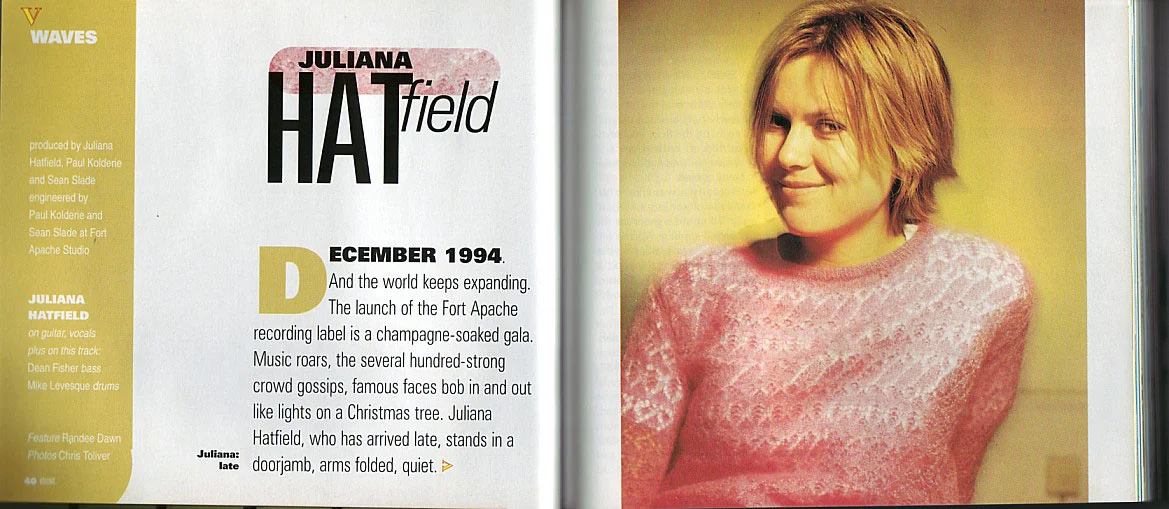
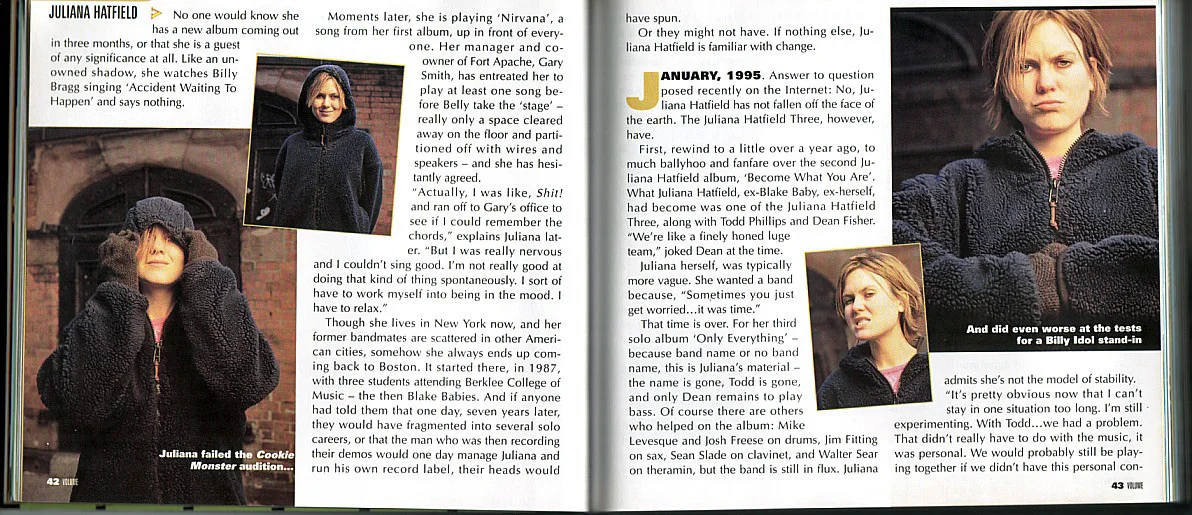
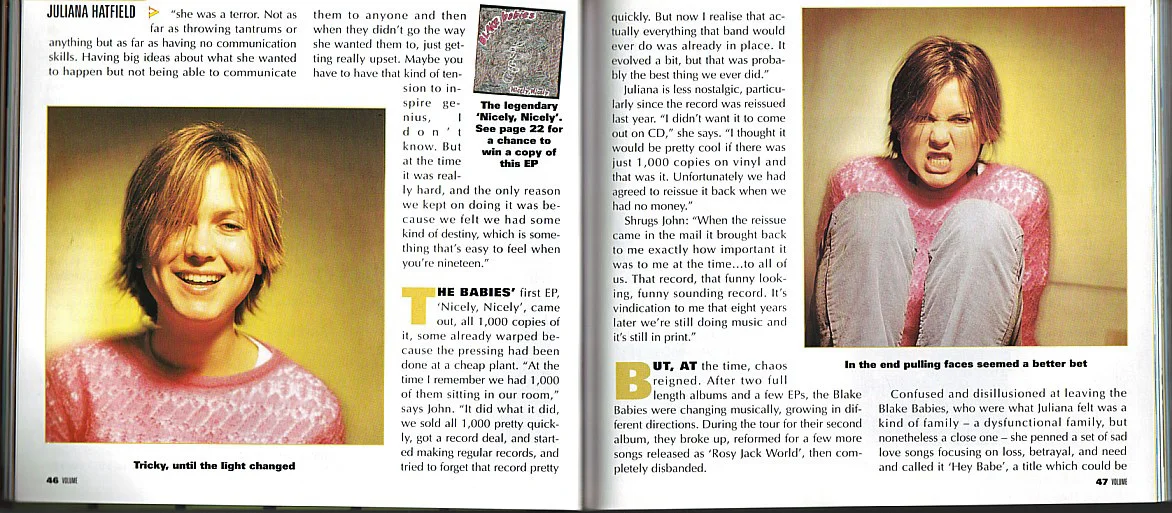
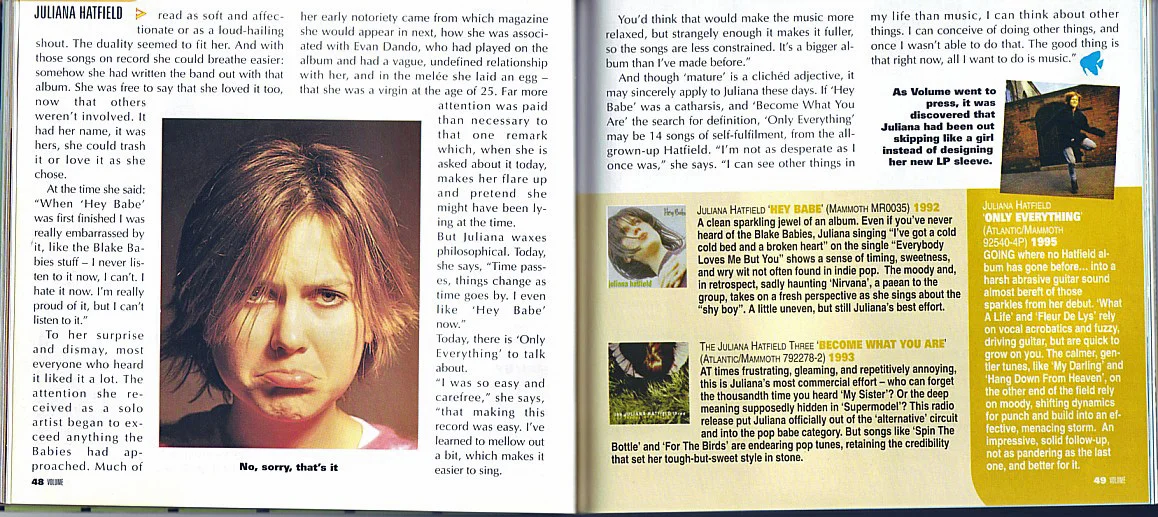
Show transcriptHide transcript
Juliana Hatfield
Feature Randee Dawn · Photos Chris Toliver
December 1994.
And the world keeps expanding.
The launch of the Fort Apache recording label is a champagne-soaked gala. Music roars, the several hundred-strong crowd gossips, famous faces bob in and out like lights on a Christmas tree. Juliana Hatfield, who has arrived late, stands in a doorjamb, arms folded, quiet.
No one would know she has a new album coming out in three months, or that she is a guest of any significance at all. Like an unowned shadow, she watches Billy Bragg singing ‘Accident Waiting To Happen’ and says nothing.
Moments later, she is playing ‘Nirvana’, a song from her first album, up in front of everyone. Her manager and co-owner of Fort Apache, Gary Smith, has entreated her to play at least one song before Belly take the ‘stage’ — really only a space cleared away on the floor and partitioned off with wires and speakers — and she has hesitantly agreed.
“Actually, I was like, Shit! and ran off to Gary’s office to see if I could remember the chords,” explains Juliana later. “But I was really nervous and I couldn’t sing good. I’m not really good at doing that kind of thing spontaneously. I sort of have to work myself into being in the mood. I have to relax.”
Though she lives in New York now, and her former bandmates are scattered in other American cities, somehow she always ends up coming back to Boston. It started there, in 1987, with three students attending Berklee College of Music — the then Blake Babies. And if anyone had told them that one day, seven years later, they would have fragmented into several solo careers, or that the man who was then recording their demos would one day manage Juliana and run his own record label, their heads would have spun.
Or they might not have. If nothing else, Juliana Hatfield is familiar with change.
January, 1995.
Answer to question posed recently on the Internet: No, Juliana Hatfield has not fallen off the face of the earth. The Juliana Hatfield Three, however, have.
First, rewind to a little over a year ago, to much ballyhoo and fanfare over the second Juliana Hatfield album, ‘Become What You Are’. What Juliana Hatfield, ex-Blake Baby, ex-herself, had become was one of the Juliana Hatfield Three, along with Todd Phillips and Dean Fisher.
“We’re like a finely honed luge team,” joked Dean at the time.
Juliana herself, was typically more vague. She wanted a band because, “Sometimes you just get worried…it was time.”
That time is over. For her third solo album ‘Only Everything’ — because band name or no band name, this is Juliana’s material — the name is gone, Todd is gone, and only Dean remains to play bass. Of course there are others who helped on the album: Mike Levesque and Josh Freese on drums, Jim Fitting on sax, Sean Slade on clavinet, and Walter Sear on theramin, but the band is still in flux. Juliana admits she’s not the model of stability. “It’s pretty obvious now that I can’t stay in one situation too long. I’m still experimenting. With Todd…we had a problem. That didn’t really have to do with the music, it was personal. We would probably still be playing together if we didn’t have this personal conflict.”
She will not elaborate. Soft-spoken, the baby-girl voice she sings with is genuine, and she will begin a sentence with total conviction and enthusiasm, then lose steam at the end, often punctuating her faded away opinions with “yeah.”
Continuing, she says, “Once a situation becomes comfortable to me, I like to ruin it, because I don’t like being comfortable. I like changing it — I think you can grow more when you put yourself in a brand new scary situation.”
Meet ‘Only Everything’. Not exactly a scary situation, Hatfield’s new album is a different one. There are no standout immediate hits like ‘My Sister’ or topical railings about supermodels or Henry Rollins. Instead, ‘Only Everything’ is less clean, harder hitting, and more aggressively dynamic than anything Juliana has done before. Declaring, rather than asking, “Hey, can I get some bass,” at the start of the funky, breathy “Fleur De Lys,” Hatfield fully takes the reins, once again in charge.
“Well,” she says, “I played harder this time around. I talked to my guitar a little bit. It was a very laid back session but I — suddenly I felt a little more in control of my instrument. I’m a better player now, so I don’t have as much fear of the guitar. I used to let it push me around, and now I push it around.”
“I always knew she’d be big. She’s got something that’s appealing, and she’s very ambitious, so I knew she’d do well,” says John Strohm, who along with Juliana formed the Blake Babies, and who currently leads Velo Deluxe (see page 176 of this issue). “And it’s a good thing to see, because I realise that all the time I was putting up with all that bullshit it was right, that there was something about it that made it worth doing.”
Once upon a time, before there was any pushing being done, there was a band of students called the Blake Babies. The Babies was the first time Juliana had ever taken up her bass and played her songs for people.
According to Juliana, the band was never meant to be serious, although it is arguable that if you have enough gumption to get a recording contract some of the idea of casual, off-hand playing goes out of the thing.
Juliana liked the bass. She could play the piano; her mother had made her take lessons for years. But the guitar had remained an alien until high school.
“It looked like fun and I wanted to play songs,” she says, shrugging. “Once you get it, it’s just a breeze. I remember when I was learning it hurt a lot, but then you get used to it and it’s like second nature. But when first I started playing bass it was really hard and I got really discouraged, and the strings seemed like big gun barrels.”
But it was with the bass that she began to get a more confident voice in her singing and her songs; bass brought out a resonance in Juliana, made her want to get away from poppy, heartfelt songs and dig deeper into her psyche. “Bass is the feminine instrument to play,” she says, without qualification.
And bass, along with singing wispily-yet-mightily about relationships and often weak men, was Juliana’s forte. But, according to John, Juliana was not the easiest person to be in a band with.
“When she was 19,” he says, “she was a terror. Not as far as throwing tantrums or anything but as far as having no communication skills. Having big ideas about what she wanted to happen but not being able to communicate them to anyone and then when they didn’t go the way she wanted them to, just getting really upset. Maybe you have to have that kind of tension to inspire genius, I don’t know. But at the time it was really hard, and the only reason we kept on doing it was because we felt we had some kind of destiny, which is something that’s easy to feel when you’re nineteen.”
The Babies’ first EP, ‘Nicely, Nicely’, came out, all 1,000 copies of it, some already warped because the pressing had been done at a cheap plant. “At the time I remember we had 1,000 of them sitting in our room,” says John. “It did what it did, we sold all 1,000 pretty quickly, got a record deal, and started making regular records, and tried to forget that record pretty quickly. But now I realise that actually everything that band would ever do was already in place. It evolved a bit, but that was probably the best thing we ever did.”
Juliana is less nostalgic, particularly since the record was reissued last year. “I didn’t want it to come out on CD,” she says. “I thought it would be pretty cool if there was just 1,000 copies on vinyl and that was it. Unfortunately we had agreed to reissue it back when we had no money.”
Shrugs John: “When the reissue came in the mail it brought back to me exactly how important it was to me at the time…to all of us. That record, that funny looking, funny sounding record. It’s vindication to me that eight years later we’re still doing music and it’s still in print.”
But, at the time, chaos reigned. After two full length albums and a few EPs, the Blake Babies were changing musically, growing in different directions. During the tour for their second album, they broke up, reformed for a few more songs released as ‘Rosy Jack World’, then completely disbanded.
Confused and disillusioned at leaving the Blake Babies, who were what Juliana felt was a kind of family — a dysfunctional family, but nonetheless a close one — she penned a set of sad love songs focusing on loss, betrayal, and need and called it ‘Hey Babe’, a title which could be read as soft and affectionate or as a loud-hailing shout. The duality seemed to fit her. And with those songs on record she could breathe easier: somehow she had written the band out with that album. She was free to say that she loved it too, now that others weren’t involved. It had her name, it was hers, she could trash it or love it as she chose.
At the time she said: “When ‘Hey Babe’ was first finished I was really embarrassed by it, like the Blake Babies stuff — I never listen to it now, I can’t. I hate it now. I’m really proud of it, but I can’t listen to it.”
To her surprise and dismay, most everyone who heard it liked it a lot. The attention she received as a solo artist began to exceed anything the Babies had approached. Much of her early notoriety came from which magazine she would appear in next, how she was associated with Evan Dando, who had played on the album and had a vague, undefined relationship with her, and in the melée she laid an egg — that she was a virgin at the age of 25. Far more attention was paid than necessary to that one remark which, when she is asked about it today, makes her flare up and pretend she might have been lying at the time.
But Juliana waxes philosophical. Today, she says, “Time passes, things change as time goes by. I even like ‘Hey Babe’ now.”
Today, there is ‘Only Everything’ to talk about.
“I was so easy and carefree,” she says, “that making this record was easy. I’ve learned to mellow out a bit, which makes it easier to sing.
“You’d think that would make the music more relaxed, but strangely enough it makes it fuller, so the songs are less constrained. It’s a bigger album than I’ve made before.”
And though ‘mature’ is a clichéd adjective, it may sincerely apply to Juliana these days. If ‘Hey Babe’ was a catharsis, and ‘Become What You Are’ the search for definition, ‘Only Everything’ may be 14 songs of self-fulfilment, from the all-grown-up Hatfield. “I’m not as desperate as I once was,” she says. “I can see other things in my life than music, I can think about other things. I can conceive of doing other things, and once I wasn’t able to do that. The good thing is that right now, all I want to do is music.”
As Volume went to press, it was discovered that Juliana had been out skipping like a girl instead of designing her new LP sleeve.
Album guide
Juliana Hatfield — ‘Hey Babe’ (Mammoth MR0035), 1992
A clean sparkling jewel of an album. Even if you’ve never heard of the Blake Babies, Juliana singing “I’ve got a cold cold bed and a broken heart” on the single “Everybody Loves Me But You” shows a sense of timing, sweetness, and wry wit not often found in indie pop. The moody and, in retrospect, sadly haunting ‘Nirvana’, a paean to the group, takes on a fresh perspective as she sings about the “shy boy”. A little uneven, but still Juliana’s best effort.
The Juliana Hatfield Three — ‘Become What You Are’ (Atlantic/Mammoth 792278-2), 1993
At times frustrating, gleaming, and repetitively annoying, this is Juliana’s most commercial effort — who can forget the thousandth time you heard ‘My Sister’? Or the deep meaning supposedly hidden in ‘Supermodel’? This radio release put Juliana officially out of the ‘alternative’ circuit and into the pop babe category. But songs like ‘Spin The Bottle’ and ‘For The Birds’ are endearing pop tunes, retaining the credibility that set her tough-but-sweet style in stone.
Juliana Hatfield — ‘Only Everything’ (Atlantic/Mammoth 92540-4P), 1995
Coming where no Hatfield album has gone before…into a harsh abrasive guitar sound almost bereft of those sparkles from her debut. ‘What A Life’ and ‘Fleur De Lys’ rely on vocal acrobatics and fuzzy, driving guitar, but are quick to grow on you. The calmer, gentler tunes, like ‘My Darling’ and ‘Hang Down From Heaven’, on the other end of the field rely on moody, shifting dynamics for punch and build into an effective, menacing storm. An impressive, solid follow-up, not as pandering as the last one, and better for it.
Captions and side matter
- Juliana: late
- Juliana failed the Cookie Monster audition…
- And did even worse at the tests for a Billy Idol stand-in
- Juliana started thinking hard about how to get into a brand new, scary situation
- Tricky, until the light changed
- The legendary ‘Nicely, Nicely’. See page 221 for a chance to win a copy of this EP
- In the end pulling faces seemed a better bet
- No, sorry, that’s it
Recording credits
Produced by Juliana Hatfield, Paul Kolderie and Sean Slade. Engineered by Paul Kolderie and Sean Slade at Fort Apache Studio.
Juliana Hatfield on guitar, vocals; plus on this track: Dean Fisher, bass; Mike Levesque, drums.
Melody Maker - March 1995
Interview from March 1995.
Appalling headline.
"(On 'What A Life') It's about a photograph I saw of all these people sitting around, rock 'n' roll people, a kind of debauched after the party thing. I'm not proud of what I wrote about it. I guess it was what I was thinking at the time but, now, I think I was being judgmental and nihilistic in a kind of gross way. I don't feel that way all the time and I really don't like to be so negative. I try to keep it to myself, or at least not be so obvious about it. Who am I to say things like that? They weren't hurting anybody."
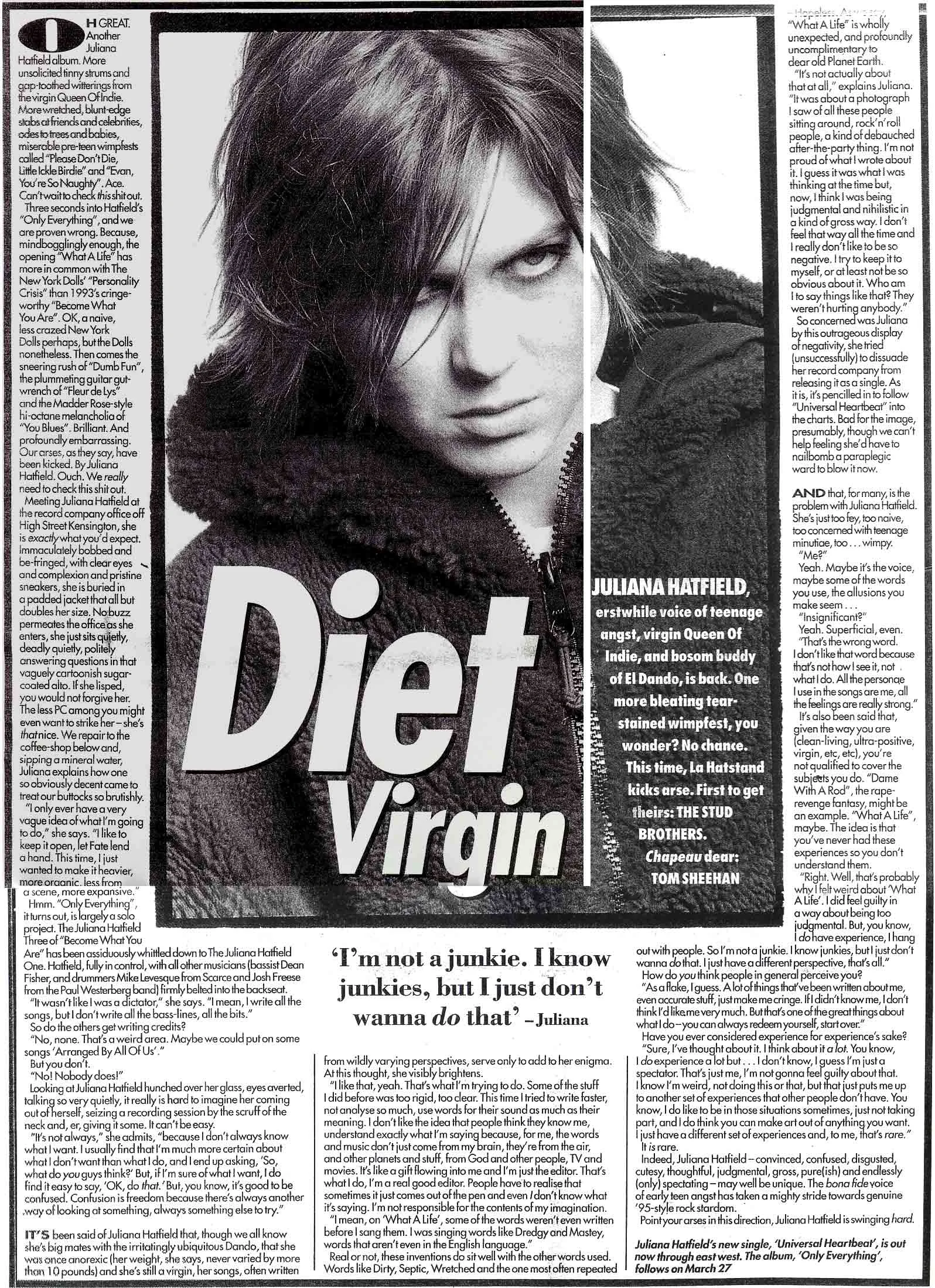
Show transcriptHide transcript
Diet Virgin
Melody Maker, 11 March 1995
JULIANA HATFIELD, erstwhile voice of teenage angst, virgin Queen Of Indie, and bosom buddy of El Dando, is back. One more bleating tear-stained wimpfest, you wonder? No chance. This time, La Hatstand kicks arse. First to get theirs: THE STUD BROTHERS. Chapeau dear: TOM SHEEHAN
OH GREAT. Another Juliana Hatfield album. More unsolicited tinny strums and gap-toothed witterings from the virgin Queen Of Indie. More wretched, blunt-edge stabs at friends and celebrities, odes to trees and babies, miserable pre-teen wimpfests called “Please Don’t Die, Little Ickle Birdie” and “Evan, You’re So Naughty”. Ace. Can’t wait to check this shit out.
Three seconds into Hatfield’s “Only Everything”, and we are proven wrong. Because, mindbogglingly enough, the opening “What A Life” has more in common with The New York Dolls’ “Personality Crisis” than 1993’s cringeworthy “Become What You Are”. OK, a naive, less crazed New York Dolls perhaps, but the Dolls nonetheless. Then comes the sneering rush of “Dumb Fun”, the plummeting guitar gut-wrench of “Fleur de Lys” and the Madder Rose-style hi-octane melancholia of “You Blues”. Brilliant. And profoundly embarrassing. Our arses, as they say, have been kicked. By Juliana Hatfield. Ouch. We really need to check this shit out.
Meeting Juliana Hatfield at the record company office off High Street Kensington, she is exactly what you’d expect. Immaculately bobbed and be-fringed, with clear eyes and complexion and pristine sneakers, she is buried in a padded jacket that all but doubles her size. No buzz permeates the office as she enters, she just sits quietly, deadly quietly, politely answering questions in that vaguely cartoonish sugar-coated alto. If she lisped, you would not forgive her. The less PC among you might even want to strike her — she’s that nice. We repair to the coffee-shop below and, sipping a mineral water, Juliana explains how one so obviously decent came to treat our buttocks so brutishly.
“I only ever have a very vague idea of what I’m going to do,” she says. “I like to keep it open, let Fate lend a hand. This time, I just wanted to make it heavier, more organic, less from a scene, more expansive.”
Hmm. “Only Everything”, it turns out, is largely a solo project. The Juliana Hatfield Three of “Become What You Are” has been assiduously whittled down to The Juliana Hatfield One. Hatfield, fully in control, with all other musicians (bassist Dean Fisher, and drummers Mike Levesque from Scarce and Josh Freese from the Paul Westerberg band) firmly belted into the backseat.
“It wasn’t like I was a dictator,” she says. “I mean, I write all the songs, but I don’t write all the bass-lines, all the bits.”
So do the others get writing credits?
“No, none. That’s a weird area. Maybe we could put on some songs ‘Arranged By All Of Us’.”
But you don’t.
“No! Nobody does!”
Looking at Juliana Hatfield hunched over her glass, eyes averted, talking so very quietly, it really is hard to imagine her coming out of herself, seizing a recording session by the scruff of the neck and, er, giving it some. It can’t be easy.
“It’s not always,” she admits, “because I don’t always know what I want. I usually find that I’m much more certain about what I don’t want than what I do, and I end up asking, ‘So, what do you guys think?’ But, if I’m sure of what I want, I do find it easy to say, ‘OK, do that.’ But, you know, it’s good to be confused. Confusion is freedom because there’s always another way of looking at something, always something else to try.”
IT’S been said of Juliana Hatfield that, though we all know she’s big mates with the irritatingly ubiquitous Dando, that she was once anorexic (her weight, she says, never varied by more than 10 pounds) and she’s still a virgin, her songs, often written from wildly varying perspectives, serve only to add to her enigma.
At this thought, she visibly brightens.
“I like that, yeah. That’s what I’m trying to do. Some of the stuff I did before was too rigid, too clear. This time I tried to write faster, not analyse so much, use words for their sound as much as their meaning. I don’t like the idea that people think they know me, understand exactly what I’m saying because, for me, the words and music don’t just come from my brain, they’re from the air, and other planets and stuff, from God and other people, TV and movies. It’s like a gift flowing into me and I’m just the editor. That’s what I do, I’m a real good editor. People have to realise that sometimes it just comes out of the pen and even I don’t know what it’s saying. I’m not responsible for the contents of my imagination.
“I mean, on ‘What A Life’, some of the words weren’t even written before I sang them. I was singing words like Dredgy and Mastey, words that aren’t even in the English language.”
Real or not, these inventions do sit well with the other words used. Words like Dirty, Septic, Wretched and the one most often repeated — Hopeless. Awesome!
“What A Life” is wholly unexpected, and profoundly uncomplimentary to dear old Planet Earth.
“It’s not actually about that at all,” explains Juliana. “It was about a photograph I saw of all these people sitting around, rock’n’roll people, a kind of debauched after-the-party thing. I’m not proud of what I wrote about it. I guess it was what I was thinking at the time but, now, I think I was being judgmental and nihilistic in a kind of gross way. I don’t feel that way all the time and I really don’t like to be so negative. I try to keep it to myself, or at least not be so obvious about it. Who am I to say things like that? They weren’t hurting anybody.”
So concerned was Juliana by this outrageous display of negativity, she tried (unsuccessfully) to dissuade her record company from releasing it as a single. As it is, it’s pencilled in to follow “Universal Heartbeat” into the charts. Bad for the image, presumably, though we can’t help feeling she’d have to nailbomb a paraplegic ward to blow it now.
AND that, for many, is the problem with Juliana Hatfield. She’s just too fey, too naive, too concerned with teenage minutiae, too . . . wimpy.
“Me?”
Yeah. Maybe it’s the voice, maybe some of the words you use, the allusions you make seem . . .
“Insignificant?”
Yeah. Superficial, even.
“That’s the wrong word. I don’t like that word because that’s not how I see it, not what I do. All the personae I use in the songs are me, all the feelings are really strong.”
It’s also been said that, given the way you are (clean-living, ultra-positive, virgin, etc, etc), you’re not qualified to cover the subjects you do. “Dame With A Rod”, the rape-revenge fantasy, might be an example. “What A Life”, maybe. The idea is that you’ve never had these experiences so you don’t understand them.
“Right. Well, that’s probably why I felt weird about ‘What A Life’. I did feel guilty in a way about being too judgmental. But, you know, I do have experience, I hang out with people. So I’m not a junkie. I know junkies, but I just don’t wanna do that. I just have a different perspective, that’s all.”
‘I’m not a junkie. I know junkies, but I just don’t wanna do that’ — Juliana
How do you think people in general perceive you?
“As a flake, I guess. A lot of things that’ve been written about me, even accurate stuff, just make me cringe. If I didn’t know me, I don’t think I’d like me very much. But that’s one of the great things about what I do — you can always redeem yourself, start over.”
Have you ever considered experience for experience’s sake?
“Sure, I’ve thought about it. I think about it a lot. You know, I do experience a lot but . . . I don’t know, I guess I’m just a spectator. That’s just me, I’m not gonna feel guilty about that. I know I’m weird, not doing this or that, but that just puts me up to another set of experiences that other people don’t have. You know, I do like to be in those situations sometimes, just not taking part, and I do think you can make art out of anything you want. I just have a different set of experiences and, to me, that’s rare.”
It is rare.
Indeed, Juliana Hatfield — convinced, confused, disgusted, cutesy, thoughtful, judgmental, gross, pure(ish) and endlessly (only) spectating — may well be unique. The bona fide voice of early teen angst has taken a mighty stride towards genuine ’95-style rock stardom.
Point your arses in this direction, Juliana Hatfield is swinging hard.
Juliana Hatfield’s new single, ‘Universal Heartbeat’, is out now through east west. The album, ‘Only Everything’, follows on March 27.
NME - March 1995
Interview from 1995 - "Everything And The Grrrl"
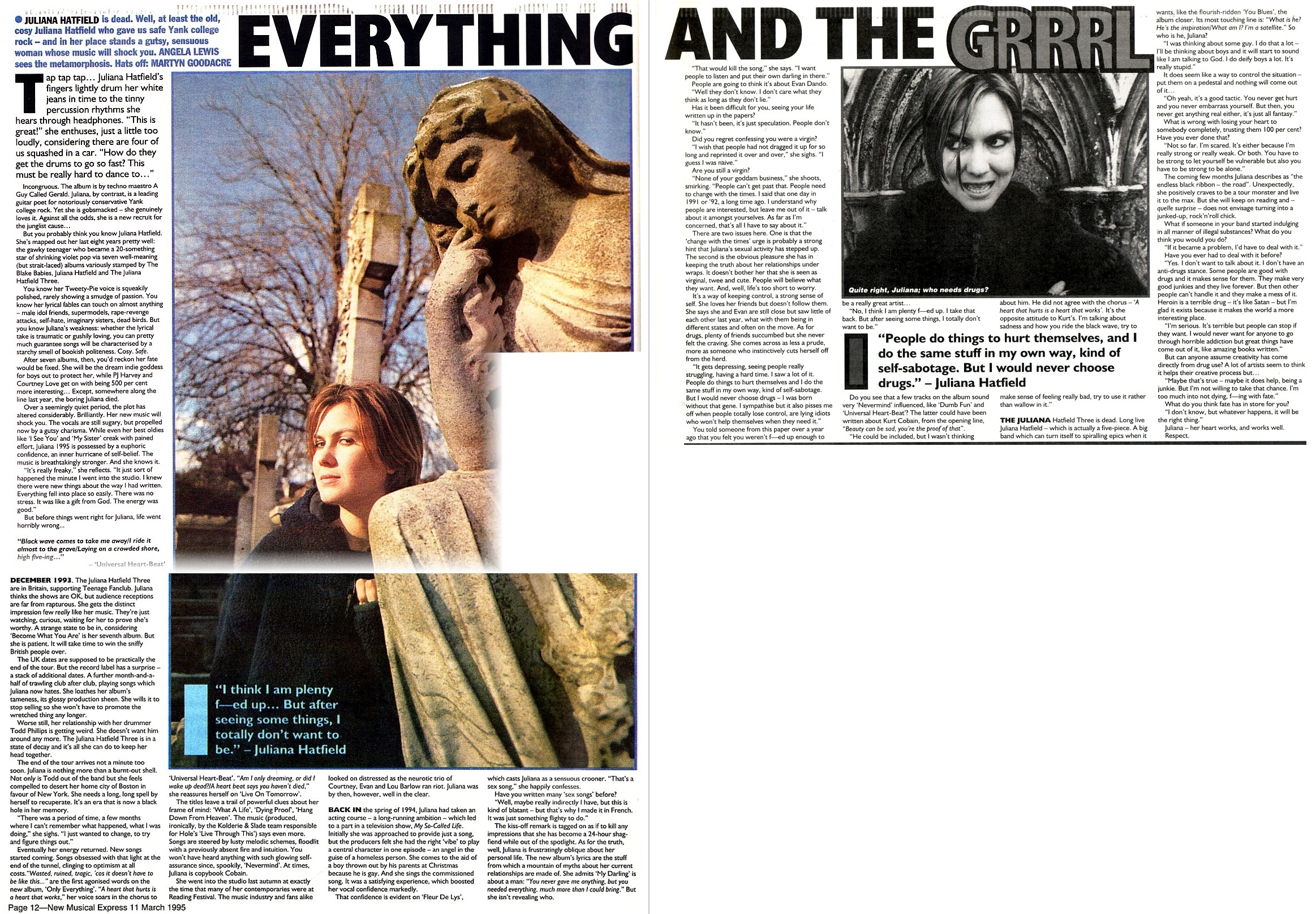
Show transcriptHide transcript
EVERYTHING AND THE GRRRL
JULIANA HATFIELD is dead. Well, at least the old, cosy Juliana Hatfield who gave us safe Yank college rock — and in her place stands a gutsy, sensuous woman whose music will shock you. ANGELA LEWIS sees the metamorphosis. Hats off: MARTYN GOODACRE
Tap tap tap… Juliana Hatfield’s fingers lightly drum her white jeans in time to the tinny percussion rhythms she hears through headphones. “This is great!” she enthuses, just a little too loudly, considering there are four of us squashed in a car. “How do they get the drums to go so fast? This must be really hard to dance to…”
Incongruous. The album is by techno maestro A Guy Called Gerald. Juliana, by contrast, is a leading guitar poet for notoriously conservative Yank college rock. Yet she is gobsmacked — she genuinely loves it. Against all the odds, she is a new recruit for the junglist cause…
But you probably think you know Juliana Hatfield. She’s mapped out her last eight years pretty well: the gawky teenager who became a 20-something star of shrinking violet pop via seven well-meaning (but strait-laced) albums variously stamped by The Blake Babies, Juliana Hatfield and The Juliana Hatfield Three.
You know her Tweety-Pie voice is squeakily polished, rarely showing a smudge of passion. You know her lyrical fables can touch on almost anything — male idol friends, supermodels, rape-revenge attacks, self-hate, imaginary sisters, dead birds. But you know Juliana’s weakness: whether the lyrical take is traumatic or gushily loving, you can pretty much guarantee songs will be characterised by a starchy smell of bookish politeness. Cosy. Safe.
After seven albums, then, you’d reckon her fate would be fixed. She will be the dream indie goddess for boys out to protect her, while PJ Harvey and Courtney Love get on with being 500 per cent more interesting… Except, somewhere along the line last year, the boring Juliana died.
Over a seemingly quiet period, the plot has altered considerably. Brilliantly. Her new music will shock you. The vocals are still sugary, but propelled now by a gutsy charisma. While even her best oldies like ‘I See You’ and ‘My Sister’ creak with pained effort, Juliana 1995 is possessed by a euphoric confidence, an inner hurricane of self-belief. The music is breathtakingly stronger. And she knows it.
“It’s really freaky,” she reflects. “It just sort of happened the minute I went into the studio. I knew there were new things about the way I had written. Everything fell into place so easily. There was no stress. It was like a gift from God. The energy was good.”
But before things went right for Juliana, life went horribly wrong…
“Black wave comes to take me away/I ride it almost to the grave/Laying on a crowded shore, high five-ing…”
— ‘Universal Heart-Beat’
DECEMBER 1993. The Juliana Hatfield Three are in Britain, supporting Teenage Fanclub. Juliana thinks the shows are OK, but audience receptions are far from rapturous. She gets the distinct impression few really like her music. They’re just watching, curious, waiting for her to prove she’s worthy. A strange state to be in, considering ‘Become What You Are’ is her seventh album. But she is patient. It will take time to win the sniffy British people over.
The UK dates are supposed to be practically the end of the tour. But the record label has a surprise — a stack of additional dates. A further month-and-a-half of trawling club after club, playing songs which Juliana now hates. She loathes her album’s tameness, its glossy production sheen. She wills it to stop selling so she won’t have to promote the wretched thing any longer.
Worse still, her relationship with her drummer Todd Phillips is getting weird. She doesn’t want him around any more. The Juliana Hatfield Three is in a state of decay and it’s all she can do to keep her head together.
The end of the tour arrives not a minute too soon. Juliana is nothing more than a burnt-out shell. Not only is Todd out of the band but she feels compelled to desert her home city of Boston in favour of New York. She needs a long, long spell by herself to recuperate. It’s an era that is now a black hole in her memory.
“There was a period of time, a few months where I can’t remember what happened, what I was doing,” she sighs. “I just wanted to change, to try and figure things out.”
Eventually her energy returned. New songs started coming. Songs obsessed with that light at the end of the tunnel, clinging to optimism at all costs. “Wasted, ruined, tragic, ’cos it doesn’t have to be like this…” are the first agonised words on the new album, ‘Only Everything’. “A heart that hurts is a heart that works,” her voice soars in the chorus to ‘Universal Heart-Beat’. “Am I only dreaming, or did I wake up dead?/A heart beat says you haven’t died,” she reassures herself on ‘Live On Tomorrow’.
The titles leave a trail of powerful clues about her frame of mind: ‘What A Life’, ‘Dying Proof’, ‘Hang Down From Heaven’. The music (produced, ironically, by the Kolderie & Slade team responsible for Hole’s ‘Live Through This’) says even more. Songs are steered by lusty melodic schemes, floodlit with a previously absent fire and intuition. You won’t have heard anything with such glowing self-assurance since, spookily, ‘Nevermind’. At times, Juliana is copybook Cobain.
She went into the studio last autumn at exactly the time that many of her contemporaries were at Reading Festival. The music industry and fans alike looked on distressed as the neurotic trio of Courtney, Evan and Lou Barlow ran riot. Juliana was by then, however, well in the clear.
BACK IN the spring of 1994, Juliana had taken an acting course — a long-running ambition — which led to a part in a television show, My So-Called Life. Initially she was approached to provide just a song, but the producers felt she had the right ‘vibe’ to play a central character in one episode — an angel in the guise of a homeless person. She comes to the aid of a boy thrown out by his parents at Christmas because he is gay. And she sings the commissioned song. It was a satisfying experience, which boosted her vocal confidence markedly.
That confidence is evident on ‘Fleur De Lys’, which casts Juliana as a sensuous crooner. “That’s a sex song,” she happily confesses.
Have you written many ‘sex songs’ before?
“Well, maybe really indirectly I have, but this is kind of blatant — but that’s why I made it in French. It was just something flighty to do.”
The kiss-off remark is tagged on as if to kill any impressions that she has become a 24-hour shag-fiend while out of the spotlight. As for the truth, well, Juliana is frustratingly oblique about her personal life. The new album’s lyrics are the stuff from which a mountain of myths about her current relationships are made of. She admits ‘My Darling’ is about a man: “You never gave me anything, but you needed everything, much more than I could bring.” But she isn’t revealing who.
“That would kill the song,” she says. “I want people to listen and put their own darling in there.”
People are going to think it’s about Evan Dando.
“Well they don’t know. I don’t care what they think as long as they don’t lie.”
Has it been difficult for you, seeing your life written up in the papers?
“It hasn’t been, it’s just speculation. People don’t know.”
Did you regret confessing you were a virgin?
“I wish that people had not dragged it up for so long and reprinted it over and over,” she sighs. “I guess I was naïve.”
Are you still a virgin?
“None of your goddam business,” she shoots, smirking. “People can’t get past that. People need to change with the times. I said that one day in 1991 or ’92, a long time ago. I understand why people are interested, but leave me out of it — talk about it amongst yourselves. As far as I’m concerned, that’s all I have to say about it.”
There are two issues here. One is that the ‘change with the times’ urge is probably a strong hint that Juliana’s sexual activity has stepped up. The second is the obvious pleasure she has in keeping the truth about her relationships under wraps. It doesn’t bother her that she is seen as virginal, twee and cute. People will believe what they want. And, well, life’s too short to worry.
It’s a way of keeping control, a strong sense of self. She loves her friends but doesn’t follow them. She says she and Evan are still close but saw little of each other last year, what with them being in different states and often on the move. As for drugs, plenty of friends succumbed but she never felt the craving. She comes across as less a prude, more as someone who instinctively cuts herself off from the herd.
“It gets depressing, seeing people really struggling, having a hard time. I saw a lot of it. People do things to hurt themselves and I do the same stuff in my own way, kind of self-sabotage. But I would never choose drugs — I was born without that gene. I sympathise but it also pisses me off when people totally lose control, are lying idiots who won’t help themselves when they need it.”
You told someone from this paper over a year ago that you felt you weren’t f—ed up enough to be a really great artist…
“No, I think I am plenty f—ed up. I take that back. But after seeing some things, I totally don’t want to be.”
Photo caption: Quite right, Juliana, who needs drugs?
“People do things to hurt themselves, and I do the same stuff in my own way, kind of self-sabotage. But I would never choose drugs.” — Juliana Hatfield
Do you see that a few tracks on the album sound very ‘Nevermind’ influenced, like ‘Dumb Fun’ and ‘Universal Heart-Beat’? The latter could have been written about Kurt Cobain, from the opening line, “Beauty can be sad, you’re the proof of that”.
“He could be included, but I wasn’t thinking about him. He did not agree with the chorus — ‘A heart that hurts is a heart that works’. It’s the opposite attitude to Kurt’s. I’m talking about sadness and how you ride the black wave, try to make sense of feeling really bad, try to use it rather than wallow in it.”
THE JULIANA Hatfield Three is dead. Long live Juliana Hatfield — which is actually a five-piece. A big band which can turn itself to sprawling epics when it wants, like the flourish-ridden ‘You Blues’, the album closer. Its most touching line is: “What is he?/He’s the inspiration/What am I?/I’m a satellite.” So who is he, Juliana?
“I was thinking about some guy. I do that a lot — I’ll be thinking about boys and it will start to sound like I am talking to God. I do deify boys a lot. It’s really stupid.”
It does seem like a way to control the situation — put them on a pedestal and nothing will come out of it…
“Oh yeah, it’s a good tactic. You never get hurt and you never embarrass yourself. But then, you never get anything real either, it’s just all fantasy.”
What is wrong with losing your heart to somebody completely, trusting them 100 per cent? Have you ever done that?
“Not so far. I’m scared. It’s either because I’m really strong or really weak. Or both. You have to be strong to let yourself be vulnerable but also you have to be strong to be alone.”
The coming few months Juliana describes as “the endless black ribbon — the road”. Unexpectedly, she positively craves to be a tour monster and live it to the max. But she will keep on reading and — quelle surprise — does not envisage turning into a junked-up, rock’n’roll chick.
What if someone in your band started indulging in all manner of illegal substances? What do you think you would do?
“If it became a problem, I’d have to deal with it.”
Have you ever had to deal with it before?
“Yes. I don’t want to talk about it. I don’t have an anti-drugs stance. Some people are good with drugs and it makes sense for them. They make very good junkies and they live forever. But then other people can’t handle it and they make a mess of it. Heroin is a terrible drug — it’s like Satan — but I’m glad it exists because it makes the world a more interesting place.
“I’m serious. It’s terrible but people can stop if they want. I would never want for anyone to go through horrible addiction but great things have come out of it, like amazing books written.”
But can anyone assume creativity has come directly from drug use? A lot of artists seem to think it helps their creative process but…
“Maybe that’s true — maybe it does help, being a junkie. But I’m not willing to take that chance. I’m too much into not dying, f—ing with fate.”
What do you think fate has in store for you?
“I don’t know, but whatever happens, it will be the right thing.”
Juliana — her heart works, and works well.
Respect.
Record Collector 1995
Interview / article from 1995
"When I started playing with the Blake Babies, I found that the vocal training I'd had was really useful, as it had strengthened my voice. And the ear training helped me figure out a chord quicker than I would have done otherwise. But I deliberately tried to keep a lot of the stuff I was learning out of my head when I was actually making music. It can kill the mystery and the magic. I don't always want to know what chord I'm playing."
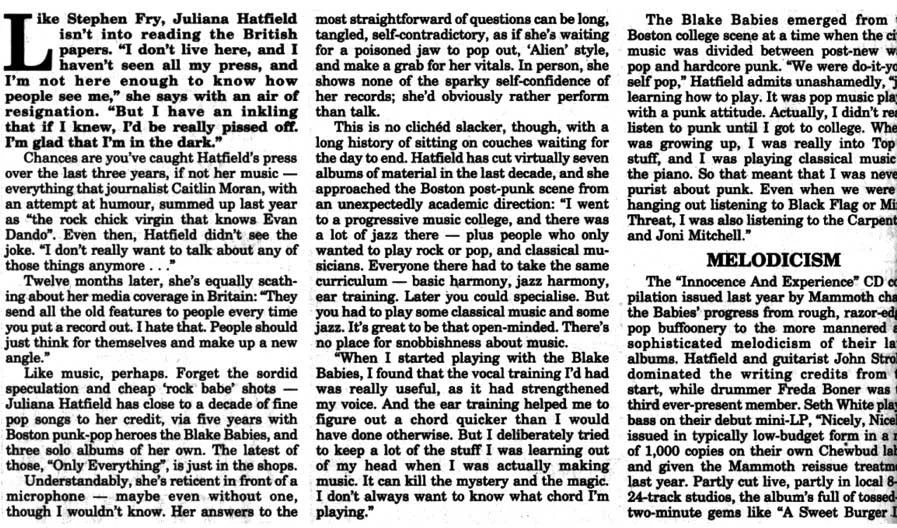
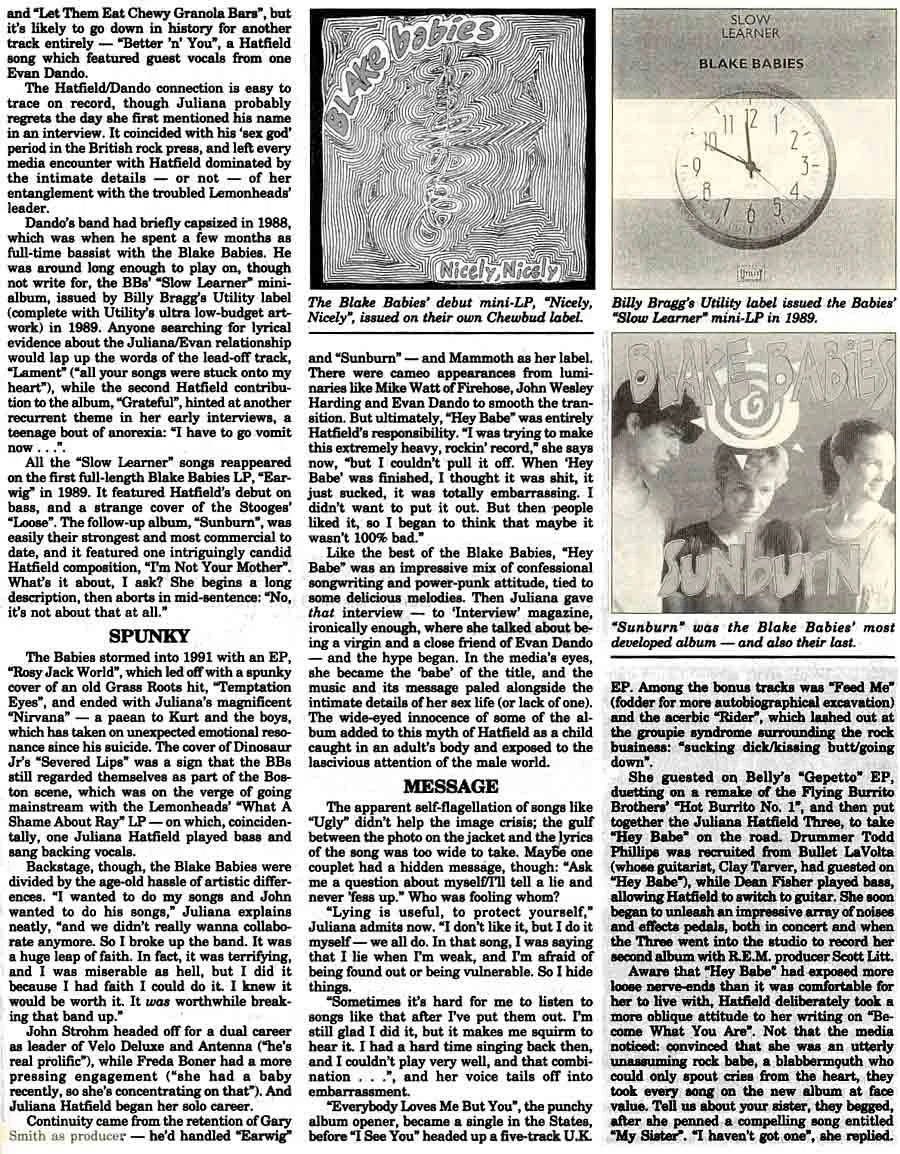
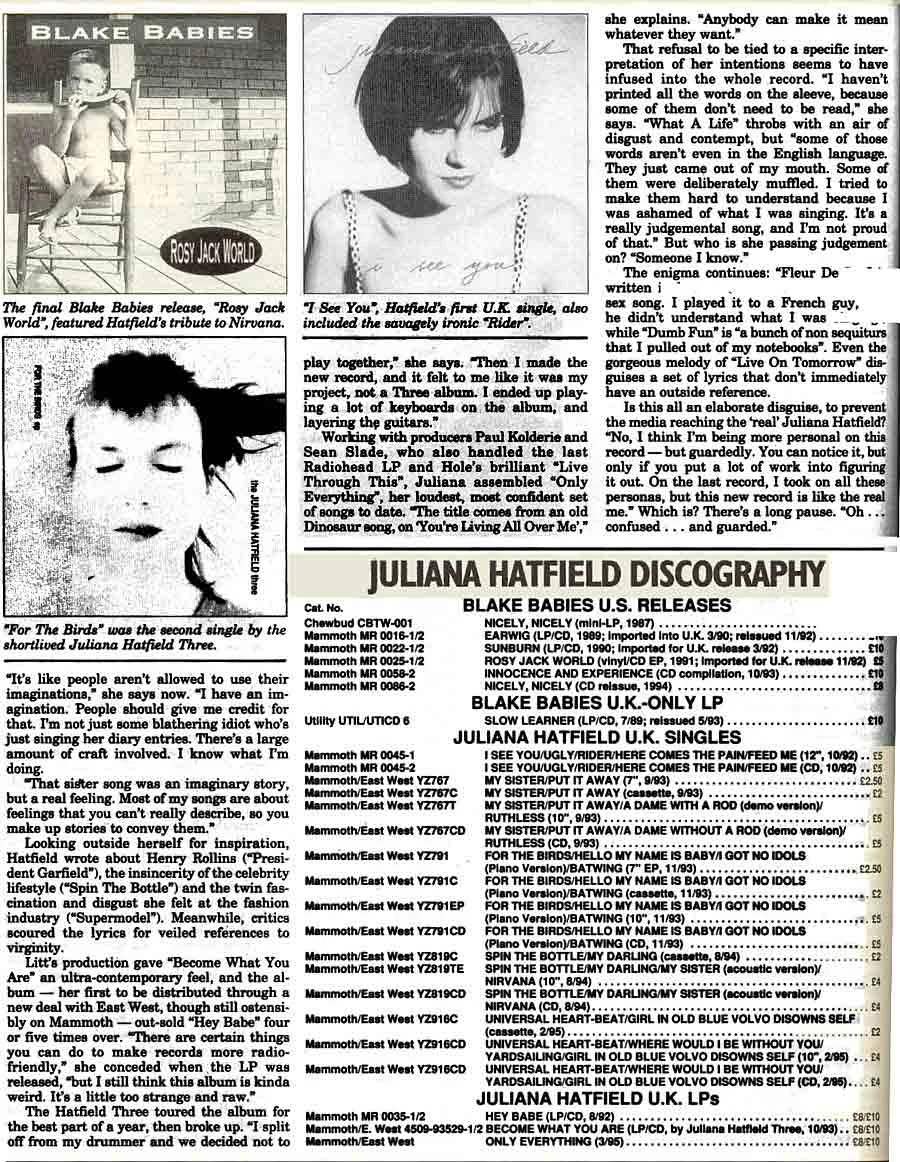
Show transcriptHide transcript
Juliana Hatfield Interview
Record Collector, 1995
Like Stephen Fry, Juliana Hatfield isn't into reading the British papers. “I don't live here, and I haven't seen all my press, and I'm not here enough to know how people see me,” she says with an air of resignation. “But I have an inkling that if I knew, I'd be really pissed off. I'm glad that I'm in the dark.”
Chances are you've caught Hatfield's press over the last three years, if not her music — everything that journalist Caitlin Moran, with an attempt at humour, summed up last year as “the rock chick virgin that knows Evan Dando”. Even then, Hatfield didn't see the joke. “I don't really want to talk about any of those things anymore . . .”
Twelve months later, she's equally scathing about her media coverage in Britain: “They send all the old features to people every time you put a record out. I hate that. People should just think for themselves and make up a new angle.”
Like music, perhaps. Forget the sordid speculation and cheap ‘rock babe’ shots — Juliana Hatfield has close to a decade of fine pop songs to her credit, via five years with Boston punk-pop heroes the Blake Babies, and three solo albums of her own. The latest of those, “Only Everything”, is just in the shops.
Understandably, she's reticent in front of a microphone — maybe even without one, though I wouldn't know. Her answers to the most straightforward of questions can be long, tangled, self-contradictory, as if she's waiting for a poisoned jaw to pop out, ‘Alien’ style, and make a grab for her vitals. In person, she shows none of the sparky self-confidence of her records; she'd obviously rather perform than talk.
This is no clichéd slacker, though, with a long history of sitting on couches waiting for the day to end. Hatfield has cut virtually seven albums of material in the last decade, and she approached the Boston post-punk scene from an unexpectedly academic direction: “I went to a progressive music college, and there was a lot of jazz there — plus people who only wanted to play rock or pop, and classical musicians. Everyone there had to take the same curriculum — basic harmony, jazz harmony, ear training. Later you could specialise. But you had to play some classical music and some jazz. It's great to be that open-minded. There's no place for snobbishness about music.
“When I started playing with the Blake Babies, I found that the vocal training I'd had was really useful, as it had strengthened my voice. And the ear training helped me to figure out a chord quicker than I would have done otherwise. But I deliberately tried to keep a lot of the stuff I was learning out of my head when I was actually making music. It can kill the mystery and the magic. I don't always want to know what chord I'm playing.”
The Blake Babies emerged from the Boston college scene at a time when the city's music was divided between post-new wave pop and hardcore punk. “We were do-it-yourself pop,” Hatfield admits unashamedly, “just learning how to play. It was pop music played with a punk attitude. Actually, I didn't really listen to punk until I got to college. When I was growing up, I was really into Top 40 stuff, and I was playing classical music on the piano. So that meant that I was never a purist about punk. Even when we were hanging out listening to Black Flag or Minor Threat, I was also listening to the Carpenters and Joni Mitchell.”
Melodicism
The “Innocence And Experience” CD compilation issued last year by Mammoth charts the Babies' progress from rough, razor-edged pop buffoonery to the more mannered and sophisticated melodicism of their later albums. Hatfield and guitarist John Strohm dominated the writing credits from the start, while drummer Freda Boner was the third ever-present member. Seth White played bass on their debut mini-LP, “Nicely, Nicely”, issued in typically low-budget form in a run of 1,000 copies on their own Chewbud label, and given the Mammoth reissue treatment last year. Partly cut live, partly in local 8- and 24-track studios, the album's full of tossed-off two-minute gems like “A Sweet Burger LP” and “Let Them Eat Chewy Granola Bars”, but it's likely to go down in history for another track entirely — “Better 'n' You”, a Hatfield song which featured guest vocals from one Evan Dando.
The Hatfield/Dando connection is easy to trace on record, though Juliana probably regrets the day she first mentioned his name in an interview. It coincided with his ‘sex god’ period in the British rock press, and left every media encounter with Hatfield dominated by the intimate details — or not — of her entanglement with the troubled Lemonheads' leader.
Dando's band had briefly capsized in 1988, which was when he spent a few months as full-time bassist with the Blake Babies. He was around long enough to play on, though not write for, the BBs' “Slow Learner” mini-album, issued by Billy Bragg's Utility label (complete with Utility's ultra low-budget artwork) in 1989. Anyone searching for lyrical evidence about the Juliana/Evan relationship would lap up the words of the lead-off track, “Lament” (“all your songs were stuck onto my heart”), while the second Hatfield contribution to the album, “Grateful”, hinted at another recurrent theme in her early interviews, a teenage bout of anorexia: “I have to go vomit now . . .”
All the “Slow Learner” songs reappeared on the first full-length Blake Babies LP, “Earwig” in 1989. It featured Hatfield's debut on bass, and a strange cover of the Stooges' “Loose”. The follow-up album, “Sunburn”, was easily their strongest and most commercial to date, and it featured one intriguingly candid Hatfield composition, “I'm Not Your Mother”. What's it about, I ask? She begins a long description, then aborts in mid-sentence: “No, it's not about that at all.”
Spunky
The Babies stormed into 1991 with an EP, “Rosy Jack World”, which led off with a spunky cover of an old Grass Roots hit, “Temptation Eyes”, and ended with Juliana's magnificent “Nirvana” — a paean to Kurt and the boys, which has taken on unexpected emotional resonance since his suicide. The cover of Dinosaur Jr's “Severed Lips” was a sign that the BBs still regarded themselves as part of the Boston scene, which was on the verge of going mainstream with the Lemonheads' “What A Shame About Ray” LP — on which, coincidentally, one Juliana Hatfield played bass and sang backing vocals.
Backstage, though, the Blake Babies were divided by the age-old hassle of artistic differences. “I wanted to do my songs and John wanted to do his songs,” Juliana explains neatly, “and we didn't really wanna collaborate anymore. So I broke up the band. It was a huge leap of faith. In fact, it was terrifying, and I was miserable as hell, but I did it because I had faith I could do it. I knew it would be worth it. It was worthwhile breaking that band up.”
John Strohm headed off for a dual career as leader of Velo Deluxe and Antenna (“he's real prolific”), while Freda Boner had a more pressing engagement (“she had a baby recently, so she's concentrating on that”). And Juliana Hatfield began her solo career.
Continuity came from the retention of Gary Smith as producer — he'd handled “Earwig” and “Sunburn” — and Mammoth as her label. There were cameo appearances from luminaries like Mike Watt of Firehose, John Wesley Harding and Evan Dando to smooth the transition. But ultimately, “Hey Babe” was entirely Hatfield's responsibility. “I was trying to make this extremely heavy, rockin' record,” she says now, “but I couldn't pull it off. When ‘Hey Babe’ was finished, I thought it was shit, it just sucked, it was totally embarrassing. I didn't want to put it out. But then people liked it, so I began to think that maybe it wasn't 100% bad.”
Like the best of the Blake Babies, “Hey Babe” was an impressive mix of confessional songwriting and power-punk attitude, tied to some delicious melodies. Then Juliana gave that interview — to ‘Interview’ magazine, ironically enough, where she talked about being a virgin and a close friend of Evan Dando — and the hype began. In the media's eyes, she became the ‘babe’ of the title, and the music and its message paled alongside the intimate details of her sex life (or lack of one). The wide-eyed innocence of some of the album added to this myth of Hatfield as a child caught in an adult's body and exposed to the lascivious attention of the male world.
Message
The apparent self-flagellation of songs like “Ugly” didn't help the image crisis; the gulf between the photo on the jacket and the lyrics of the song was too wide to take. Maybe one couplet had a hidden message, though: “Ask me a question about myself/I'll tell a lie and never 'fess up.” Who was fooling whom?
“Lying is useful, to protect yourself,” Juliana admits now. “I don't like it, but I do it myself — we all do. In that song, I was saying that I lie when I'm weak, and I'm afraid of being found out or being vulnerable. So I hide things.
“Sometimes it's hard for me to listen to songs like that after I've put them out. I'm still glad I did it, but it makes me squirm to hear it. I had a hard time singing back then, and I couldn't play very well, and that combination . . .”, and her voice tails off into embarrassment.
“Everybody Loves Me But You”, the punchy album opener, became a single in the States, before “I See You” headed up a five-track U.K. EP. Among the bonus tracks was “Feed Me” (fodder for more autobiographical excavation) and the acerbic “Rider”, which lashed out at the groupie syndrome surrounding the rock business: “sucking dick/kissing butt/going down”.
She guested on Belly's “Gepetto” EP, duetting on a remake of the Flying Burrito Brothers' “Hot Burrito No. 1”, and then put together the Juliana Hatfield Three, to take “Hey Babe” on the road. Drummer Todd Phillips was recruited from Bullet LaVolta (whose guitarist, Clay Tarver, had guested on “Hey Babe”), while Dean Fisher played bass, allowing Hatfield to switch to guitar. She soon began to unleash an impressive array of noises and effects pedals, both in concert and when the Three went into the studio to record her second album with R.E.M. producer Scott Litt.
Aware that “Hey Babe” had exposed more loose nerve-ends than it was comfortable for her to live with, Hatfield deliberately took a more oblique attitude to her writing on “Become What You Are”. Not that the media noticed: convinced that she was an utterly unassuming rock babe, a blabbermouth who could only spout cries from the heart, they took every song on the new album at face value. Tell us about your sister, they begged, after she penned a compelling song entitled “My Sister”. “I haven't got one”, she replied.
“It's like people aren't allowed to use their imaginations,” she says now. “I have an imagination. People should give me credit for that. I'm not just some blathering idiot who's just singing her diary entries. There's a large amount of craft involved. I know what I'm doing.
“That sister song was an imaginary story, but a real feeling. Most of my songs are about feelings that you can't really describe, so you make up stories to convey them.”
Looking outside herself for inspiration, Hatfield wrote about Henry Rollins (“President Garfield”), the insincerity of the celebrity lifestyle (“Spin The Bottle”) and the twin fascination and disgust she felt at the fashion industry (“Supermodel”). Meanwhile, critics scoured the lyrics for veiled references to virginity.
Litt's production gave “Become What You Are” an ultra-contemporary feel, and the album — her first to be distributed through a new deal with East West, though still ostensibly on Mammoth — out-sold “Hey Babe” four or five times over. “There are certain things you can do to make records more radio-friendly,” she conceded when the LP was released, “but I still think this album is kinda weird. It's a little too strange and raw.”
The Hatfield Three toured the album for the best part of a year, then broke up. “I split off from my drummer and we decided not to play together,” she says. “Then I made the new record, and it felt to me like it was my project, not a Three album. I ended up playing a lot of keyboards on the album, and layering the guitars.”
Working with producers Paul Kolderie and Sean Slade, who also handled the last Radiohead LP and Hole's brilliant “Live Through This”, Juliana assembled “Only Everything”, her loudest, most confident set of songs to date. The title comes from an old Dinosaur song, on “You're Living All Over Me”, she explains. “Anybody can make it mean whatever they want.”
That refusal to be tied to a specific interpretation of her intentions seems to have infused into the whole record. “I haven't printed all the words on the sleeve, because some of them don't need to be read,” she says. “What A Life” throbs with an air of disgust and contempt, but “some of those words aren't even in the English language. They just came out of my mouth. Some of them were deliberately muffled. I tried to make them hard to understand because I was ashamed of what I was singing. It's a really judgemental song, and I'm not proud of that.” But who is she passing judgement on? “Someone I know.”
The enigma continues: “Fleur De Lys” is written in [text obscured in scan]. “It's a sex song. I played it to a French guy, he didn't understand what I was [text obscured in scan],” while “Dumb Fun” is “a bunch of non sequiturs that I pulled out of my notebooks”. Even the gorgeous melody of “Live On Tomorrow” disguises a set of lyrics that don't immediately have an outside reference.
Is this all an elaborate disguise, to prevent the media reaching the ‘real’ Juliana Hatfield? “No, I think I'm being more personal on this record — but guardedly. You can notice it, but only if you put a lot of work into figuring it out. On the last record, I took on all these personas, but this new record is like the real me.” Which is? There's a long pause. “Oh . . . confused . . . and guarded.”
Picture captions
- The Blake Babies' debut mini-LP, “Nicely, Nicely”, issued on their own Chewbud label.
- Billy Bragg's Utility label issued the Babies' “Slow Learner” mini-LP in 1989.
- “Sunburn” was the Blake Babies' most developed album — and also their last.
- The final Blake Babies release, “Rosy Jack World”, featured Hatfield's tribute to Nirvana.
- “I See You”, Hatfield's first U.K. single, also included the savagely ironic “Rider”.
- “For The Birds” was the second single by the shortlived Juliana Hatfield Three.
Juliana Hatfield Discography
Blake Babies U.S. releases
| Cat. No. | Release | Guide price |
|---|---|---|
| Chewbud CBTW-001 | Nicely, Nicely (mini-LP, 1987) | — |
| Mammoth MR 0016-1/2 | Earwig (LP/CD, 1989; imported into U.K. 3/90; reissued 11/92) | £10 |
| Mammoth MR 0022-1/2 | Sunburn (LP/CD, 1990; imported for U.K. release 3/92) | £10 |
| Mammoth MR 0025-1/2 | Rosy Jack World (vinyl/CD EP, 1991; imported for U.K. release 11/92) | £5 |
| Mammoth MR 0058-2 | Innocence And Experience (CD compilation, 10/93) | £10 |
| Mammoth MR 0086-2 | Nicely, Nicely (CD reissue, 1994) | £8 |
Blake Babies U.K.-only LP
| Cat. No. | Release | Guide price |
|---|---|---|
| Utility UTIL/UTICD 6 | Slow Learner (LP/CD, 7/89; reissued 5/93) | £10 |
Juliana Hatfield U.K. singles
| Cat. No. | Release | Guide price |
|---|---|---|
| Mammoth MR 0045-1 | I See You/Ugly/Rider/Here Comes The Pain/Feed Me (12", 10/92) | £5 |
| Mammoth MR 0045-2 | I See You/Ugly/Rider/Here Comes The Pain/Feed Me (CD, 10/92) | £5 |
| Mammoth/East West YZ767 | My Sister/Put It Away (7", 9/93) | £2.50 |
| Mammoth/East West YZ767C | My Sister/Put It Away (cassette, 9/93) | £2 |
| Mammoth/East West YZ767T | My Sister/Put It Away/A Dame With A Rod (demo version)/Ruthless (10", 9/93) | £5 |
| Mammoth/East West YZ767CD | My Sister/Put It Away/A Dame Without A Rod (demo version)/Ruthless (CD, 9/93) | £5 |
| Mammoth/East West YZ791 | For The Birds/Hello My Name Is Baby/I Got No Idols (piano version)/Batwing (7" EP, 11/93) | £2.50 |
| Mammoth/East West YZ791C | For The Birds/Hello My Name Is Baby/I Got No Idols (piano version)/Batwing (cassette, 11/93) | £2 |
| Mammoth/East West YZ791EP | For The Birds/Hello My Name Is Baby/I Got No Idols (piano version)/Batwing (10", 11/93) | £5 |
| Mammoth/East West YZ791CD | For The Birds/Hello My Name Is Baby/I Got No Idols (piano version)/Batwing (CD, 11/93) | £5 |
| Mammoth/East West YZ819C | Spin The Bottle/My Darling (cassette, 8/94) | £2 |
| Mammoth/East West YZ819TE | Spin The Bottle/My Darling/My Sister (acoustic version)/Nirvana (10", 8/94) | £4 |
| Mammoth/East West YZ819CD | Spin The Bottle/My Darling/My Sister (acoustic version)/Nirvana (CD, 8/94) | £4 |
| Mammoth/East West YZ916C | Universal Heart-Beat/Girl In Old Blue Volvo Disowns Self (cassette, 2/95) | £2 |
| Mammoth/East West YZ916CD | Universal Heart-Beat/Where Would I Be Without You/Yardsailing/Girl In Old Blue Volvo Disowns Self (10", 2/95) | £4 |
| Mammoth/East West YZ916CD | Universal Heart-Beat/Where Would I Be Without You/Yardsailing/Girl In Old Blue Volvo Disowns Self (CD, 2/95) | £4 |
Juliana Hatfield U.K. LPs
| Cat. No. | Release | Guide price |
|---|---|---|
| Mammoth MR 0035-1/2 | Hey Babe (LP/CD, 8/92) | £8/£10 |
| Mammoth/E. West 4509-93529-1/2 | Become What You Are (LP/CD, by Juliana Hatfield Three, 10/93) | £8/£10 |
| Mammoth/East West | Only Everything (3/95) | £8/£10 |
Transcriber's note: Two brief fragments in the “Fleur De Lys” passage are physically obscured in the supplied scan and are marked in square brackets. The first scan is cropped at the right edge; obvious continuations were reconstructed from the following scan and context. Capitalisation, punctuation and release data otherwise follow the article as closely as the scans allow.
Vox - Spring 1995
Interview from Spring 1995.
Juliana's last major appearance of the era in the UK music press.
"I had a bit-part on My So-Called Life, a new teen TV show in the States. That was hard, but also exciting. It's not some dumb, glamorised soap like Beverley Hills 90210. It's like a realistic take on Twin Peaks, weird and dark and confused. Just like real life."
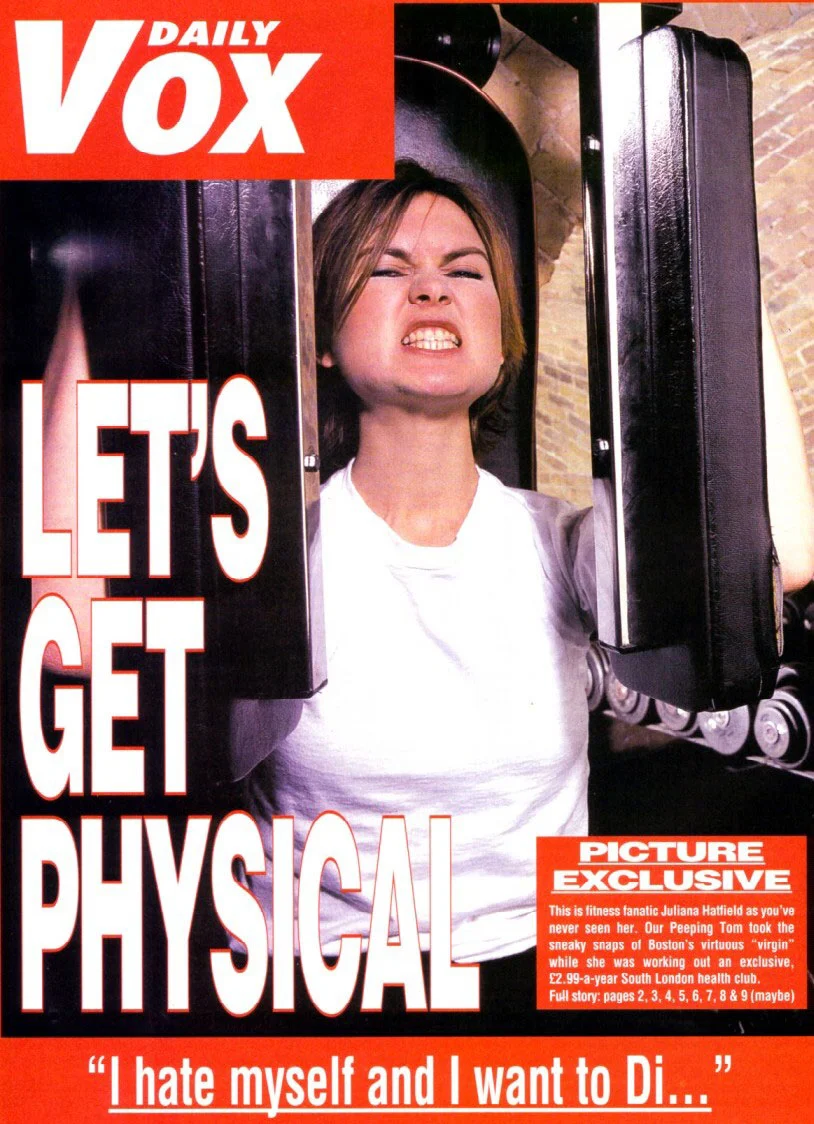
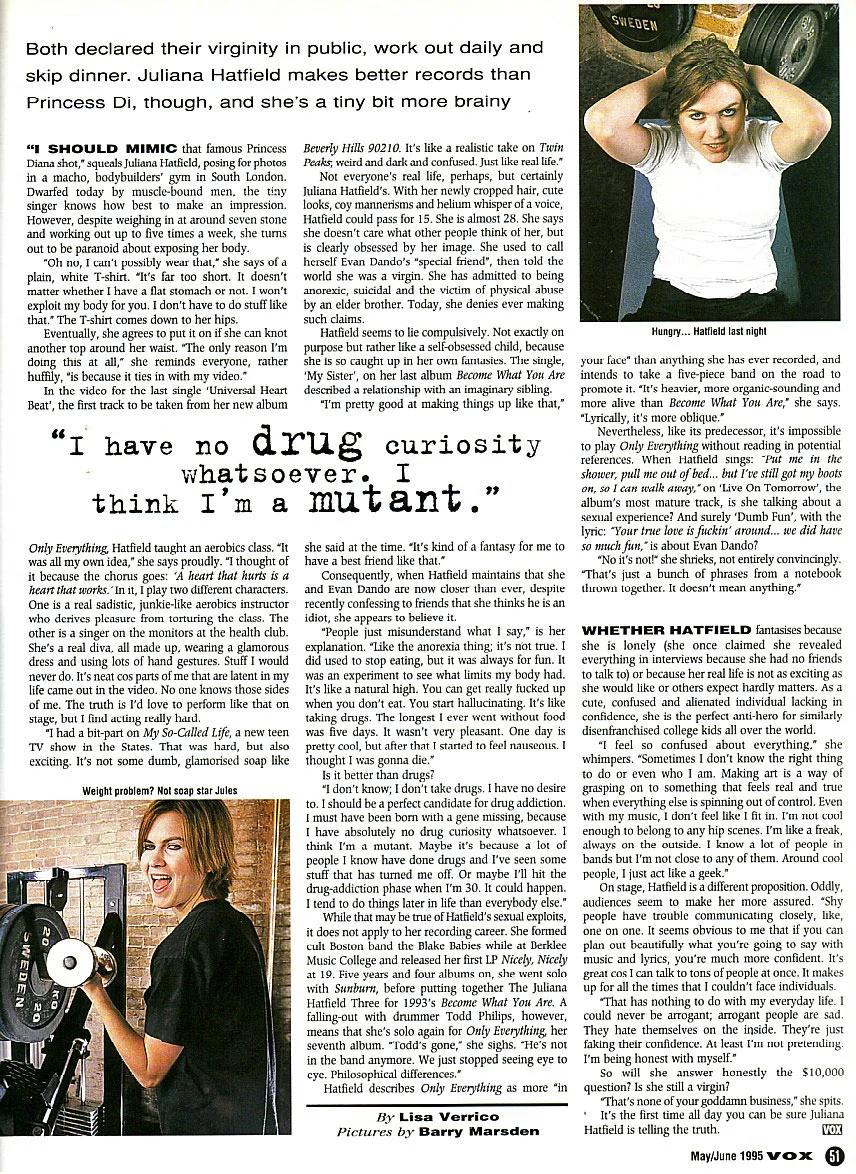
Show transcriptHide transcript
LET’S GET PHYSICAL
Cover text
“I hate myself and I want to Di…”
PICTURE EXCLUSIVE
This is fitness fanatic Juliana Hatfield as you’ve never seen her. Our Peeping Tom took the sneaky snaps of Boston’s virtuous “virgin” while she was working out an exclusive, £2.99-a-year South London health club. Full story: pages 2, 3, 4, 5, 6, 7, 8 & 9 (maybe)
Article
Both declared their virginity in public, work out daily and skip dinner. Juliana Hatfield makes better records than Princess Di, though, and she’s a tiny bit more brainy
“I SHOULD MIMIC that famous Princess Diana shot,” squeals Juliana Hatfield, posing for photos in a macho, bodybuilders’ gym in South London. Dwarfed today by muscle-bound men, the tiny singer knows how best to make an impression. However, despite weighing in at around seven stone and working out up to five times a week, she turns out to be paranoid about exposing her body.
“Oh no, I can’t possibly wear that,” she says of a plain, white T-shirt. “It’s far too short. It doesn’t matter whether I have a flat stomach or not. I won’t exploit my body for you. I don’t have to do stuff like that.” The T-shirt comes down to her hips.
Eventually, she agrees to put it on if she can knot another top around her waist. “The only reason I’m doing this at all,” she reminds everyone, rather huffily, “is because it ties in with my video.”
In the video for the last single ‘Universal Heart Beat’, the first track to be taken from her new album Only Everything, Hatfield taught an aerobics class. “It was all my own idea,” she says proudly. “I thought of it because the chorus goes: ‘A heart that hurts is a heart that works.’ In it, I play two different characters. One is a real sadistic, junkie-like aerobics instructor who derives pleasure from torturing the class. The other is a singer on the monitors at the health club. She’s a real diva, all made up, wearing a glamorous dress and using lots of hand gestures. Stuff I would never do. It’s neat cos parts of me that are latent in my life came out in the video. No one knows those sides of me. The truth is I’d love to perform like that on stage, but I find acting really hard.
“I had a bit-part on My So-Called Life, a new teen TV show in the States. That was hard, but also exciting. It’s not some dumb, glamorised soap like Beverly Hills 90210. It’s like a realistic take on Twin Peaks, weird and dark and confused. Just like real life.”
Not everyone’s real life, perhaps, but certainly Juliana Hatfield’s. With her newly cropped hair, cute looks, coy mannerisms and helium whisper of a voice, Hatfield could pass for 15. She is almost 28. She says she doesn’t care what other people think of her, but is clearly obsessed by her image. She used to call herself Evan Dando’s “special friend”, then told the world she was a virgin. She has admitted to being anorexic, suicidal and the victim of physical abuse by an elder brother. Today, she denies ever making such claims.
Hatfield seems to lie compulsively. Not exactly on purpose but rather like a self-obsessed child, because she is so caught up in her own fantasies. The single, ‘My Sister’, on her last album Become What You Are described a relationship with an imaginary sibling.
“I’m pretty good at making things up like that,” she said at the time. “It’s kind of a fantasy for me to have a best friend like that.”
Consequently, when Hatfield maintains that she and Evan Dando are now closer than ever, despite recently confessing to friends that she thinks he is an idiot, she appears to believe it.
“People just misunderstand what I say,” is her explanation. “Like the anorexia thing; it’s not true. I did used to stop eating, but it was always for fun. It was an experiment to see what limits my body had. It’s like a natural high. You can get really fucked up when you don’t eat. You start hallucinating. It’s like taking drugs. The longest I ever went without food was five days. It wasn’t very pleasant. One day is pretty cool, but after that I started to feel nauseous. I thought I was gonna die.”
Is it better than drugs?
“I don’t know; I don’t take drugs. I have no desire to. I should be a perfect candidate for drug addiction. I must have been born with a gene missing, because I have absolutely no drug curiosity whatsoever. I think I’m a mutant. Maybe it’s because a lot of people I know have done drugs and I’ve seen some stuff that has turned me off. Or maybe I’ll hit the drug-addiction phase when I’m 30. It could happen. I tend to do things later in life than everybody else.”
While that may be true of Hatfield’s sexual exploits, it does not apply to her recording career. She formed cult Boston band the Blake Babies while at Berklee Music College and released her first LP Nicely, Nicely at 19. Five years and four albums on, she went solo with Sunburn, before putting together The Juliana Hatfield Three for 1993’s Become What You Are. A falling-out with drummer Todd Philips, however, means that she’s solo again for Only Everything, her seventh album. “Todd’s gone,” she sighs. “He’s not in the band anymore. We just stopped seeing eye to eye. Philosophical differences.”
Hatfield describes Only Everything as more “in your face” than anything she has ever recorded, and intends to take a five-piece band on the road to promote it. “It’s heavier, more organic-sounding and more alive than Become What You Are,” she says. “Lyrically, it’s more oblique.”
Nevertheless, like its predecessor, it’s impossible to play Only Everything without reading in potential references. When Hatfield sings: “Put me in the shower, pull me out of bed… but I’ve still got my boots on, so I can walk away,” on ‘Live On Tomorrow’, the album’s most mature track, is she talking about a sexual experience? And surely ‘Dumb Fun’, with the lyric: “Your true love is fuckin’ around… we did have so much fun,” is about Evan Dando?
“No it’s not!” she shrieks, not entirely convincingly. “That’s just a bunch of phrases from a notebook thrown together. It doesn’t mean anything.”
WHETHER HATFIELD fantasises because she is lonely (she once claimed she revealed everything in interviews because she had no friends to talk to) or because her real life is not as exciting as she would like or others expect hardly matters. As a cute, confused and alienated individual lacking in confidence, she is the perfect anti-hero for similarly disenfranchised college kids all over the world.
“I feel so confused about everything,” she whimpers. “Sometimes I don’t know the right thing to do or even who I am. Making art is a way of grasping on to something that feels real and true when everything else is spinning out of control. Even with my music, I don’t feel like I fit in. I’m not cool enough to belong to any hip scenes. I’m like a freak, always on the outside. I know a lot of people in bands but I’m not close to any of them. Around cool people, I just act like a geek.”
On stage, Hatfield is a different proposition. Oddly, audiences seem to make her more assured. “Shy people have trouble communicating closely, like, one on one. It seems obvious to me that if you can plan out beautifully what you’re going to say with music and lyrics, you’re much more confident. It’s great cos I can talk to tons of people at once. It makes up for all the times that I couldn’t face individuals.
“That has nothing to do with my everyday life. I could never be arrogant; arrogant people are sad. They hate themselves on the inside. They’re just faking their confidence. At least I’m not pretending. I’m being honest with myself.”
So will she answer honestly the $10,000 question? Is she still a virgin?
“That’s none of your goddamn business,” she spits.
It’s the first time all day you can be sure Juliana Hatfield is telling the truth. ■
—By Lisa Verrico
—Pictures by Barry Marsden
Display text and captions
“I have no drug curiosity whatsoever. I think I’m a mutant.”
Weight problem? Not soap star Jules
Hungry… Hatfield last night
Transcription notes
- The body text has been reconstructed in reading order; the pull quote and picture captions are collected separately rather than interrupting sentences.
- The cover appears to omit “at” from “working out an exclusive … health club”; the wording above is retained as printed.
- The article prints the solo album title as Sunburn. That wording is retained rather than silently corrected.
Drum Media - 1997
Interview circa Please Do Not Disturb - October 1997
"The new stuff is more laidback, but at the same time it's more expansive, so it's like....more powerful, even though it's more laidback. I've been doing it by myself mostly, and I'm trying to let the music evolve of its own pace, rather than forcing it."
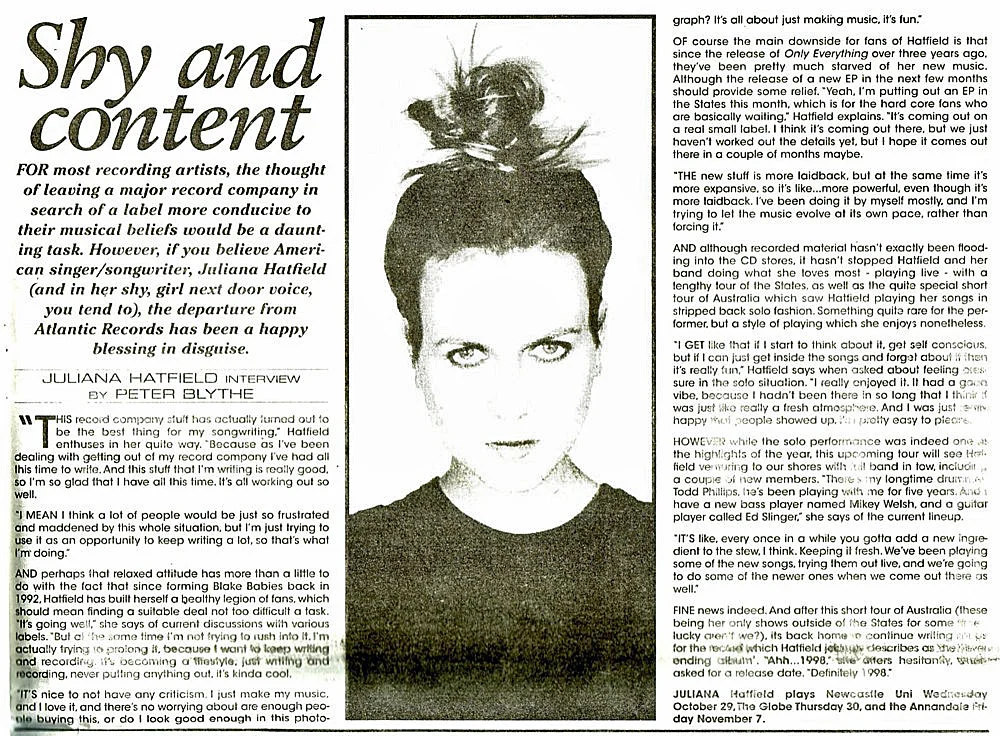
Show transcriptHide transcript
Shy and content
Juliana Hatfield interview by Peter Blythe
For most recording artists, the thought of leaving a major record company in search of a label more conducive to their musical beliefs would be a daunting task. However, if you believe American singer/songwriter, Juliana Hatfield (and in her shy, girl next door voice, you tend to), the departure from Atlantic Records has been a happy blessing in disguise.
“This record company stuff has actually turned out to be the best thing for my songwriting,” Hatfield enthuses in her quiet way. “Because as I’ve been dealing with getting out of my record company I’ve had all this time to write. And this stuff that I’m writing is really good, so I’m so glad that I have all this time. It’s all working out so well.
“I mean I think a lot of people would be just so frustrated and maddened by this whole situation, but I’m just trying to use it as an opportunity to keep writing a lot, so that’s what I’m doing.”
And perhaps that relaxed attitude has more than a little to do with the fact that since forming Blake Babies back in 1992, Hatfield has built herself a healthy legion of fans, which should mean finding a suitable deal not too difficult a task.
“It’s going well,” she says of current discussions with various labels. “But at the same time I’m not trying to rush into it. I’m actually trying to prolong it, because I want to keep writing and recording. It’s becoming a lifestyle, just writing and recording, never putting anything out, it’s kinda cool.
“It’s nice to not have any criticism. I just make my music, and I love it, and there’s no worrying about are enough people buying this, or do I look good enough in this photograph? It’s all about just making music, it’s fun.”
Of course the main downside for fans of Hatfield is that since the release of Only Everything over three years ago, they’ve been pretty much starved of her new music. Although the release of a new EP in the next few months should provide some relief. “Yeah, I’m putting out an EP in the States this month, which is for the hard core fans who are basically waiting,” Hatfield explains. “It’s coming out on a real small label. I think it’s coming out there, but we just haven’t worked out the details yet, but I hope it comes out there in a couple of months maybe.
“The new stuff is more laidback, but at the same time it’s more expansive, so it’s like...more powerful, even though it’s more laidback. I’ve been doing it by myself mostly, and I’m trying to let the music evolve at its own pace, rather than forcing it.”
And although recorded material hasn’t exactly been flooding into the CD stores, it hasn’t stopped Hatfield and her band doing what she loves most — playing live — with a lengthy tour of the States, as well as the quite special short tour of Australia which saw Hatfield playing her songs in stripped back solo fashion. Something quite rare for the performer, but a style of playing which she enjoys nonetheless.
“I get like that if I start to think about it, get self conscious, but if I can just get inside the songs and forget about it then it’s really fun,” Hatfield says when asked about feeling pressure in the solo situation. “I really enjoyed it. It had a good vibe, because I hadn’t been there in so long that I think it was just like really a fresh atmosphere. And I was just really happy that people showed up, it’s pretty easy to please.”
However while the solo performance was indeed one of the highlights of the year, this upcoming tour will see Hatfield venturing to our shores with full band in tow, including a couple of new members. “There’s my longtime drummer Todd Phillips, he’s been playing with me for five years. And I have a new bass player named Mikey Welsh, and a guitar player called Ed Slinger,” she says of the current lineup.
“It’s like, every once in a while you gotta add a new ingredient to the stew, I think. Keeping it fresh. We’ve been playing some of the new songs, trying them out live, and we’re going to do some of the newer ones when we come out there as well.”
Fine news indeed. And after this short tour of Australia (these being her only shows outside of the States for some time — lucky aren’t we?), it’s back home to continue writing songs for the record which Hatfield jokingly describes as the “never-ending album”. “Ahh...1998,” she offers hesitantly, when asked for a release date. “Definitely 1998.”
Juliana Hatfield plays Newcastle Uni Wednesday October 29, The Globe Thursday 30, and the Annandale Friday November 7.
Echo - 1998
Juliana looking forward to Beautiful Creature, circa Bed
"I think I'm gonna mix up the instruments next time, maybe do some more acoustic recording, but also more band stuff, with keyboards and cellos maybe."
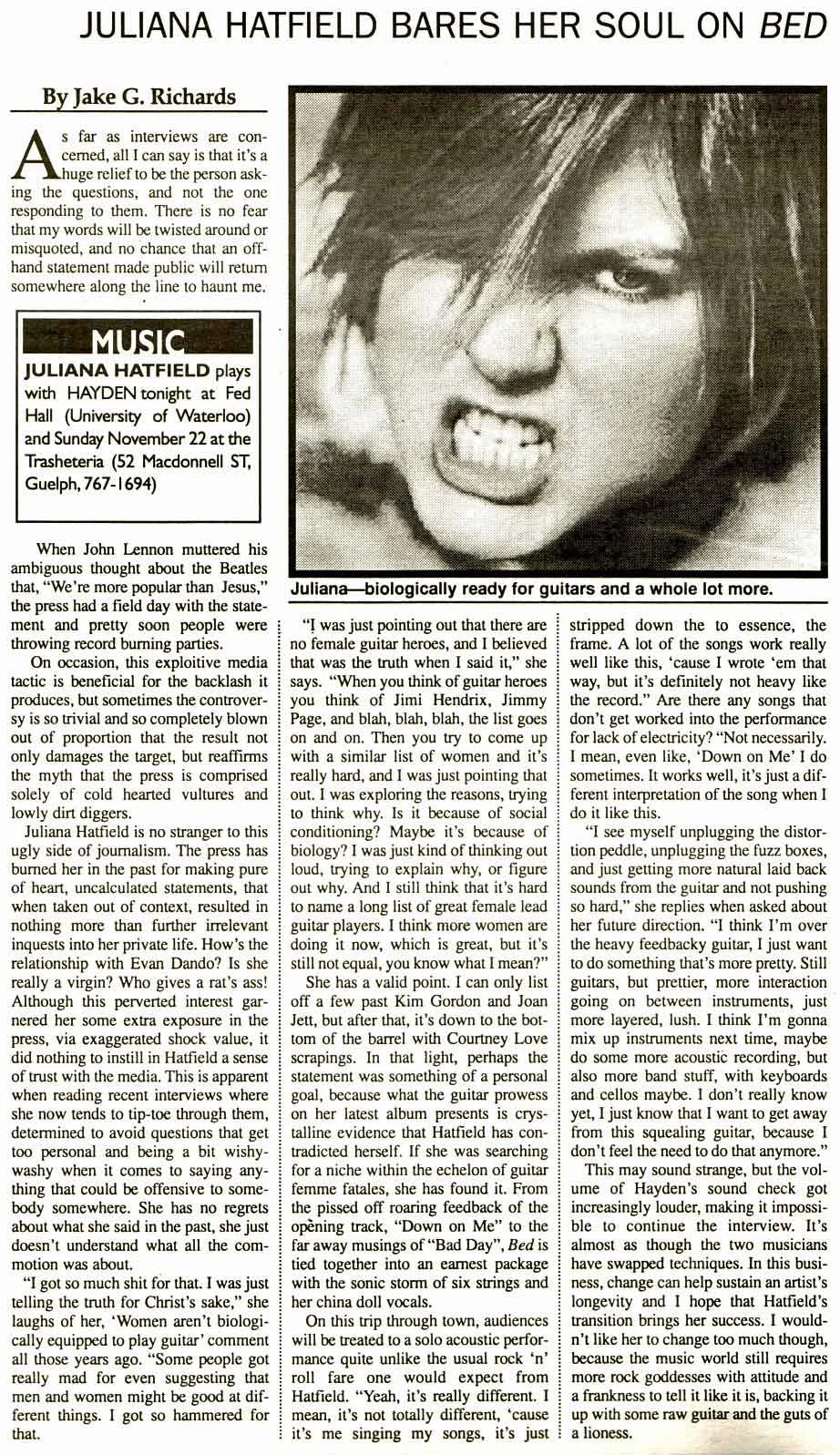
Show transcriptHide transcript
Juliana Hatfield Bares Her Soul on Bed
By Jake G. Richards
As far as interviews are concerned, all I can say is that it’s a huge relief to be the person asking the questions, and not the one responding to them. There is no fear that my words will be twisted around or misquoted, and no chance that an off-hand statement made public will return somewhere along the line to haunt me.
MUSIC
JULIANA HATFIELD plays with HAYDEN tonight at Fed Hall (University of Waterloo) and Sunday November 22 at the Trasheteria (52 Macdonnell ST, Guelph, 767-1694)
When John Lennon muttered his ambiguous thought about the Beatles that, “We’re more popular than Jesus,” the press had a field day with the statement and pretty soon people were throwing record burning parties.
On occasion, this exploitive media tactic is beneficial for the backlash it produces, but sometimes the controversy is so trivial and so completely blown out of proportion that the result not only damages the target, but reaffirms the myth that the press is comprised solely of cold hearted vultures and lowly dirt diggers.
Juliana Hatfield is no stranger to this ugly side of journalism. The press has burned her in the past for making pure of heart, uncalculated statements, that when taken out of context, resulted in nothing more than further irrelevant inquests into her private life. How’s the relationship with Evan Dando? Is she really a virgin? Who gives a rat’s ass!
Although this perverted interest garnered her some extra exposure in the press, via exaggerated shock value, it did nothing to instill in Hatfield a sense of trust with the media. This is apparent when reading recent interviews where she now tends to tip-toe through them, determined to avoid questions that get too personal and being a bit wishy-washy when it comes to saying anything that could be offensive to somebody somewhere. She has no regrets about what she said in the past, she just doesn’t understand what all the commotion was about.
“I got so much shit for that. I was just telling the truth for Christ’s sake,” she laughs of her, ‘Women aren’t biologically equipped to play guitar’ comment all those years ago. “Some people got really mad for even suggesting that men and women might be good at different things. I got so hammered for that.
“I was just pointing out that there are no female guitar heroes, and I believed that was the truth when I said it,” she says. “When you think of guitar heroes you think of Jimi Hendrix, Jimmy Page, and blah, blah, blah, the list goes on and on. Then you try to come up with a similar list of women and it’s really hard, and I was just pointing that out. I was exploring the reasons, trying to think why. Is it because of social conditioning? Maybe it’s because of biology? I was just kind of thinking out loud, trying to explain why, or figure out why. And I still think that it’s hard to name a long list of great female lead guitar players. I think more women are doing it now, which is great, but it’s still not equal, you know what I mean?”
She has a valid point. I can only list off a few past Kim Gordon and Joan Jett, but after that, it’s down to the bottom of the barrel with Courtney Love scrapings. In that light, perhaps the statement was something of a personal goal, because what the guitar prowess on her latest album presents is crystalline evidence that Hatfield has contradicted herself. If she was searching for a niche within the echelon of guitar femme fatales, she has found it. From the pissed off roaring feedback of the opening track, “Down on Me”, to the far away musings of “Bad Day”, Bed is tied together into an earnest package with the sonic storm of six strings and her china doll vocals.
On this trip through town, audiences will be treated to a solo acoustic performance quite unlike the usual rock ‘n’ roll fare one would expect from Hatfield.
“Yeah, it’s really different. I mean, it’s not totally different, ’cause it’s me singing my songs, it’s just stripped down the to essence, the frame. A lot of the songs work really well like this, ’cause I wrote ’em that way, but it’s definitely not heavy like the record.”
Are there any songs that don’t get worked into the performance for lack of electricity?
“Not necessarily. I mean, even like, ‘Down on Me’ I do sometimes. It works well, it’s just a different interpretation of the song when I do it like this.”
“I see myself unplugging the distortion peddle, unplugging the fuzz boxes, and just getting more natural laid back sounds from the guitar and not pushing so hard,” she replies when asked about her future direction. “I think I’m over the heavy feedbacky guitar, I just want to do something that’s more pretty. Still guitars, but prettier, more interaction going on between instruments, just more layered, lush. I think I’m gonna mix up instruments next time, maybe do some more acoustic recording, but also more band stuff, with keyboards and cellos maybe. I don’t really know yet, I just know that I want to get away from this squealing guitar, because I don’t feel the need to do that anymore.”
This may sound strange, but the volume of Hayden’s sound check got increasingly louder, making it impossible to continue the interview. It’s almost as though the two musicians have swapped techniques. In this business, change can help sustain an artist’s longevity and I hope that Hatfield’s transition brings her success. I wouldn’t like her to change too much though, because the music world still requires more rock goddesses with attitude and a frankness to tell it like it is, backing it up with some raw guitar and the guts of a lioness.
Photo caption: Juliana—biologically ready for guitars and a whole lot more.
Transcription note
The apparent source typos “stripped down the to essence” and “distortion peddle” have been retained as printed. Line-wrap hyphenation has been removed; punctuation, spelling, and capitalization otherwise follow the scan.